






By Said Arikat
March 7, 2026
News Analysis
Washington, D.C. — Night after night, viewers of major American television networks are treated to a familiar ritual. On glowing screens, commentators stand before digital battlefield maps, tracing missile arcs and strike corridors as if narrating a playoff game. On networks such as CNN, NBC, CBS, ABC, and Fox News, panels filled with retired generals and security analysts walk audiences through the latest American–Israeli attacks on Iran in a tone that often sounds less like journalism than celebration.
The graphics are polished, the language confident, and the commentary heavy with tactical detail. Missiles are described as “precise,” operations as “successful,” and every strike as a calculated move on an ever-evolving chessboard. Arrows sweep across maps while analysts speculate about retaliation scenarios and escalation ladders. What viewers rarely hear, however, is the most basic journalistic question: was this war necessary in the first place?
Instead of interrogating the origins of the conflict, much of the coverage assumes its legitimacy and moves directly to discussing how it is being fought. This subtle framing matters. By treating the war as a given, television news shifts the conversation away from political responsibility and toward military performance. War becomes a technical exercise rather than a political choice made by leaders.
Another striking feature of the coverage is how faithfully many outlets echo official narratives coming from Washington and Tel Aviv. Statements from the White House and the Israeli government are frequently repeated almost verbatim, often with little scrutiny or historical context. Anchors introduce segments with language about “defending allies” or “restoring deterrence”—phrases that quietly assume the righteousness of the campaign before any real debate has begun.
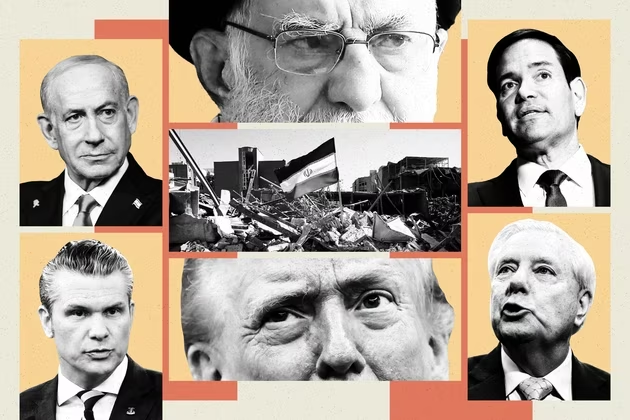
Rarely mentioned in these nightly discussions is the decades-long political campaign by Israeli Prime Minister Benjamin Netanyahu to push the United States toward a war with Iran. For years, Netanyahu repeatedly warned that Iran represented an existential threat and insisted that diplomacy would never stop Tehran’s ambitions. Confronting Iran, he has said openly, has been one of the central missions of his political life.
Today he has a willing partner in President Donald Trump, whose administration has embraced Israel’s hard-line view of Iran with remarkable enthusiasm. Yet television audiences seldom hear this alignment examined critically. Instead, analysts focus on the mechanics of bombing campaigns, the range of missiles, or the resilience of Iranian air defenses.
The dominance of retired military officers on television panels helps explain this imbalance. Soldiers are trained to think about how to win wars, not whether wars should begin. When generals dominate airtime, conversations naturally revolve around strategy, targets, and escalation scenarios. Missing from the discussion are diplomats, historians, regional specialists, and critics who might ask whether the conflict itself was avoidable.
The result is a kind of televised war theater. Maps glow, graphics pulse, and experts narrate events in real time, but the deeper political story remains blurred. Viewers see where missiles land but rarely hear sustained discussion about why the war began or whose interests it ultimately serves.
This pattern is not new. During earlier conflicts, American television networks often echoed official narratives in the opening stages of war, only revisiting the underlying assumptions months or years later. The urgency of breaking news and the pressures of patriotism can narrow the boundaries of acceptable debate.
But the stakes of a war involving Iran are enormous. Iran is a large regional power with allies, proxies, and strategic reach stretching across the Middle East. A prolonged confrontation risks widening into a conflict that could destabilize energy markets, draw in other states, and reshape the region for years.
Those consequences demand journalism that questions power rather than amplifies it. Instead of simply replaying government talking points, networks could ask harder questions: What evidence justified war? What alternatives were ignored? Who benefits politically from escalation?
Until those questions are asked consistently, television coverage will continue to resemble a running commentary on military operations rather than an investigation into the decisions that produced them. The danger is not merely journalistic failure; it is democratic complacency.
Criticism of this pattern does not require sympathy for Iran’s government. Tehran’s policies, its repression at home, and its regional interventions deserve scrutiny. Yet acknowledging those realities does not relieve journalists of their obligation to question whether bombing campaigns were the only option available. Responsible reporting must be capable of holding two ideas at once: that Iran’s government can be deeply problematic, and that war against it still demands rigorous justification.
For now, however, much of cable news appears more comfortable illustrating airstrikes than interrogating the politics behind them. The maps glow, the generals explain, and the official narrative moves smoothly from podium to studio.
Meanwhile, the central question remains largely absent from the broadcast: who decided this war was unavoidable, and why were Americans never seriously shown another path?
Television coverage of war shapes how the public understands it—and therefore how democracy responds to it. When networks treat conflict as a tactical spectacle while echoing official narratives, they risk normalizing decisions that deserve far deeper scrutiny. Journalism’s duty is not to choreograph missile strikes on digital maps but to interrogate the power that orders them. Without that critical distance, the media ceases to function as a watchdog and instead becomes, willingly or not, a megaphone for war.
שתף את דעתך
When War Becomes a Television Spectacle