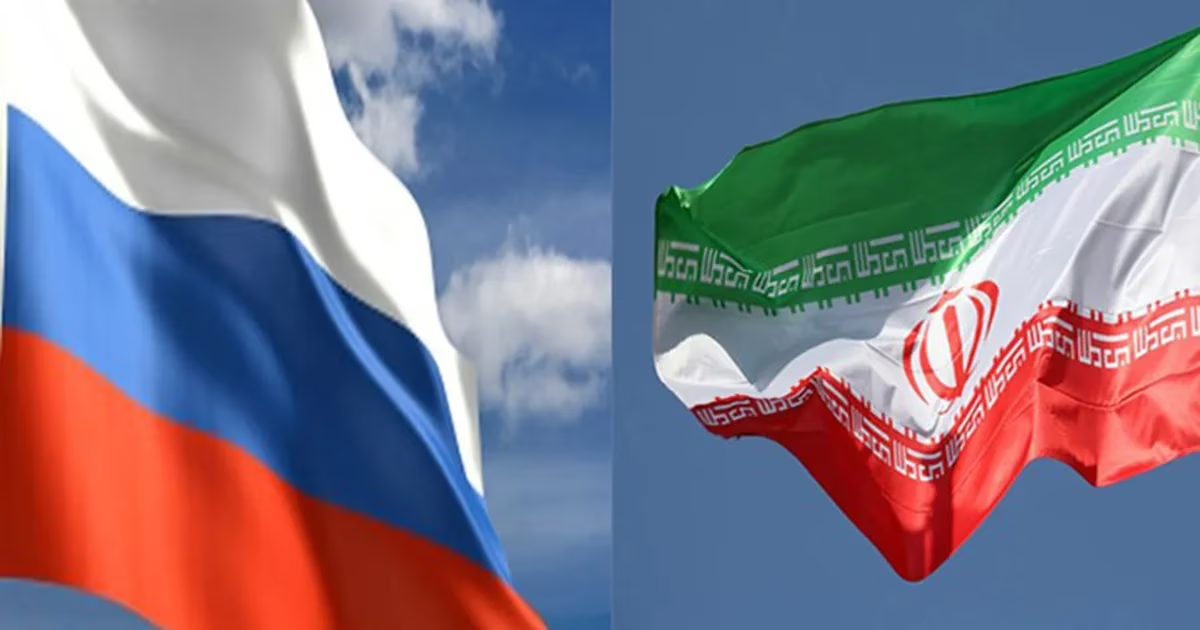







There is a traditional conviction that Russia would be the biggest loser if the Iranian regime collapsed, but a careful reading of Kremlin policies reveals pragmatic calculations that transcend emotions. Moscow views the current confrontation between Washington and Tel Aviv on one hand, and Tehran on the other, as a complex equation of geopolitical gains and losses.
One of the primary opportunities lies in the possibility of diverting international attention from the Ukrainian front, which has drained Western resources for years. With the United States engaging in a new and costly theater of operations in the Middle East, the priority of the Kyiv file will automatically recede in global decision-making circles and major media coverage.
Observers believe that the American administration's preoccupation with a widespread regional crisis will necessarily lead to a slowdown in the pace of military and financial aid to Ukraine. This shift will make it difficult for the White House to pass new support packages amid a heated internal debate over the costs of engaging in multi-front conflicts.
In terms of energy, the war emerges as a catalyst for the growth of Russian revenues despite the severe sanctions imposed on it. The mere threat of disrupting navigation in the Strait of Hormuz or targeting oil facilities is enough to raise global crude oil prices, providing the Russian treasury with significant financial breathing room that compensates for price discounts.
Moscow mathematically benefits from every additional dollar in the price of a barrel of oil, as the global increase reduces the impact of Western restrictions on its exports. Thus, a geopolitical shock in the Gulf region could turn into a massive financial resource supporting the Russian war effort in other areas.
As for the third opportunity, it relates to European unity and the cohesion of NATO, as wars in the Middle East reactivate old fault lines. European countries' positions vary between those who see the need to contain escalation to avoid new waves of migration, and those who lean towards security hardening behind Washington.
These cracks within the Western camp weaken the ability to make unified and decisive decisions against Russia in the near future. The more European division increases over the cost of energy and the legitimacy of external interventions, the more Moscow finds an international environment that is less rigid and less willing to coordinate escalation against its interests.
Regarding regional influence, Russia is betting on the decline of US credibility as a guarantor of stability in the Arab region. The widening scope of confrontation under the American umbrella raises doubts among Arab capitals about the utility of complete reliance on Washington to secure navigation and energy.
This climate of doubt opens wide margins for maneuver for Russian diplomacy to present itself as an alternative or a reliable mediator who speaks with all parties. Moscow does not necessarily seek to completely displace Washington, but rather to seize the vacuums left by erratic American policies in the region.
The fall of the regime in Tehran, despite the risks of chaos it carries on the Caspian Sea borders, may give Russia an opportunity to redistribute strategic cards. An Iranian ally exhausted by sanctions may become a burden at some point, while regional chaos provides opportunities for Russian intervention in new forms.
Reports indicate that Moscow may invest in new arms deals and security partnerships with countries that were historically within the American sphere of influence. This shift in loyalties and alliances strengthens Russia's position as an international player that cannot be overlooked in future regional security arrangements.
For the Kremlin, prolonging the conflict in the Middle East serves its strategy of draining the political and military energy of the West. The more allies get bogged down in the details of the Iranian crisis, the less able they are to impose their terms in settlements related to Eastern Europe.
Ultimately, Russia does not view the collapse of its allies in terms of absolute loss, but in terms of alternative opportunities generated by radical change. It is the grand chess game in which Moscow excels at moving its pieces, exploiting every tremor in the global order to strengthen its position.
Thus, Russia's stance on escalation against Iran remains governed by a cold pragmatism that balances preserving its partner with capitalizing on its fall. It is a strategy of 'seizing gains' from the heart of crises, where the existential threats of others turn into golden opportunities to enhance Russian influence.
Moscow does not bet on Iran's collapse as a victory, but rather treats it as an event that rearranges international priorities, prices, and alliances.
שתף את דעתך
The Kremlin's Cold Calculations: Why Tehran's Fall Might Not Trouble Moscow?