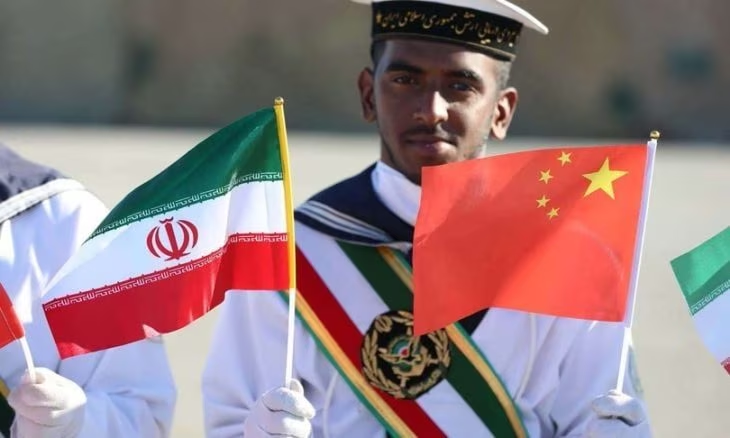







Questions are escalating about the nature of China's stance towards the comprehensive war waged by the United States and Israel against Iran, especially in light of the declared strategic partnership between Beijing and Tehran. Analytical readings confirm that China will not be an active helper for Iran in this confrontation, as the Chinese leadership places its interests in energy security above any ideological considerations or political alliances, preferring to closely monitor the scene without direct involvement.
Beijing's calculations are closely linked to its enormous dependence on energy resources from the Middle East, as China imported about 55% of its oil needs from the region in 2025. Supplies from Iran alone account for about 13% of total Chinese imports, making any disruption to navigation in the Strait of Hormuz a direct threat to the Chinese economy, which still relies on oil to operate its vital sectors.
Despite the signing of a $400 billion strategic cooperation agreement in 2021, the reality indicates that most projects under this agreement have not been implemented. This is due to Tehran's apprehension about Chinese influence, met by Beijing's frustration with the unreliability of the Iranian side, and Chinese assessments that Iranian military and political power is exaggerated compared to the actual size of its economy.
Recent Chinese diplomatic reactions have shown clear coolness towards military escalation, with the Ministry of Foreign Affairs merely issuing typical condemnations of the assassination of Supreme Leader Ali Khamenei without condemning the comprehensive military campaign. Beijing called on all parties, including Iran, to cease military operations, in a clear indication of its desire to maintain balanced relations with Gulf states, Israel, and the United States.
Chinese strategic experts believe that the Iranian regime suffers from a significant gap between its revolutionary ambitions and its limited economic capabilities, as its GDP does not exceed 90% of Israel's. This disparity has led Beijing to doubt Tehran's ability to withstand Western military technology for long, especially after repeated security breaches that enabled Israel to target senior leaders and scientists.
Furthermore, the relationship with Washington stands out as a crucial factor in China's hesitation, as the world anticipates an upcoming summit between Chinese President Xi Jinping and Donald Trump at the end of March. Beijing seeks to avoid any clash that could hinder opportunities to reach a comprehensive agreement ending years of bitter trade and political rivalry between the two great powers, making the sacrifice of Iran a viable option for the sake of stable bilateral relations.
Reports indicate that Beijing has lost confidence in Iran's ability to effectively manage its proxies in the region, especially after the decline in the role of these groups under successive blows. Chinese observers considered the withdrawal of Iranian forces from Yemen in April 2025 as evidence of Iran's weak resolve in protecting its allies, which reinforced China's conviction not to bet on a regime that might collapse internally.
Should the war lead to a regime change in Tehran, Beijing does not see this as the worst-case scenario as long as the new leadership guarantees the continued flow of oil and the protection of Chinese investments. Chinese pragmatism dictates dealing with any authority that emerges after the war, provided it avoids military adventures that threaten the stability of global energy markets, whose prices have risen by 6% since the conflict began.
China currently holds oil reserves estimated at about 1.4 billion barrels, which gives it enough room for maneuver to withstand a short-term supply disruption, but it fears a long war of attrition. If the confrontation continues for an extended period and leads to the closure of the Strait of Hormuz, Beijing may be forced to re-evaluate its position, not in defense of Iran, but to protect its energy-dependent national security.
Political circles in Beijing mock Iran's responses, which they described as 'theatrical' in the face of major assassinations, deepening the trust gap between the two countries. Chinese analysts believe that Iran finds itself caught in a dilemma between its ideological roots and its urgent need to lift Western sanctions, a contradiction that prevents it from making decisive strategic decisions in moments of major confrontation.
Economically, Beijing is monitoring the Israeli economy's losses, which have reached 9.4 billion shekels per week, but it realizes that unlimited American support for Israel fundamentally alters the balance of power. This understanding prompts the Chinese leadership to adhere to a cautious diplomatic path, avoiding entanglement in a proxy war that could drain its resources at a time when it seeks to strengthen its internal growth.
China's current stance reflects a shift in its view of the Middle East, where Beijing no longer sees Iran as a 'spearhead' against Western hegemony, but rather as a troubled economic partner. This shift explains why Beijing refrains from providing qualitative military support, such as drones or advanced technologies, preferring to wait until the features of the region's new political map become clear.
Ultimately, the security of waterways remains the only red line that might prompt China to act, as the closure of the Strait of Hormuz would mean a global energy crisis whose consequences Beijing cannot bear. However, China's primary bet remains on reaching understandings with the new US administration that guarantee its vital interests away from the fires of war raging in Tehran.
Strategic assessments conclude that China, despite its anti-hegemony rhetoric, remains a player seeking profit and economic stability first, which makes it closer to passive neutrality in the Iranian crisis. What matters to Beijing is not who governs in Tehran, but who ensures the safe arrival of oil tankers at Chinese ports, which any future leadership that prioritizes economics over ideology could provide.
China is prepared to work with any leadership that emerges after the strikes, as long as it protects the flow of oil and prioritizes shared economic interests.
שתף את דעתך
Why is China reluctant to save Tehran? Oil calculations and the summit with Trump govern Beijing's stance