







Washington – Saeed Erikat – 3/6/2026
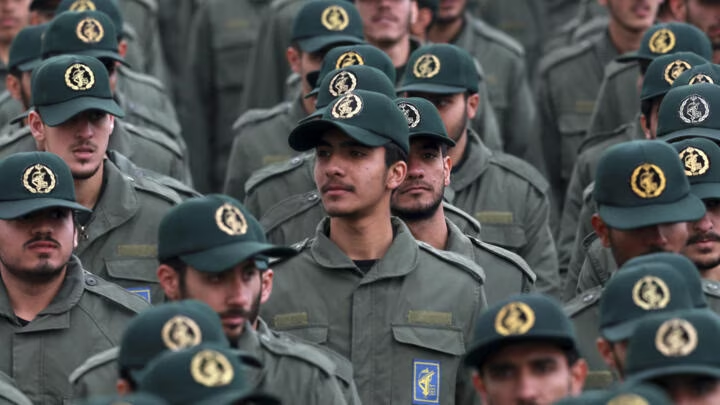
In a direct message to Iranian security institutions, US President Donald Trump on Thursday called on members of the Revolutionary Guard, army, and police to lay down their weapons and join what he described as "the Iranian people," warning that they would face only death if they continued to fight against American and Israeli forces. He also called on Iranian diplomats abroad to seek asylum and participate in forming a "new and better Iran," affirming the United States' readiness to grant immunity to security personnel who decide to abandon the fight.
Trump's statements came during an event at the White House to honor the "Inter Miami" team after winning the American Major League Soccer championship, where he entered the East Room accompanied by the team captain and Argentine star Lionel Messi before the sports event turned into a political platform during which the President announced the latest developments in the escalating war against Iran.
Trump said that the United States and Israel continue to carry out extensive military operations against Iran, confirming that recent strikes have destroyed a large part of Iran's missile capabilities. He added that US forces have destroyed twenty-four Iranian ships in the past three days and that operations are proceeding at a faster pace than planned and on an unprecedented scale.
He explained that the strikes focus on dismantling Iran's military structure, including missile launch platforms and drone capabilities, stressing that US forces are destroying these capabilities in a way no one expected. He reiterated that Washington acted because it saw that Tehran was preparing to attack American interests, adding, "If we had not struck them, they would have attacked us," without presenting any evidence.
In an interview with "ABC News," Trump said that US strikes destroyed about 58% of Iran's missile launch platforms, considering that the extent of the destruction would require Tehran nearly ten years to rebuild its military capabilities.
Regarding the future of operations, he said that some observers believe the war has effectively ended, but he added that for him, it has not ended yet and will end when he decides so, affirming that the United States will not allow the emergence of an Iranian leadership that poses a threat to its neighbors or to Washington.
He also indicated that his administration is working on measures to limit the impact of the war on global oil markets and trying to contain the economic turmoil resulting from the military confrontation.
For his part, US Secretary of War Pete Hegseth said that the United States possesses enough ammunition and equipment to continue the war against Iran for a long time, stressing that Iran's bet that Washington will not bear the cost of a prolonged conflict represents a major miscalculation.
He added that US forces are not suffering from a shortage of ammunition and are capable of continuing military operations for a long time if necessary, denying what he described as Iranian propaganda about shooting down an American aircraft.
Politically, Hegseth hinted that Trump might play a role in determining the nature of future Iranian leadership, but he stressed that the United States does not plan to receive refugees from the Middle East, considering that countries in the region are capable of accommodating them.
As for the commander of US Central Command, Admiral Brad Cooper, he said that military operations are progressing rapidly and according to established plans, confirming that US forces have destroyed a large part of Iran's air defense systems.
In Congress, a divergence in political discourse emerged when Republican House Speaker Mike Johnson said that the United States is conducting a "limited operation" over Iran, indicating that it is limited in scope and duration.
Johnson added, after the House voted to reject a war powers resolution aimed at stopping Trump's attacks, that Washington is not at war and does not intend to be so, considering that the military mission is almost accomplished.
He said that the strikes led to a 90% reduction in Iranian ballistic missile launches, and drone use decreased by about 80% as a result of continuous strikes.
Cooper revealed that US forces also destroyed twenty-four Iranian warships and that Trump issued directives to destroy the Iranian naval base to prevent Tehran from rebuilding its fleet, noting that Washington possesses additional undisclosed operational capabilities to counter drones.
Since last Saturday, the United States and Israel have launched a wide-ranging war on Iran, which Tel Aviv named "Lion's Roar" while Washington called it "Epic Fury." The strikes resulted in the death of Supreme Leader Ali Khamenei and a number of senior military and security officials, in addition to civilians, while Tehran responded with a counter-operation named "True Promise 4."
The confrontation continues amid fears of the conflict expanding regionally.
Trump's call for members of the Revolutionary Guard and the Iranian army to surrender reflects a clear attempt to shift the battle from the military to the psychological and political sphere. The message not only aims to weaken Iran's fighting capability but also seeks to dismantle the loyalty of security institutions to the regime. However, such calls rarely achieve quick results, as foreign wars often lead to strengthening internal cohesion rather than dismantling it, especially when soldiers feel that their country is under direct attack from foreign powers.
In contrast, the US administration's rhetoric reveals a great deal of ambiguity regarding the ultimate goal of the war. While Washington talks about destroying Iran's military capabilities, other statements indicate a desire to influence the form of political leadership in Tehran. This overlap between military and political objectives reflects a strategic dilemma that the United States has faced for decades in the Middle East: the ability to destroy armies does not necessarily mean the ability to shape the political systems that will succeed them.
Economically, the estimated cost of the war at about one billion dollars per day raises serious questions within the United States about the feasibility of continuing operations for a long period. Recent history shows that costly wars in the Middle East often turn into a long drain on American resources without achieving decisive objectives. With rising energy prices and the potential for global market disruption, the economic cost could become an internal pressure factor on the US administration, perhaps no less impactful than the military challenges.
שתף את דעתך
Trump Calls on Revolutionary Guard to Surrender, Urges Iranian Diplomats to Defect