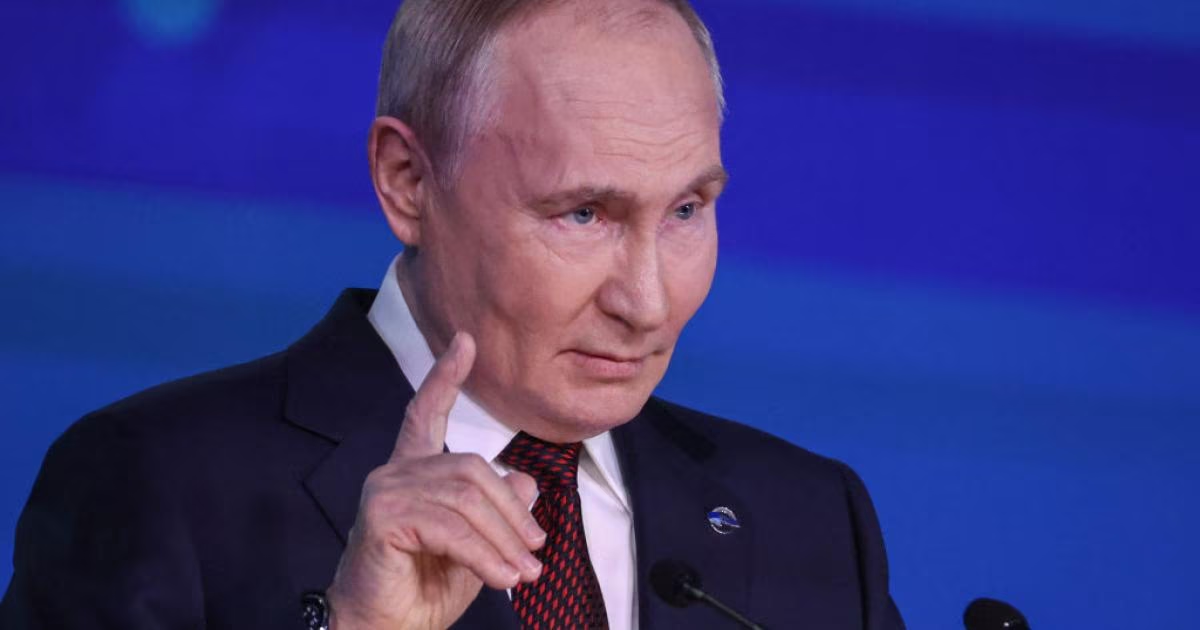







The Kremlin officially announced that the Islamic Republic of Iran has not submitted any requests for military supplies or armament support from Moscow, despite the severe military escalation in the region. The spokesman for the Russian presidency, Dmitry Peskov, affirmed that Russia's position on the field developments is firm and has not changed, noting that communication channels between the two countries remain open within the framework of existing cooperation.
These statements come at a time when Russian-Iranian relations are witnessing an unprecedented strategic rapprochement, culminating in the signing of a comprehensive partnership agreement last year extending for two decades. Moscow plays a pivotal role in Iran's peaceful nuclear program by building new units at the Bushehr plant, while field reports indicate previous cooperation that included Tehran supplying Moscow with drones used on other fronts.
In a related context, the Russian Foreign Ministry directly accused both the United States and Israel of trying to expand the conflict in the Middle East by provoking the Iranian leadership. Moscow considered that the recent military moves aim to push Tehran to carry out retaliatory strikes targeting objectives in Arab countries, thereby directly dragging the Gulf states into a comprehensive regional confrontation.
Russian diplomatic sources explained that Washington and Tel Aviv are seeking to use Iranian counterattacks as a pretext to involve Arab parties in the conflict, which Moscow considers a plan that serves the interests of international parties at the expense of regional security. In recent days, human and material losses have been recorded in some Arab countries as a result of the mutual missile barrages since the start of the widespread aggression against Iranian territories.
On the diplomatic front, Russian President Vladimir Putin initiated intensive telephone calls with the leaders of four Gulf states to discuss the repercussions of the current crisis. Putin offered to use Moscow's influence and close relations with Tehran to convey the concerns of the Gulf capitals, especially regarding threats to target oil infrastructure and energy facilities, which have already been affected by a 6% rise in global prices.
On the ground, the military confrontation led by the United States and Israel against Iran entered its sixth day, after it began on the morning of February 28. The intensive air raids in their first hours resulted in the martyrdom of Supreme Leader Ali Khamenei and a number of senior military commanders, which prompted Tehran to declare a 'long-term war' strategy and activate a decentralized command system under the supervision of Ahmed Vahidi.
Economic reports indicate that this confrontation has caused severe financial bleeding for the Israeli occupation, with weekly losses reaching approximately 9.4 billion shekels. Demands are escalating within Israeli circles for the need to lower the level of alert to reduce economic burdens, while the cost of American military operations is estimated at about one billion dollars per day, putting immense pressure on defense budgets that reached record numbers for 2026.
In conclusion, observers believe that Russia's current position seeks to balance powers and prevent a complete collapse of the security system in the Gulf, while continuing its political support for Tehran. The region remains open to scenarios in light of Iran's insistence on a military response, and the continued operations of the United States and Israel aimed at changing the political map in the Middle East.
The United States and Israel deliberately pushed Iran to carry out retaliatory strikes against targets in some Arab countries, with the aim of drawing the region into a war that serves the interests of external parties.
שתף את דעתך
Moscow accuses Washington and Tel Aviv of luring Arabs into war and denies Tehran's request for military support