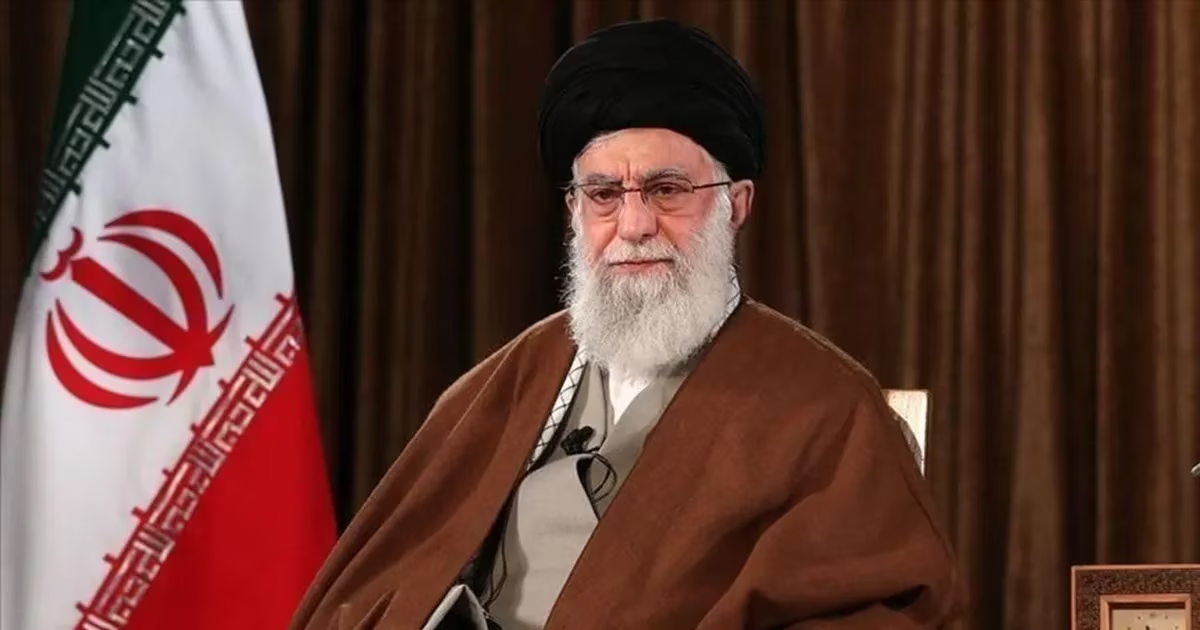







Following the announcement of the death of the Supreme Leader of the Islamic Revolution of Iran, Sayyid Ali Khamenei, sharp divisions in Arab and Islamic viewpoints emerged. This divergence reflects the nature of figures with complex roles whose careers combine positions that evoke praise and others that warrant condemnation, making their departure a rich subject for debate.
Social media platforms were filled with existential and jurisprudential questions about the nature of the stance towards the deceased, with opinions ranging from condolences to gloating. Many questioned the classification of the personality as a 'martyr' or otherwise, questions that have historically recurred with figures such as Saddam Hussein, Gamal Abdel Nasser, and Hassan Nasrallah.
This type of debate overlooks the fact that bestowing titles like 'martyr' or 'cursed' is merely an individual prayer, and its owner does not possess indulgences or the power to punish. Accountability and punishment, from a religious perspective, are purely divine prerogatives, and these personal convictions should not turn into fierce social battles.
The deeper problem lies in the transformation of these discussions into sectarian and political fanaticism that hinders peoples from seeing the larger strategic realities. Dwelling on the ruins of the past and its disputes prevents the nation from effectively moving forward in the face of current challenges that threaten its existence and stability.
Today, real fears emerge that preoccupation with the stance on Khamenei's personality will lead to a loss of direction regarding the military threats facing the region. Attempting to confine the situation to settling scores with the Iranian regime may overlook the broader goals of international powers in destroying the capabilities of nations.
No sane person can ignore the injustices that occurred in countries like Syria, but a purely self-interested perspective requires thinking beyond momentary emotions. Removing or weakening regimes in the context of international wars may not necessarily serve the interests of rebellious peoples or those seeking stability.
International acceptance of some regimes in the previous stage was linked to the balance of power and the presence of an Iranian bogeyman, and the disappearance of this party may change the rules of the game in a way that does not serve Arab causes. Therefore, what is required is to read the scene from the perspective of strategic interests and harms, far from the momentary elation over yesterday's adversaries.
Some extremists have emerged to delve into doctrines and classify the battle as a conflict between faith and disbelief, which is a flawed oversimplification of the complex reality of political alliances. Islamic history and the Prophet's biography are rich with examples of alliances built on common interests and warding off evils, not on doctrinal conformity.
The Holy Quran in Surah Ar-Rum presented a model of political alignment based on the global balance of power at that time, despite the radical doctrinal difference with the Romans. This Quranic lesson confirms that political contexts require language and alignments different from those of preaching or doctrinal reporting.
It seems that the collective Arab mind suffers from a weakness in political memory, as the same mistakes are repeated at every historical turning point the region goes through. The inability to distinguish between fixed and changing positions keeps the nation in a constant cycle around issues that have been exhausted in research and theorizing.
The most dangerous matter is the infiltration of this disorder in vision into the elites and religious institutions that are supposed to be more balanced. Those who follow the statements issued by some bodies find a stark contradiction and superficiality in dealing with major events, which makes them lose credibility with the masses.
We are in urgent need of an impartial and neutral research effort that analyzes contemporary religious and political discourse to identify points of weakness and disorder. Reviewing the positions of scientific and popular platforms has become an urgent necessity to form a collective consciousness capable of facing future challenges.
Ultimately, individuals depart, and positions remain recorded in the pages of history, but living peoples are those who do not mortgage their future to the conflicts of the dead. Thinking with reason and deliberation is the only way to escape the traps of polarization set for the region at every stage of political transition.
The real battle is not about whom we mourn or whom we gloat over, but about how to preserve what remains of national entities in the face of fragmentation projects. Awareness of the historical moment requires transcending narrow sectarian differences towards a broader horizon that achieves the nation's supreme interests.
The battle now is not about evaluating the Iranian regime as much as it is about realizing what will result from the wars aimed at destroying states and peoples.
שתף את דעתך
Khamenei's Departure: Between Popular Division and Regional Destiny Challenges