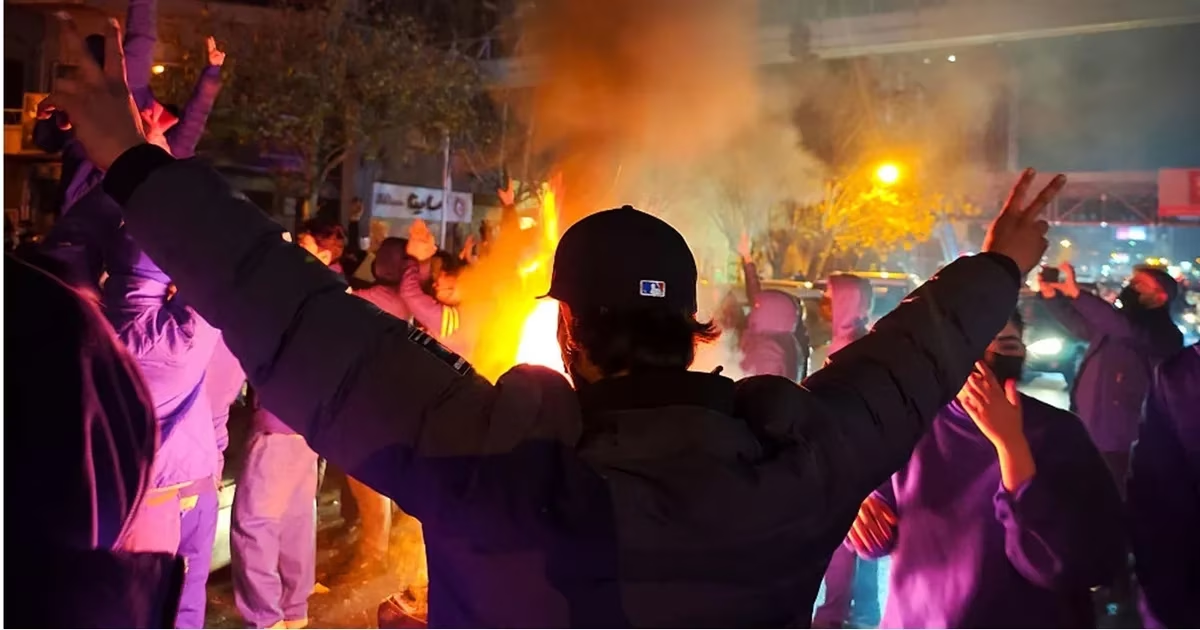







Media sources reported that decision-making and analysis circles in Israel have begun promoting a new strategy aimed at moving beyond the stage of air strikes against Iran and achieving the goal of 'regime change.' This vision is based on the necessity of exploiting popular anger and supporting the internal opposition by transforming it into an armed force capable of field confrontation.
In this context, Giora Eiland, former head of the National Security Council, affirmed that the current results of American and Israeli air attacks may damage military capabilities, but they will not fundamentally end the threat. Eiland considered that the Iranian regime remaining in power after these military rounds would be considered a victory for it, regardless of the extent of material losses it might incur.
Eiland explained in a strategic analysis that the current war must be fought with an 'all or nothing' mentality, noting that public statements from Washington and Tel Aviv link military success to the ability of the internal opposition to emerge at the appropriate time. He believes that this shift requires action that goes beyond aerial bombardment to include ground operations launched from within Iranian territory or along its borders.
The former Israeli official touched upon the role of Kurdish militias stationed in Iraq, describing them as having high combat motivation and field capabilities that can be utilized. He considered these militias to be one of the contributing factors in igniting a ground confrontation against the central authorities in Tehran, especially in the rugged border areas.
The most important factor in Eiland's plan is the regular Iranian army, which he distinguished from the Revolutionary Guard, which owes absolute loyalty to the political leadership. He pointed out that the regular army, which has historically suffered from marginalization since the Iran-Iraq War, possesses a huge arsenal of tanks and artillery that could change the balance of power if it sided with the opposition.
Eiland believes that the joining of parts of the regular army to the popular movement, coinciding with external attacks, will create a 'critical mass' that genuinely threatens the regime's survival. He stressed that the presence of tens of thousands of armed soldiers in the ranks of the opposition would provide the necessary momentum to transform protests into a comprehensive armed uprising.
To achieve this goal, Eiland called for a high level of operational coordination between these forces and the United States, emphasizing that this coordination must precede any field movement by months. He explained that military unit commanders in the Iranian army need guarantees of effective real-time American air support before taking any risks.
Eiland gave an example of an armored brigade from the regular army potentially seizing a city or vital facility, considering that one such military success could be enough to rally the hesitant. He added that such qualitative operations usually lead to the spread of rebellion among other armed forces and society like wildfire.
The analysis indicated that Israeli circles are anticipating secret American efforts to recruit internal elements with military capabilities, benefiting from Washington's long experience in this field. Despite acknowledging the failure of some previous attempts, he believes that the current circumstances may be conducive to achieving a breakthrough within the Iranian military structure.
Eiland warned that relying solely on air raids and waiting for the masses to spontaneously take to the streets will not achieve the desired goals of overthrowing the authority. He stressed that popular pressure needs 'military fangs' provided by armed militias and defecting forces to break the prestige of the regime's security apparatuses.
The article also highlighted the importance of coordination with neighboring countries to Iran, such as Azerbaijan and Iraq, to facilitate the movement of opposition forces and provide them with logistical support. He considered that encircling Iran with a belt of armed forces loyal to Western and Israeli orientations is the only way to ensure that the regime does not recover from the current strikes.
In conclusion of his vision, Eiland affirmed that the current battle differs from previous confrontations, as it requires unprecedented intelligence and operational coordination between external and internal forces. He considered that failure to militarily mobilize the Iranian interior would mean losing a strategic opportunity that might not be repeated to reshape the political map in the region.
These statements reflect the extent of Israeli ambitions to exploit regional tensions to impose a new reality in Tehran, beyond merely destroying nuclear or military facilities. They show a desire to transform the conflict from a confrontation between states into a war of internal attrition that undermines the foundations of the Iranian state from within.
It is worth noting that these calls come at a time when the region is witnessing unprecedented escalation, as political sources in Washington seek to evaluate all available options for dealing with Iranian influence. The hypothesis of a regular army defection or minority movements remains a subject of wide debate among strategic analysts regarding its realism and its ability to withstand the grip of the Revolutionary Guard.
Complete success in the war must include regime change, and the joining of armed militias alone will increase the strength of Iran's internal opposition.
שתף את דעתך
Former Israeli National Security Advisor Calls for Inciting Iranian Army and Kurds to Overthrow the Regime