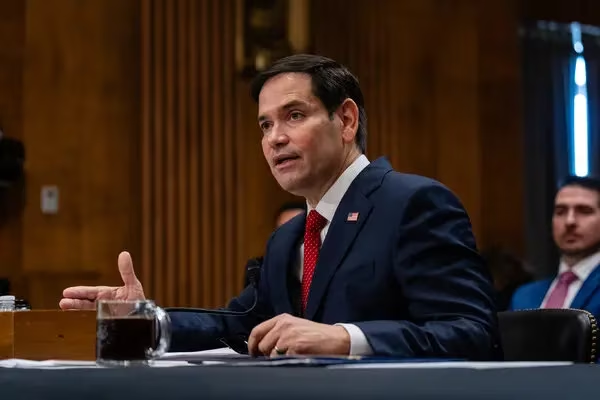







Washington — Said Arikat – 3/3/2026
In a statement revealing a sensitive aspect of the background to the American decision, US Secretary of State Marco Rubio said that the United States launched its operations against Iran because it knew that Israel was planning to launch an attack, and that an Iranian response would have targeted American forces in the region.
Rubio explained that the administration concluded that any Israeli strike on Iran would have provoked a direct response against American interests, which prompted Washington to engage early in the confrontation. He added that waiting until Israel implemented its plan would have led to greater losses, considering that the decision came to protect American forces.
This narrative intersects with what the New York Times reported, which stated that journalist Tucker Carlson tried to persuade President Donald Trump not to engage in a new war, but Trump informed him that the Israeli attack was going to happen anyway, and that the United States had no choice but to participate in it.
According to the report, Israeli Prime Minister Benjamin Netanyahu was keen that American-Iranian negotiations not impede any potential military coordination, which reinforces the impression that the military initiative stemmed from Israeli calculations, not from an imminent Iranian escalation.
In contrast, the US administration continued to justify the war as a necessity to confront Iran's nuclear program, despite previous statements by its officials that the air strikes in June 2025 destroyed Iran's nuclear capabilities. Vice President J.D. Vance also said that there are indications that Iran is seeking to develop a nuclear weapon, providing an additional justification for the operations.
However, official messages seemed contradictory. In an initial statement, Trump hinted that the goal might extend to regime change, and referred to the killing of Iranian Supreme Leader Ali Khamenei in the first round of attacks, while Rubio returned to confirm that the goal was limited to neutralizing the "threat of short-range ballistic missiles" and Iran's naval capabilities.
When asked about the duration of the operations, Rubio said that the war would continue "as long as necessary," without specifying a time limit or clear criteria for ending it.
In this context, the issue is no longer about a preemptive strike against an imminent Iranian threat, but rather an American decision to engage in a confrontation that its ally was preparing to launch. The difference is fundamental: the initiative, according to statements and reports, did not come in response to an Iranian attack, but in anticipation of Iran's response to an Israeli attack.
The shift in narrative from "thwarting an Iranian threat" to "anticipating a response to an Israeli attack" redefines the moral and political framework of the war. If Israel was the party that intended to initiate the attack, then Washington's entry does not appear as a purely defensive step, but as a strategic choice to protect its ally from the repercussions of its decision. This raises a question about the limits of the United States' commitment to Israel's security, and whether this commitment automatically imposes involvement in wars chosen by the other party.
The multiplicity of declared goals — from neutralizing missiles to the possibility of regime change — reflects an attempt to reframe a decision made in a narrow context related to Israeli calculations. With the absence of a precise definition of the desired end, the risks of sliding into an open conflict increase. For when the primary motive is not a direct threat, but preventing the repercussions of an ally's attack, it becomes difficult to draw a clear line between support and full involvement in a long war.
שתף את דעתך
Rubio: Washington acted because Israel was preparing to attack