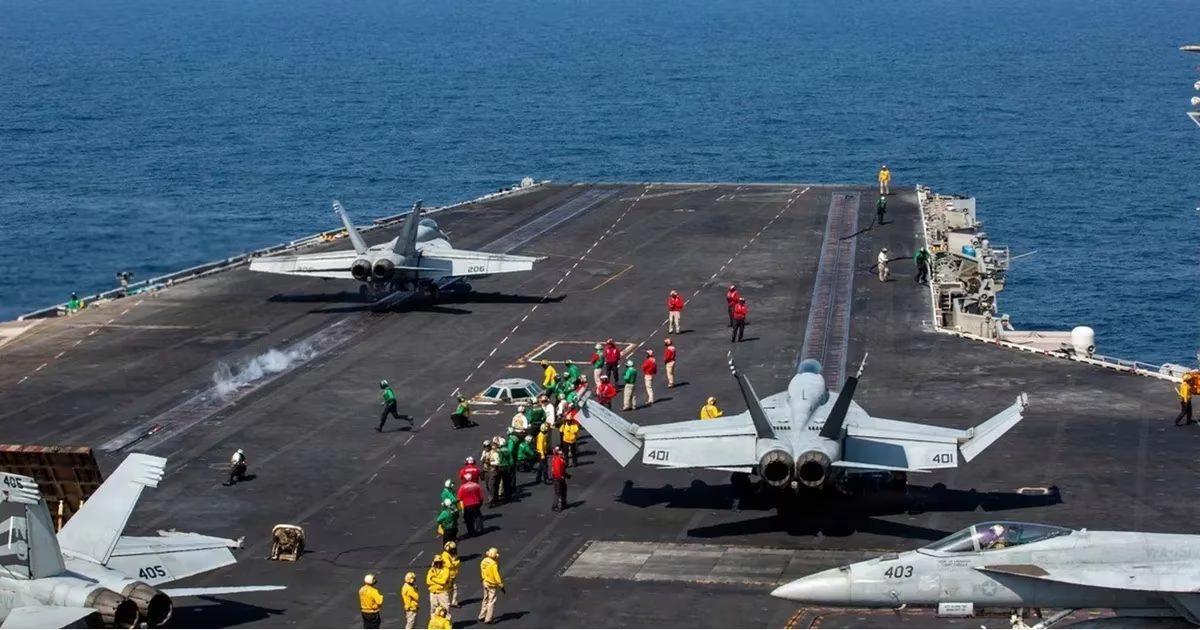







The Middle East witnessed a dramatic shift in the balance of power following the United States, in coordination with Israel, carrying out the largest direct military operation against the Islamic Republic of Iran in decades. The strike, dubbed 'Epic Wrath,' directly targeted the leadership structure in Tehran, including the Supreme Leader and high-ranking officials, plunging the region into a dark strategic tunnel.
Sources reported that the widespread attack included the destruction of sensitive defensive and missile facilities across the country, utilizing a sophisticated arsenal of naval missiles and fighter jets. The operation also featured the use of advanced 'LUCAS' drones, which contributed to neutralizing Iranian air defense systems in the initial hours of the attack.
These developments come after years of 'maximum pressure' policy and the failure of diplomatic efforts to revive the nuclear deal, with reports indicating that regional pressures pushed Washington to adopt the military option. Observers believe that the current US administration sought to end what it describes as the transnational Iranian threat through a decisive strike targeting the regime's head and its qualitative capabilities.
For his part, the US President announced that the operation's goal goes beyond mere military retaliation, aiming instead to redraw the rules of engagement and impose a new political reality in the region. Washington affirmed that undermining Tehran's leadership structure is the only way to prevent it from achieving a nuclear breakthrough or continuing to destabilize neighboring countries through its proxies.
In response, the Iranian retaliation was not long in coming, as Tehran launched retaliatory missile and drone attacks targeting American military bases in the Arabian Gulf region. The Revolutionary Guard announced that any aggression against the country's sovereignty would be met with an all-out war, warning that American and Israeli interests in the region have become legitimate and direct targets.
Economically, the strike caused an earthquake in global energy markets, with Brent crude prices immediately soaring to record levels. Major capitals are concerned about the potential disruption of navigation in the Strait of Hormuz, which is the main artery for the flow of about one-fifth of the world's daily oil consumption.
Economic analysts warned that continued escalation could push oil prices past the $100 per barrel mark, exacerbating global inflation rates. Financial markets have already begun to react to the crisis through investors fleeing to safe havens like gold, coinciding with a significant decline in regional stock market indices.
Diplomatically, a state of anticipation and caution prevailed in European capitals, which called for restraint and avoiding a slide into an uncontrollable comprehensive regional confrontation. Diplomatic sources confirmed that the European Union did not participate in the military operation, preferring to stick to negotiating paths despite the complexity of the field situation after the recent assassinations.
Russia and China, for their part, expressed grave concern about the repercussions of the attack on international peace and security, considering that the use of military force complicates crises rather than resolving them. Reports indicated that Moscow might increase its defense cooperation with Tehran in the face of this escalation, threatening to turn the conflict into a broader international confrontation.
Domestically in the United States, the operation sparked sharp political division between supporters who see it as a necessary correction of the strategic course, and opponents who warn against exceeding congressional authority. Democratic representatives demanded immediate restrictions on military operations, fearing the country's involvement in a long-term war of attrition in the Middle East without legislative authorization.
Military experts believe that 'Epic Wrath' aims to restore American deterrence, which has declined in recent years, and send a firm message to all forces allied with Iran. However, risks remain of Tehran resorting to asymmetric warfare tactics or cyberattacks that could target critical infrastructure of adversaries.
Targeting the supreme leadership in Iran represents a precedent in the history of the conflict, which puts the Iranian regime to an existential test to prove its ability to cohere and respond. All eyes are now on how Tehran will manage the succession and leadership file in the absence of its historical figures, and the extent of its impact on its regional influence in Iraq, Syria, and Lebanon.
In this complex scenario, concerns arise about the bilateral confrontation turning into a multipolar war involving many regional and international parties. The military objectives achieved in the initial hours may be followed by geopolitical repercussions whose extent cannot be predicted, especially if Iran decides to activate all available pressure cards.
In conclusion, the February 2026 operation remains a turning point that will be studied for a long time in strategic research centers, as it combined military audacity with major economic risk. The question will remain whether this strike will actually lead to regional stability under a new deterrence umbrella, or if it will be the spark that ignites an unquenchable regional fire.
US President Donald Trump: This step aims to impose comprehensive change in the regime's behavior and liberate the Iranian people from oppression.
שתף את דעתך
Operation 'Epic Wrath': An American-Israeli Strike Targets Tehran's Leadership and Shifts the Balance of Power