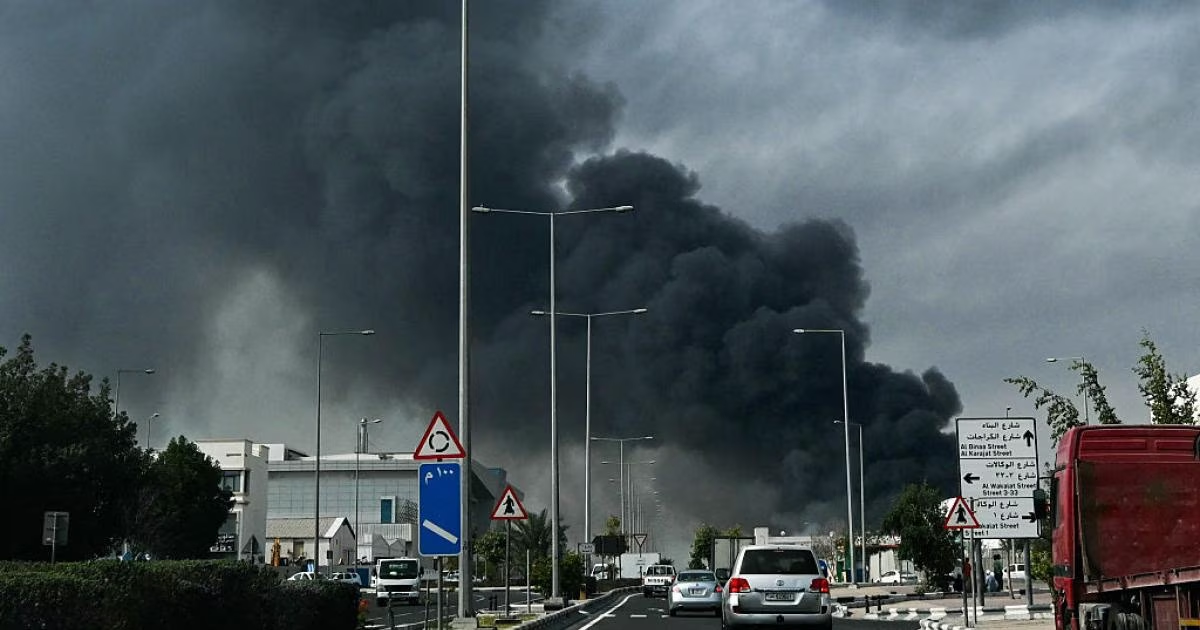







The Qatari Ministry of Foreign Affairs, today, Sunday, expressed its strong condemnation of the Iranian attacks that targeted several countries in the Arabian Gulf region. Doha considered these military movements a direct threat to the role of mediators and undermining the essential diplomatic tools used to contain regional crises.
The official spokesperson for the Qatari Ministry of Foreign Affairs, Majid Al-Ansari, affirmed in his statements that targeting the Sultanate of Oman represents an assault on the principle of mediation that Muscat has always adhered to in order to prevent bloodshed. He pointed out that Oman had made diligent efforts to keep the doors of diplomacy open until the last moments before the outbreak of confrontation.
The Qatari official stressed that this pattern of attacks represents a catastrophic development that threatens international peace and stability in the region. He noted that Qatar had previously warned against the consequences of targeting mediators, considering that what is currently happening weakens the ability to reach peaceful solutions to escalating crises.
In Riyadh, the Kingdom of Saudi Arabia took firm diplomatic measures by summoning its Iranian ambassador, Ali Reza Enayati. This step came to officially protest what the Kingdom described as flagrant aggressions that affected its territories and the territories of sisterly countries in the region during the past hours.
During the summoning process, the Saudi Deputy Minister of Foreign Affairs, Engineer Waleed bin Abdulkarim Al-Khuraiji, conveyed the Kingdom's strong displeasure and condemnation of these violations. Al-Khuraiji affirmed Riyadh's categorical rejection of any infringement on the sovereignty of states, noting that these actions seriously undermine regional security.
On the ground, the United Arab Emirates announced 3 deaths and 58 others injured with varying degrees of wounds since the start of the Iranian strikes. This toll comes amid continued military tension that has affected civilian facilities and properties in several Emirati regions as a result of missile barrages.
In Kuwait, the Ministry of Health confirmed one death and 32 other injuries, all of foreign nationalities, due to the attacks. The ministry's spokesperson, Dr. Abdullah Al-Sanad, explained that a number of the injured underwent delicate surgical operations at Al-Adan Hospital as a result of their injuries.
The electricity grid in Kuwait also suffered partial damage, leading to power outages in scattered areas, especially in the southern region. The Ministry of Electricity attributed this outage to falling shrapnel resulting from the interception of drones that targeted the country, confirming that emergency teams are working to repair the damage.
Field reports indicate that the Iranian attacks included 9 Arab countries: Saudi Arabia, Kuwait, UAE, Qatar, Bahrain, Oman, Jordan, Syria, and Iraq. These attacks caused material damage to airports, ports, and vital buildings, despite Tehran's assertion that it only targets American bases.
These developments come in response to a widespread military aggression launched by Israel and the United States against Iran since Saturday morning. Air and missile strikes on Tehran resulted in the deaths of 201 people, including Supreme Leader Ali Khamenei and a number of high-ranking security leaders in the country.
Sources reported that the recent military escalation came at a time when indirect negotiations between Washington and Tehran were making tangible progress. The Sultanate of Oman was playing the primary mediating role in these talks, which made its targeting a source of widespread international surprise and concern.
This is the second time that negotiation paths have collapsed due to direct military intervention, after a similar incident occurred in June 2025. Observers believe that the region has slipped into a comprehensive confrontation whose repercussions may expand to include all global shipping and energy lines.
For its part, Tehran insists that its military response was defensive and necessary to confront the aggression that targeted its supreme leadership. However, the scale of civilian casualties in neighboring Arab countries has sparked a widespread wave of international condemnation, amid calls for restraint and avoiding an all-out war.
Civil defense and emergency teams in the affected Gulf countries continue to assess losses and remove debris resulting from falling missiles and drones. Meanwhile, political circles are awaiting the nature of the upcoming response from Washington and Tel Aviv, which portends further escalation in the coming hours.
The deliberate targeting of brothers in Oman, a country that has made sincere efforts in mediation endeavors, is a targeting of the principle of mediation itself.
שתף את דעתך
Bloody Regional Escalation: Deaths in the Gulf Due to Iranian Retaliation and Saudi Arabia Summons Tehran's Ambassador