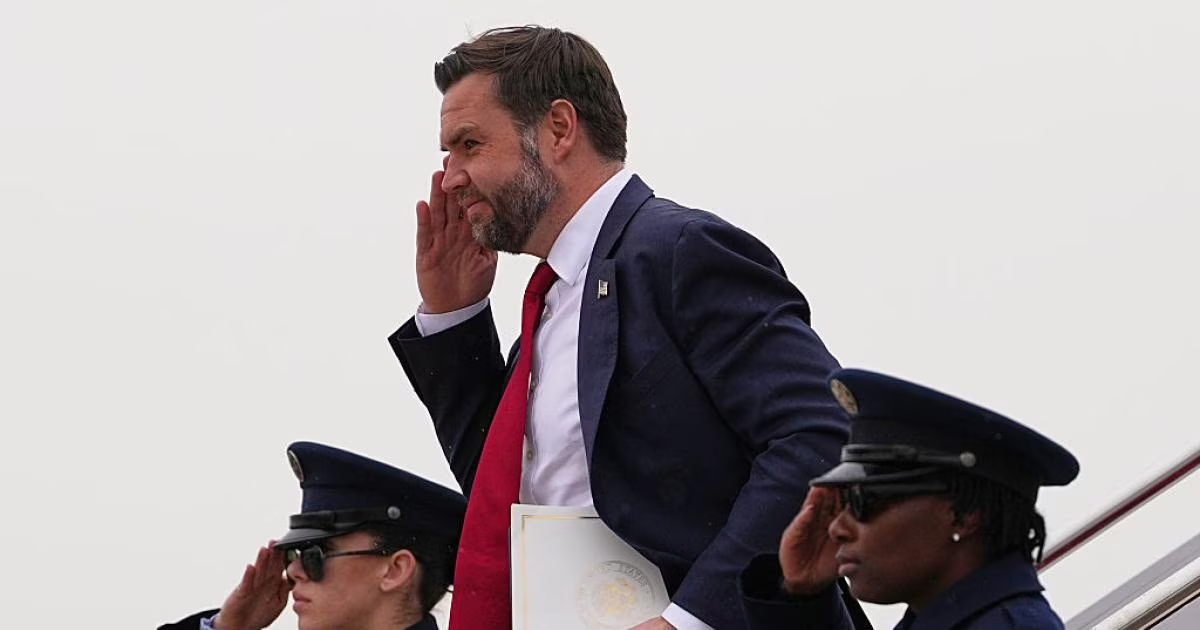







US Vice President J.D. Vance affirmed that the current US administration is not considering entering into military conflicts in the Middle East that would extend for years. Vance clarified in press statements that any military action President Donald Trump might decide against Tehran would not necessarily lead to the United States sinking into a new military quagmire, as some suggest.
Vance, who previously served in the US Marine Corps, stressed that the diplomatic option remains Washington's preferred method for resolving differences with the Iranian side. However, the US Vice President linked the success of this path to the nature of Iranian actions and the messages Tehran sends during the current phase, which is witnessing an escalation in political rhetoric.
In a related context, the third round of indirect talks between the United States and Iran concluded in Geneva, Switzerland, which diplomatic sources described as very serious. Iranian Foreign Minister Abbas Araghchi indicated that this round was the most intensive since the launch of the new negotiation process, mediated by the Sultanate of Oman.
These diplomatic moves come under pressure from the deadline set by President Donald Trump on February 19, where he gave Tehran a period of ten to fifteen days to reach a final agreement. Trump warned that failure to reach understandings would lead to dire consequences, coinciding with the reinforcement of US military deployments in the region.
Informed sources reported that the negotiations held at the residence of the Omani Ambassador in Geneva witnessed in-depth discussions on the nuclear file and the lifting of economic sanctions. The US side was represented in these meetings by Special Envoy Steve Witkoff and Jared Kushner, President Trump's son-in-law, reflecting the importance the administration attaches to this file.
For his part, Iranian Foreign Minister Abbas Araghchi stated that the negotiating delegation presented Tehran's demands clearly and explicitly during the meetings held through the Omani mediator. Araghchi affirmed that good progress has been made in drafting the elements of a potential agreement, indicating a desire by both parties to avoid military confrontation through diplomatic channels.
Discussions are scheduled to move to a technical level in the Austrian capital, Vienna, next Monday, where discussions will take place under the direct supervision of the International Atomic Energy Agency. This technical track aims to address the precise details related to Iran's nuclear activities and ensure their peaceful nature in accordance with required international standards.
Omani Foreign Minister Sayyid Badr bin Hamad Al Busaidi, who is leading the mediation between the two countries, affirmed that significant progress has indeed been made, necessitating the return of delegations to their capitals for consultation. Al Busaidi clarified that efforts are continuing to bridge viewpoints and overcome obstacles that still stand in the way of reaching a comprehensive and sustainable agreement.
Reports indicate that the fourth round of political negotiations may be held in less than a week, in order to maintain the momentum of progress achieved in Geneva. During this period, both parties must prepare a set of technical and legal documents that will form the basic structure of any future agreement between Washington and Tehran.
IAEA Director General Rafael Grossi participated in the Geneva round as a technical observer, which Iranian sources considered a step contributing to advancing the talks with greater precision. Grossi seeks to ensure sufficient technical guarantees that dispel Western concerns about Tehran's nuclear ambitions and allow for the transition to implementation phases.
Washington adheres to its essential position of preventing Iran from possessing any nuclear weapon, a demand that constitutes the core of the historical dispute between the two parties. In contrast, Tehran continues to deny its pursuit of developing atomic weapons, affirming its legitimate right to possess a nuclear program dedicated to peaceful and medical purposes and energy generation.
In addition to the nuclear file, ballistic missile issues and Iran's regional influence emerge as additional obstacles that Washington seeks to integrate into any final agreement. Despite Iran's declared rejection of discussing these files outside the framework of the nuclear program, the intensity of recent meetings indicates the possibility of major political trade-offs.
The region is experiencing a state of cautious anticipation, as the intensive diplomatic track coincides with military preparations on various fronts. Observers believe that the next few days will be crucial in determining the course of the relationship between the Trump administration and the Islamic Republic, either towards a historic breakthrough or unprecedented escalation.
In conclusion, Vance's statement ruling out a long war sends a reassuring message to the American public, but it carries an implicit threat that any military action would be swift and focused. The bet now is on what the technical Vienna round and the anticipated fourth round in Geneva will yield to end the current tension in the Middle East.
The idea that we will be fighting a war in the Middle East for years with no end in sight is completely out of the question.
שתף את דעתך
Vance rules out long war with Iran, Geneva talks make 'intensive' progress