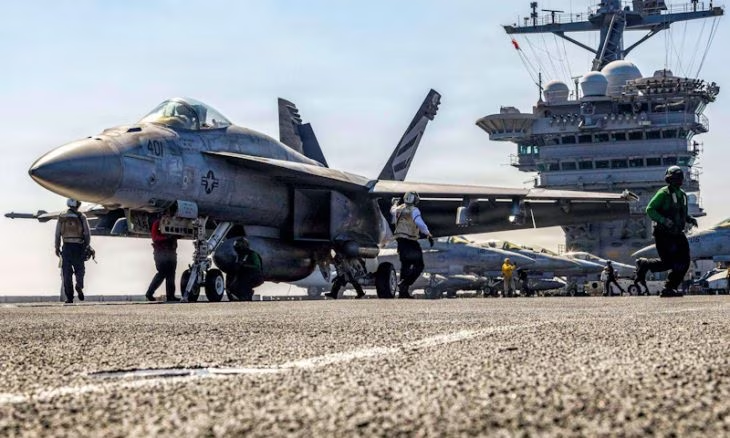







The "Financial Times" affirmed in its latest editorial that the threats made by US President Donald Trump to launch military strikes against Iran lack clear objectives and well-defined plans. The newspaper indicated that exerting maximum pressure on the Iranian regime to agree to a new deal requires sufficient military resources and international coordination, which appears to be absent in the current approach of the US administration.
The newspaper considered that Trump's ultimate goals remain shrouded in mystery, especially as they coincide with the widest wave of popular protests Iran has witnessed since the 1979 revolution. The editorial questioned whether the US President genuinely seeks a new nuclear agreement that curbs Tehran's ambitions, or if the goal is merely to push the economically exhausted regime towards complete surrender to American demands.
Sources observed a clear contradiction in the messages emanating from the White House regarding the Iranian file, with demands oscillating between the complete abandonment of the nuclear program and the imposition of strict restrictions on ballistic missiles. This confusion is evident in Trump giving a short deadline of no more than 15 days to reach an agreement, threatening that "bad things" will happen if the period expires without tangible results.
In the context of diplomatic preparations, the newspaper noted that Trump entrusted the negotiation task to his envoy Steve Witkoff and his son-in-law Jared Kushner, both of whom lack deep experience in dealing with the complex Iranian issue. This team also lacks the necessary technical knowledge to manage highly complex nuclear negotiations that require an understanding of precise scientific and political details.
On the military front, reports revealed that senior Pentagon generals issued direct warnings to President Trump regarding the risks of any large-scale military operation. These warnings centered on the lack of vital ammunition needed for a prolonged conflict, in addition to the absence of support from traditional allies who fear the repercussions of war on regional stability.
According to the analytical reading, Israeli Prime Minister Benjamin Netanyahu appears to be the only leader enthusiastic about launching a military strike on Iranian facilities. The newspaper recalled that Netanyahu had previously tried to drag the United States into direct confrontations, which raises concern among international powers that prefer diplomatic paths to avoid an escalation of the situation in the Middle East.
The article described the Iranian regime as "its own enemy" due to its brutal repressive practices against protesters, which led to the killing of thousands and provoked widespread international condemnation. This internal repression, along with the intransigence in previous negotiations with the Biden administration, led to the regime losing its legitimacy in the eyes of its people and the alienation of European powers that had supported the nuclear deal.
The newspaper explained that the Iranian people, numbering about 90 million, live in a state of anticipation and anxiety between the desire for change and the fear of the ravages of war. Despite widespread popular discontent with the regime's policies and international sanctions, there is a real fear that reckless American statements could destroy the country's capabilities and the future of its generations.
The editorial warned that limited air strikes might not achieve the desired results and would not guarantee Tehran's immediate response to American demands. It also ruled out that air power alone would succeed in changing the existing regime, even if assassination operations targeted senior political and military leaders in the Iranian power structure.
Sources warned against underestimating Iran's ability to retaliate and take revenge if it feels an existential threat to the regime's entity. Iranian response options are likely to include targeting American bases in the region, striking Washington's allies, and threatening the security of international navigation in vital waterways.
The Strait of Hormuz stands out as Iran's most dangerous bargaining chip, as about a third of the world's seaborne crude oil supplies pass through it. Any attempt to close this strait or disrupt movement in it would lead to insane jumps in energy prices, which could cause a global economic crisis that the US administration cannot bear the consequences of.
Attention turns to the third round of indirect talks in Geneva, which the newspaper considered the last and slim chance to avoid a military confrontation scenario. If these diplomatic efforts fail, Trump will face a fateful choice that could change the face of the region and the world for many years to come.
The newspaper indicated that Trump may be driven by the success of the military operation that targeted Venezuelan President Nicolas Maduro, considering it proof of absolute American superiority. However, the article stresses that the comparison between the two cases is completely wrong, as Iran possesses strategic depth and military and organizational capabilities far exceeding what Washington faced in Caracas.
The "Financial Times" concluded its advice to the US President by emphasizing the need to recall the harsh lessons the United States learned in Iraq and Afghanistan decades ago. Getting involved in a conflict with a country the size and complexity of Iran could turn into a new quagmire that drains American resources and leaves destruction whose end or strategic results cannot be predicted.
Iran is not Venezuela, and it is better for Trump to learn from the catastrophic lessons he learned from Iraq and Afghanistan before taking any military step.
שתף את דעתך
Financial Times warns Trump: Iran is not Venezuela, and the lessons of Iraq and Afghanistan are present