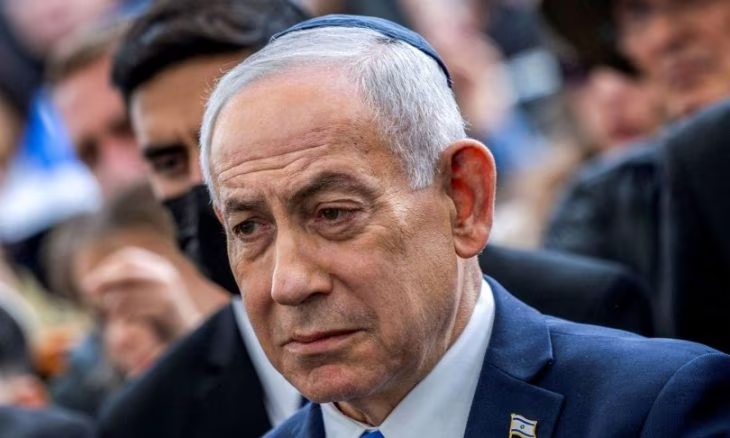







Israeli Prime Minister Benjamin Netanyahu, during a cabinet meeting, revealed his government's directions to build a broad regional and international alliance aimed at redrawing the political map in the region. Netanyahu indicated that this alliance would act as a united front in confronting what he described as radical axes that threaten regional stability from his perspective.
Informed sources clarified that the proposed system would not be limited to the immediate regional scope but would extend to include rising international powers such as India, in addition to countries from the African continent and Asia. Through this proposal, Netanyahu seeks to integrate Israel into a fabric of cross-continental alliances that ensure it a central role in international politics.
Netanyahu spoke about the necessity of a common vision uniting these countries, especially in light of the rising influence of what he called the Shiite axis and the radical Sunni axis. He considered that the current challenges compel the countries he described as 'moderate' to unite to protect their future and strength in the face of increasing threats.
The Israeli Prime Minister claimed that his government had recently delivered strong and effective blows to the Shiite axis, paving the way for strengthening this new alliance. Netanyahu believes that success in dismantling adversaries' capabilities requires completing political construction through strategic partnerships with countries that share Israel's security vision.
These statements come concurrently with arrangements for a visit by Indian Prime Minister Narendra Modi, reflecting the Israeli desire to strengthen the (Indian-Israeli-European) axis. This plan includes incorporating Greece and Cyprus as key partners in the Eastern Mediterranean region to enhance security and economic cooperation.
Netanyahu stressed that cooperation among the parties to this alliance would achieve major strategic benefits, and would not be limited to military aspects but would extend to developmental fields. He affirmed that the ultimate goal is to ensure Israel's resilience and secure its future by creating a supportive regional environment for its political orientations.
In a related context, observers believe that Netanyahu's talk of 'Sunni and Shiite axes' aims to exploit sectarian divisions in the region to achieve political gains. The Israeli discourse seeks to portray Israel as a natural ally for some Arab countries in confronting other regional powers, thereby bypassing the core of the Palestinian-Israeli conflict.
No official comment has yet been issued by the Arab or African countries that Netanyahu referred to in his discussion about joining this supposed alliance. The capitals concerned remain silent regarding these claims, which place them in the same trench as the Israeli occupation against other regional powers.
Analyses indicate that Netanyahu is trying to market a new security doctrine based on transforming the conflict from its Arab-Israeli nature to a conflict between 'moderation and radicalism.' This strategy is considered a means to escape international pressures related to Palestinian rights by presenting major security issues that concern international powers.
Involving countries like Greece and India also aims to transform Israel into a land and sea bridge connecting Asia to Europe, making the security of the occupation an international economic interest. This approach seeks to impose a new geopolitical reality that marginalizes traditional issues and focuses on shared logistical and security interests.
Critics believe that this proposal represents an attempt to create a 'regional NATO' in which Israel is the mastermind and operational center. This project aims to legitimize the occupation's presence as an indispensable force in the international security system, especially amid escalating tensions in the Middle East.
Domestically, Netanyahu is trying through these statements to demonstrate his ability to lead Israel towards new diplomatic horizons despite increasing international isolation. He uses the 'grand alliances' file as a propaganda tool to strengthen his political position before both the Israeli public and international partners.
Conversely, these statements raise concerns about fueling sectarian conflicts in the region by classifying powers based on sectarian affiliations. Experts warn that being drawn into this vision could lead to the region being engulfed in endless conflicts, ultimately serving the expansionist agenda of the occupation.
The question remains about the feasibility of forming such an alliance given the significant contradictions in the interests of the countries mentioned by Netanyahu. While Israel seeks to impose its hegemony, Arab and Islamic peoples remain committed to rejecting normalization and alliance with an entity that continues its ongoing violations in the Palestinian territories.
We seek to establish an axis of countries that see reality, challenges, and goals with one eye, in contrast to the radical axes.
שתף את דעתך
Netanyahu reveals efforts to form an international coalition including Arab states to confront 'radical axes'