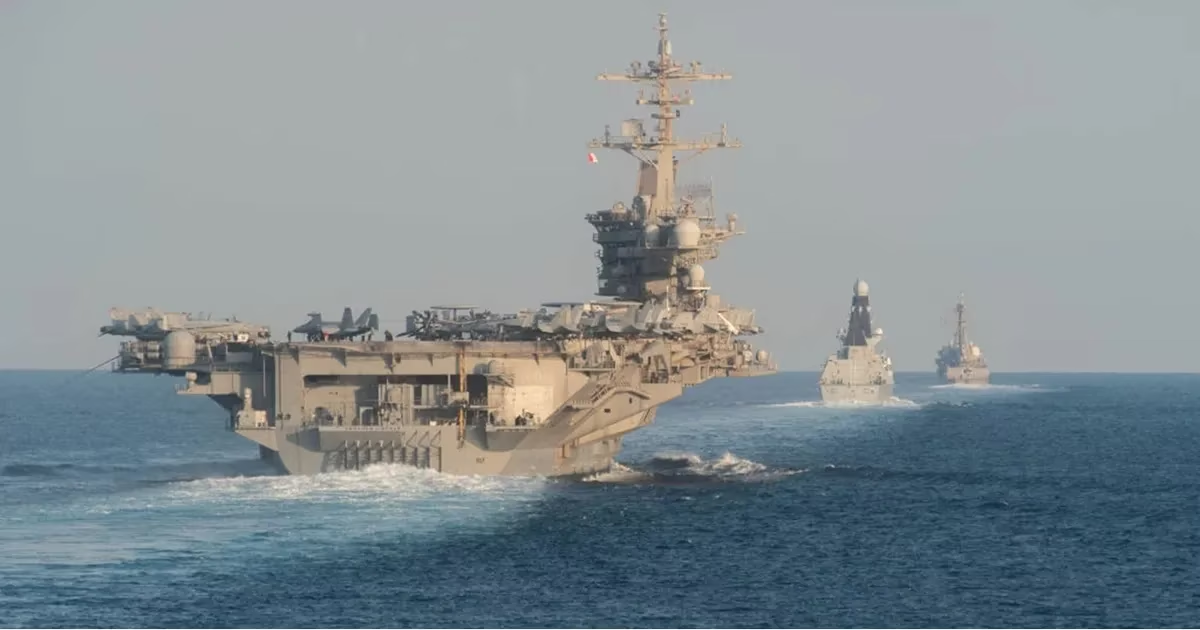







Security sources and analyses have reported that the United States has raised the pace of its military preparations in the Middle East to unprecedented levels, indicating a high probability of military action against Iran. Professor Robert Pape, director of the Chicago Project on Security and Threats, explained that the size of the air power currently stationed in the region represents between 40 to 50 percent of the total available US air capabilities worldwide, which is a dangerous indicator that goes beyond traditional deterrence.
According to updated data as of mid-February 2026, this military deployment recalls the massive preparations that preceded the Iraq wars in 1991 and 2003. Pape affirmed that Washington has historically not accustomed to mobilizing such a massive force near the borders of a potential adversary without subsequent widespread air operations, especially since the buildups are still continuously increasing and expanding geographically.
Currently, the naval strike force is centered around two groups of giant aircraft carriers, the 'Abraham Lincoln' and the 'Gerald R. Ford,' distributed between the Arabian Sea and the Mediterranean Sea. These carriers are supported by formations of warships, destroyers, and nuclear submarines that have taken strategic positions in the Arabian Gulf and the Red Sea, giving US forces the ability to maneuver and strike from multiple axes simultaneously.
On the aerial front, reports have monitored the presence of advanced squadrons of 'F-35A' stealth fighters and 'F-15E' and 'F-16' aircraft in military bases distributed among Gulf countries and Jordan. These fighters are accompanied by a massive fleet of 'C-17' strategic transport aircraft and dozens of aerial refueling aircraft, in addition to advanced command, control, and intelligence systems aimed at managing the theater of operations with high efficiency.
In the context of securing these forces and regional allies, Washington has reinforced air defense systems through the extensive deployment of 'Patriot' batteries, as well as the deployment of the advanced 'THAAD' missile defense system in Saudi Arabia or Qatar. Analysts believe that this integration between offensive and defensive power indicates that preparations have moved beyond the theoretical planning stage to operational readiness for a potential preemptive strike.
The United States has never before deployed a force of this magnitude against a potential enemy without launching air strikes.
שתף את דעתך
Security expert: US military buildup in the region portends an imminent strike against Iran