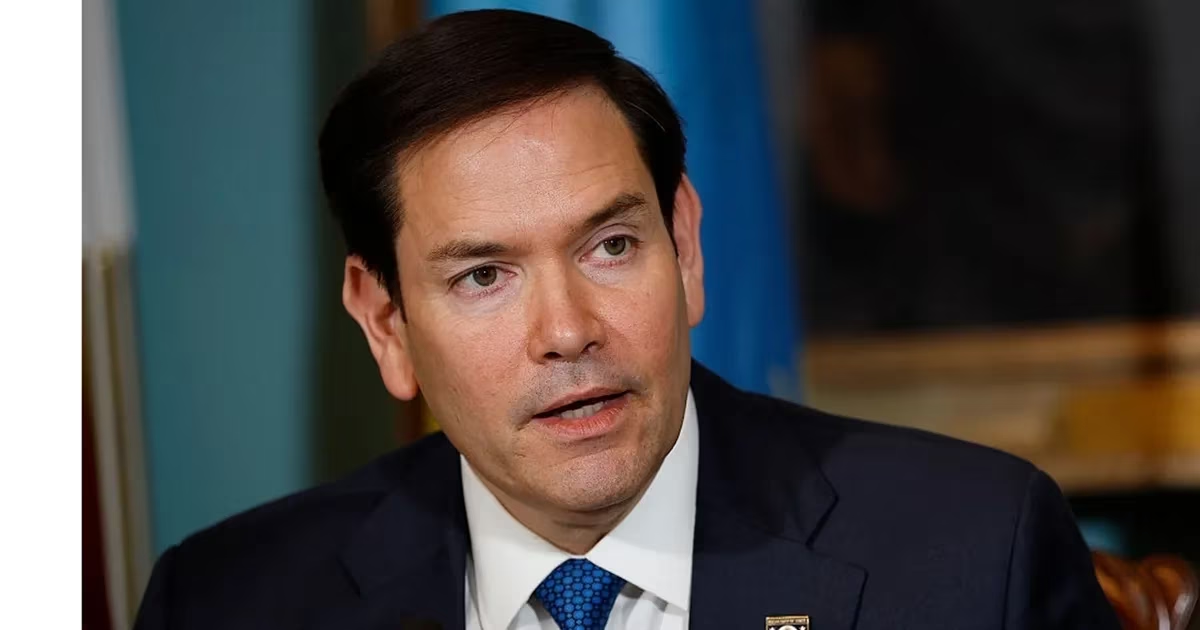







Marco Rubio's speech to security leaders at the Munich Conference carried intense strategic messages, primarily aimed at addressing the European psyche through the gateway of civilization and religion. Through his speech, Rubio sought to reassemble the European diaspora that had begun to slip from American hegemony, attempting to mend the Western alliance on solid ideological foundations.
The American official clearly criticized the economic policies pursued by the West in recent decades, considering them to have caused a decline in the industrial base of major countries. He also pointed out that encouraging immigration from cultures not aligned with Western identity now threatens social cohesion in both the Old Continent and the United States.
This revelation reflects the core concepts from which the current American administration operates, as it seeks to reshape the Western front according to a conservative vision. This trend is clearly evident in the attempt to impose an intellectual framework that links political interests and shared cultural values to confront international adversaries.
Historically, the rise of the New Evangelical movement played a pivotal role in shaping American foreign policy over the past twenty years. This was evident in the speech of former President George H.W. Bush, which was characterized by a clear religious tone, leading up to the current era which sees a similar influence in decision-making circles.
Although former President Donald Trump was not known for his personal piety, he politically relied entirely on the conservative evangelical base. This alliance translated into major strategic decisions, most notably the recognition of Jerusalem as the capital of the Israeli occupation in 2017 and the relocation of the American embassy there.
In contrast, this American vision faces a complex European reality based fundamentally on the principle of secularism and the separation of religion from the state. While France adopts a strict model of laïcité, other countries like Germany and Britain content themselves with cooperative models that maintain the state's civil and liberal nature.
However, the last decade has witnessed a tangible shift with the steady rise of conservative right-wing movements across the European continent. Observers link this rise to increasing fears of losing cultural identity, especially after the large waves of refugees following political crises and wars in the Arab region.
The war in Syria and the influx of millions of refugees into Europe led to strong adverse reactions within host communities. Right-wing parties exploited these demographic fears to strengthen their political presence, warning against what they described as a threat to the 'Christian roots' of the European continent in the face of demographic changes.
This cultural anxiety coincided with suffocating economic crises exacerbated by the repercussions of the coronavirus pandemic, making right-wing discourse more acceptable to broad segments of the population. The religious rise in Europe is no longer merely a shift in faith, but has become a means of searching for a lost identity amidst globalization and comprehensive secularism.
The history of Christian Democratic parties in Europe, such as the Christian Democratic Union in Germany, originated primarily to confront fascism and communism after World War II. Today, these roots resurface as a moral and political reference to confront contemporary challenges threatening the structure of the family and society.
This shift has created a hidden clash between conservatively oriented societies, especially in Eastern Europe, and the liberal institutions of the European Union. Some governments have resorted to using Christian symbolism as a tool to assert national sovereignty in the face of what they see as encroachment by the secular bureaucracy in Brussels.
From this perspective, Rubio's vocabulary, which focused on 'shared heritage' and 'common destiny' between the two sides of the Atlantic, can be understood. He believes that Europe's strength is a guarantee for the survival of Western civilization, calling for unity to confront rising powers, foremost among them China, which he described as an economic and powerful competitor.
While Rubio calls for postponing conflict with China through dialogue, other priorities in his speech emerge concerning the Middle East. He shows absolute support for the Israeli occupation, backed by American military movements aimed at imposing complete control over decision-making in the region to enable the civilizational vision he preaches.
In conclusion, Rubio's speech in Munich represents a political document expressing a rising American current that blends military power and religious ideology. It is a serious attempt to redefine international alliances based on identity, placing the world before a new stage of polarization that transcends economic interests to cultural conflicts.
The alliance between the United States and Europe is essential for defending their common civilization in the face of current global challenges.
שתף את דעתך
Dimensions of Rubio's Speech in Munich: An American Attempt to Reshape the Western Alliance on Ideological Grounds