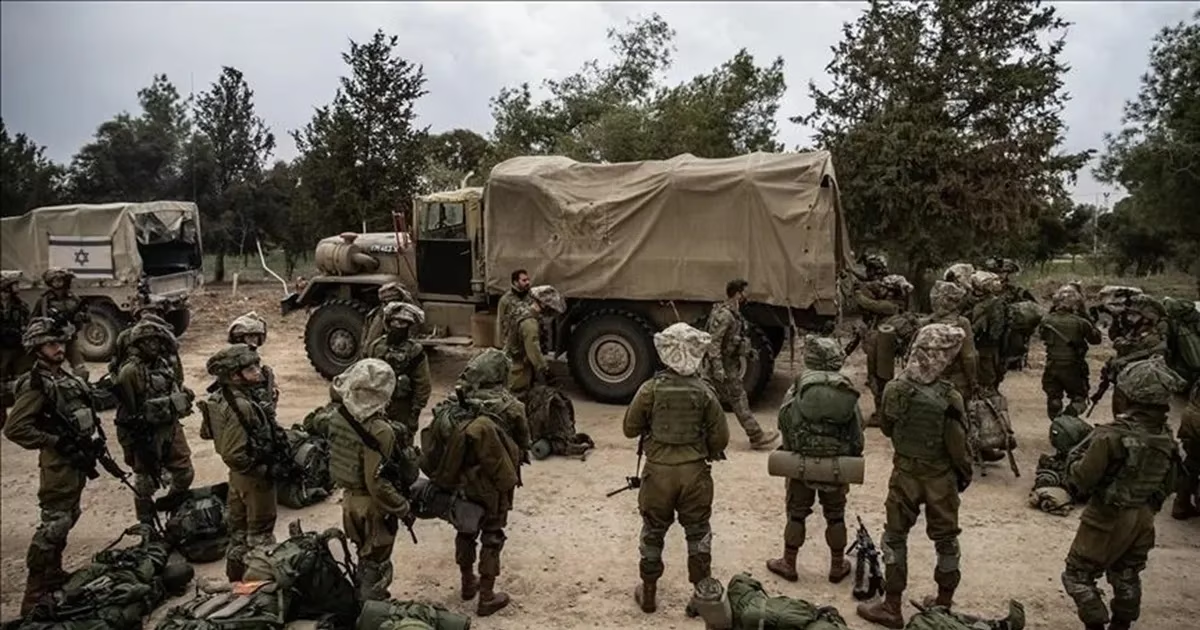







Sources reported that security circles in Tel Aviv have begun re-evaluating the strategic threat map for 2026, in light of escalating regional risks and the development of drone technology and precision missiles. Security experts believe that the principle of traditional disarmament is no longer effective in confronting current challenges, which forces the occupation to formulate a political alternative that balances security control in the Gaza Strip and preventing existential threats in the West Bank.
In this context, General Giora Eiland, former head of the National Security Council, stated that the radical shift following the events of October 7 triggered a sharp strategic discussion about the security vision adopted in recent decades. Eiland clarified that the long-held concept that Hamas had been deterred proved false, noting that this erroneous assessment came at a heavy cost in lives and demonstrated the failure of government policies towards the Strip.
Eiland pointed out that Israeli policy was not only aimed at deterrence but also sought to deepen the division between Gaza and the West Bank to ensure the absence of unified Palestinian representation that would thwart any opportunities for political negotiations. However, this approach ignored the increasing security costs, as the government believed that Hamas could be allowed to achieve political and economic stability while preventing the growth of its military capabilities, which later proved to be false.
According to published analyses, Hamas managed to collect huge financial resources that were not only used to strengthen its political rule but were primarily directed towards building a sophisticated military arsenal. Despite these results, political levels in Tel Aviv still reject the return of the Palestinian Authority to Gaza, fearing that this would lead to the unification of Palestinian geography and pave the way for a comprehensive political arrangement that does not serve Israeli security interests.
The former general believes that the two-state solution in its traditional form is no longer a viable option under current circumstances and changing regional power balances. He considered that the old assumption that a Palestinian state would be militarily weaker than Israel no longer holds true, especially since Tel Aviv operates in a turbulent environment and faces cross-border military alliances and armed organizations.
The October 7 attack revealed the possibility of fighting on one front quickly escalating into a multi-front war, with Israel now facing missile threats from Iraq, Yemen, and Iran. In this scenario, the establishment of a Palestinian state is seen as an additional hotbed of danger that could turn into a security choke point threatening Israel's heartland and vital population centers in the center.
Eiland addressed the technological revolution in weaponry, emphasizing that the term 'disarmament' in its classical sense, associated with tanks and planes, is outdated. Modern warfare relies on small and lethal means such as anti-tank missiles and drones that are easy to smuggle and hide within civilian environments and supply trucks, making their monitoring almost impossible.
The analysis concluded with four main findings. The first is that the return of the Palestinian Authority to Gaza may be a better security option than the continued rule of Hamas or attempts to find fragile local alternatives. The second conclusion emphasizes the necessity of formulating a new international strategy that recognizes that the two-state solution is no longer technically and security-wise possible given technological developments that grant small groups enormous destructive capabilities.
In conclusion, Eiland called for moving beyond the dichotomy that limits options between eternal control over the West Bank or the establishment of a fully sovereign state, proposing temporary political models that meet security needs. He stressed the need to confront the international community with the realities of the military danger resulting from any withdrawal to the 1967 borders, considering that the exclusion of the two-state solution must be based on purely security considerations, away from ideology.
The guiding concept that Hamas had been deterred was wrong, and it came at a heavy cost in blood.
שתף את דעתך
An Israeli Security Vision for 2026: Four Conclusions Reshaping the Confrontation with the Palestinians