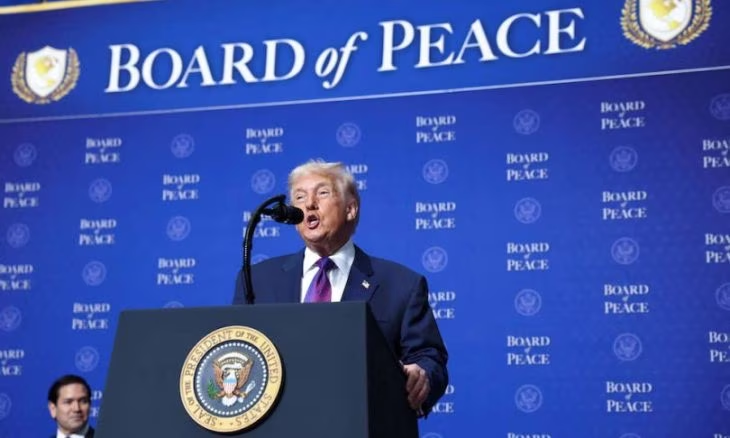







US President Donald Trump issued a stern warning to the Iranian leadership, giving them a maximum of 15 days to reach what he described as a 'meaningful deal'. Trump stressed during a meeting in Washington that failure to conclude this agreement would lead to 'bad things' happening, indicating that the coming days would be crucial in determining the course of the confrontation.
These statements come at a time when the region is witnessing a large-scale American military buildup, with Washington deploying an aircraft carrier off the Iranian coast and a second carrier heading to the region. These movements coincide with the deployment of squadrons of fighter jets and tens of thousands of soldiers to regional bases, raising the pace of readiness for any potential confrontation.
For his part, Israeli Prime Minister Benjamin Netanyahu joined the threats, warning Tehran against making any mistake by attacking Israel. Netanyahu vowed a violent military response beyond the imagination of the Iranian leadership, stressing that Tel Aviv would not hesitate to defend its security with full force if it were subjected to any direct aggression.
On the ground, some European countries have begun to take precautionary measures, with the German army announcing the temporary relocation of a number of its soldiers from the city of Erbil in northern Iraq. This decision came amid escalating security tensions in the Middle East and fears of targeting bases hosting foreign forces in the region.
In a related context, Polish Prime Minister Donald Tusk urged his citizens in Iran to leave immediately and without delay. Tusk considered that the possibility of an open armed conflict erupting in the region has become very real, requiring the utmost caution and prudence to secure Polish nationals.
Internationally, the Russian presidency called on all parties involved in the crisis to exercise maximum restraint and avoid uncalculated escalation. Moscow expressed regret that tensions had reached unprecedented levels, stressing the absolute necessity of prioritizing political and diplomatic means to resolve outstanding differences.
For its part, France called on both Washington and Tehran to return to the negotiating table as the only option to prevent Iran from acquiring nuclear weapons. Paris affirmed that the diplomatic path is the optimal way to ensure regional stability and avoid the region sliding into a comprehensive military confrontation that may not be controllable.
Economically, these tensions were directly reflected in global energy markets, with oil prices soaring to record levels not seen in many months. Brent crude recorded a significant increase, reaching $71.66 per barrel, amid fears among suppliers of supply disruptions in the event of a military conflict in the Strait of Hormuz.
In contrast, Tehran staunchly defended its position, with the head of the Atomic Energy Organization of Iran, Mohammad Eslami, affirming his country's right to possess peaceful nuclear technology. Eslami explained that uranium enrichment operations represent the basis of the national nuclear industry, noting that the program is progressing in accordance with the rules of the International Atomic Energy Agency.
Media reports quoted American sources as saying that the military options presented to the White House were designed to inflict the greatest possible damage on Iranian infrastructure. These plans include the possibility of targeting prominent political and military leaders, with the aim of weakening the ruling regime in Tehran or overthrowing it in the event of war.
Despite the threats, Iranian President Masoud Pezeshkian affirmed that his country does not seek war and has never initiated it since he took office. However, he stressed at the same time that Iran will not succumb to American demands aimed at humiliating the Iranian people or imposing external will on them under threat.
Iranian officials hinted at the possibility of closing the strategic Strait of Hormuz, which is the lifeline for global oil and gas trade, if their country is attacked. The Revolutionary Guard conducted extensive military maneuvers in the strait to raise combat readiness and test the defensive and offensive capabilities of the naval forces.
In a move reflecting the depth of regional alliances, Iranian and Russian naval forces completed joint military exercises in the Gulf of Oman and the northern Indian Ocean. These maneuvers aim to enhance security cooperation between the two countries and send a clear message regarding the balance of power in the region amid increasing American pressure.
Anticipation remains the master of the situation during the next two weeks, as the results of indirect talks in Oman and Geneva will determine the fate of the region. Either a framework will be reached that satisfies all parties and lifts sanctions on Iran, or a dark tunnel of military confrontation will be entered that could change the face of the Middle East.
We must reach a meaningful deal, otherwise bad things will happen, and you will probably find that out in the next ten days.
שתף את דעתך
Trump gives Tehran 15 days to make a deal or face dire consequences