






US Secretary of State Marco Rubio's speech at the Munich Security Conference, held in mid-February, represented a fundamental turning point in American political discourse towards the European continent. Rubio did not merely present a traditional security overview but went further, offering a comprehensive ideological reframing of the transatlantic alliance, replacing global liberal concepts with a theory centered on Western civilizational identity.
These moves come in the context of the Trump administration's attempts in its second term to establish new international rules that transcend previous diplomatic norms. Observers believe that Rubio, through this proposal, seeks to impose a new American vision that redefines the concept of global leadership, considering Trump's return to power as ushering in an era of an undisputed sole superpower.
The US Secretary of State attempted in his speech to calm the fears of allies who had begun to seek alternative blocs as a result of strict American policies. Rubio clearly affirmed that Washington does not wish to separate from Europe but aims to revive a deeply rooted historical alliance, recalling the era of World War II and the subsequent joint construction.
Rubio stressed that the fate of the United States and Europe is organically and inextricably linked, not only in terms of security and politics but also from historical, cultural, and religious standpoints. He considered this interconnectedness to be the impregnable fortress that must protect Western interests in the face of increasing global challenges threatening the cohesion of Western societies.
Although the tone of the speech was less harsh compared to Trump's previous statements, it was not without sharp criticism of European liberal policies. Rubio indicated that excessive reliance on globalization led to the decline of manufacturing sectors in the West and opened the door to waves of migration that threatened the cultural identity of Western nations.
The US Secretary also directed explicit criticism at the current international system, questioning the usefulness of the United Nations and institutions that he believes no longer offer effective solutions to current crises. He considered that adherence to abstract liberal values sometimes takes precedence over the true interests of Western peoples, which the Trump administration seeks to fundamentally change.
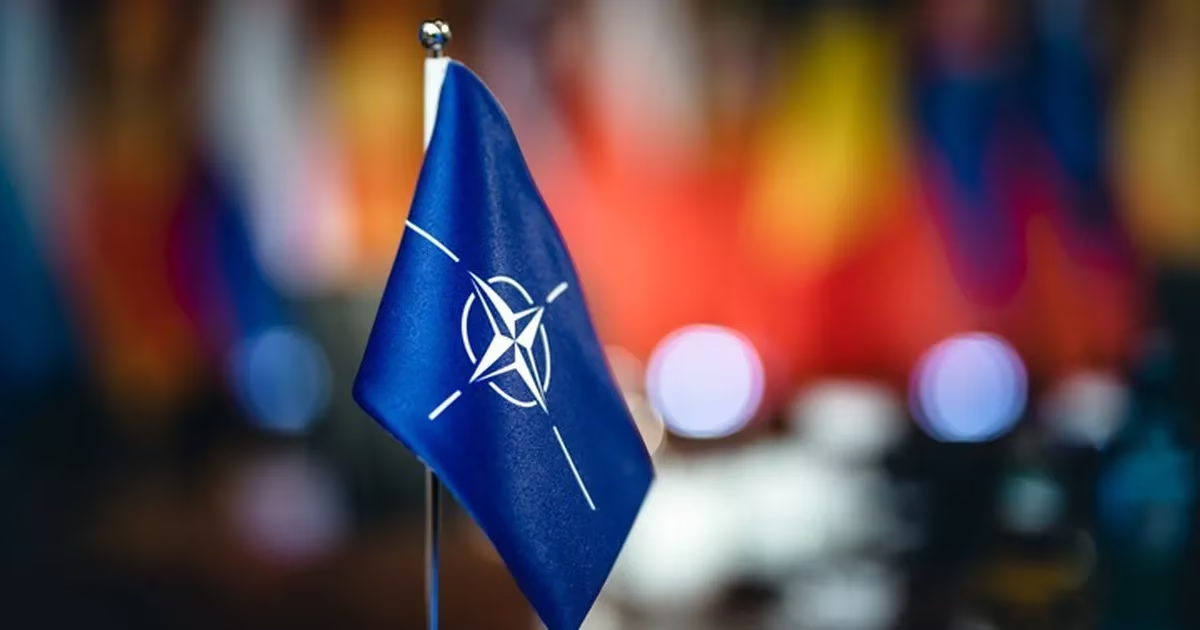
Regarding the North Atlantic Treaty Organization (NATO), Rubio's speech carried clear reassuring messages aimed at dispelling doubts about Washington's intention to withdraw from the alliance. He clarified that the US administration does not seek to divide NATO but aims to 'stimulate' it to be capable of defending civilization and common interests across the Atlantic.
These statements received a positive response from some European leaders, most notably European Commission President Ursula von der Leyen. Von der Leyen considered Rubio's speech to be an important basis for restoring trust between Washington and Brussels after periods of diplomatic and political tension.
For his part, German Foreign Minister Johann Wadephul described the speech as laying the groundwork for the strategic partnership that must be built upon in the future. The foreign ministers of France and Finland agreed with this approach, seeing Rubio's words as an opportunity to strengthen joint defense cooperation in light of accelerating geopolitical changes.
However, caution was not absent from the conference halls, as some European observers expressed concern about Washington's attempts to impose a new 'ideological dependency' on the continent. They believe that focusing on identity and civilization may be a means to attract Europe away from its political independence, which it has tried to strengthen in recent years.
Rubio deliberately played on the chord of shared history and defensive moments that brought the two sides together, in an attempt to stir the instinct of collective unity among Europeans. The strategic goal appears to be to prevent the old continent from escaping towards other international alliances that might change the global balance of power in a way that does not serve American interests.
The vision put forward by Rubio reflects the methodology of the Trump administration, which is effectively led by the duo Rubio and Kushner, who possess strong leverage to push through their agenda. This agenda relies on transforming the positions of allied countries to align with the American vision, even if it conflicts with some national interests of those countries.
Analyzes indicate that the Munich speech is just the beginning of a series of diplomatic moves aimed at reshaping the global order from an 'America First' perspective. Washington seeks to ensure Europe remains in its ideological and security orbit, while imposing new conditions related to defense contributions and economic policies.
In conclusion, Marco Rubio's speech remains an important political document that requires careful study of its vocabulary and deep implications, as it outlines the foreign policy of the world's greatest power. European reactions, whether welcoming or apprehensive, will play a crucial role in determining the shape of the transatlantic relationship over the next four years.
Under Trump, the United States wants to lead the rebuilding of the world, and the alliance with Europe must defend our common civilization.
שתף את דעתך
Rubio in Munich: Reshaping the Atlantic Alliance from a Civilizational Identity Perspective