






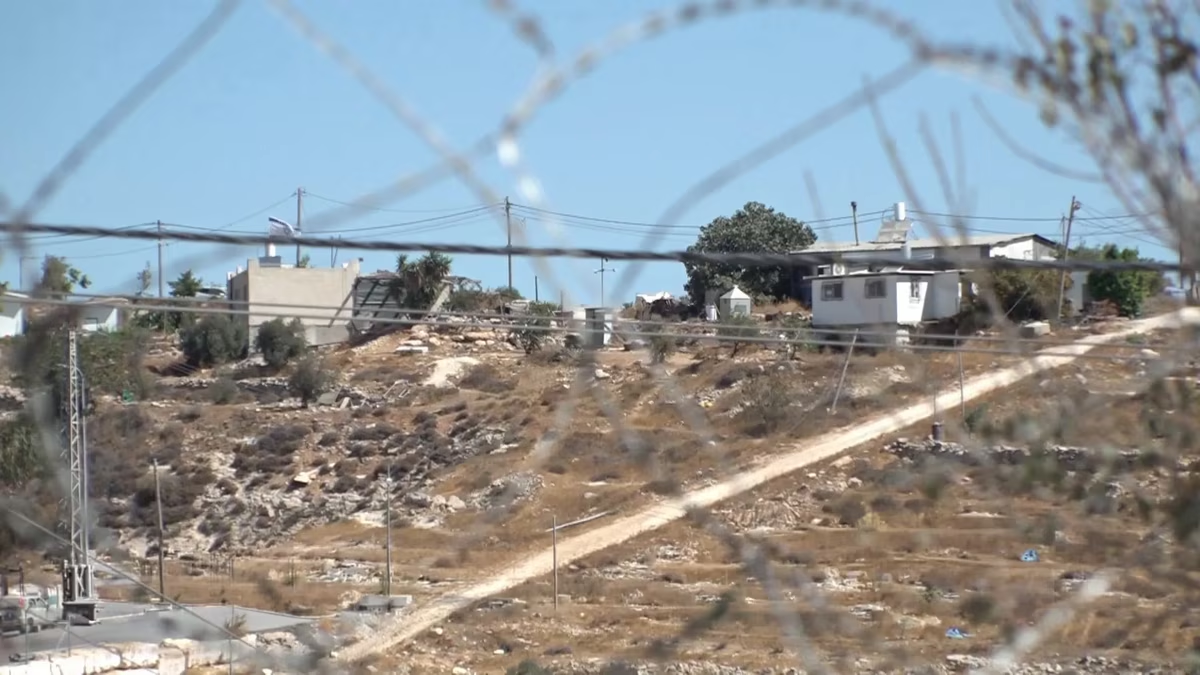
The pace of Israeli plans aimed at imposing full sovereignty over West Bank lands is accelerating, through a series of legal and administrative measures designed to end any future opportunity for the establishment of a Palestinian state. Recent developments have revealed the approval by the Ministerial Committee for Legislation of laws that terminate the operation of legislation that had regulated land ownership for many decades.
These decisions directly target the Jordanian Law of 1953, which was in force in the West Bank and prohibited non-Palestinians and Arabs from owning land. Although the occupation had introduced previous amendments that allowed settlement companies and associations to own land after 1967, the current step represents a radical shift by completely abolishing the restrictions.
Under the new measures, Israelis will be allowed to own land in the West Bank personally and directly, with land registries opened to the public. Sources reported that this legal change grants settlers tools for direct pressure on Palestinian owners and heirs, opening the door to widespread extortion and threats to seize properties.
In the city of Hebron, these decisions take a more serious turn, as the new powers grant an administrative committee linked to the settlement council almost complete sovereignty over the Ibrahimi Mosque and the Old City. This approach aims to give these areas a religious character to facilitate their conversion into settler properties, with planning and licensing powers effectively transferred to them.
These steps come within a strategic vision led by Finance Minister Bezalel Smotrich, who seeks to unprecedentedly increase the number of settlers in the West Bank. Through this, Smotrich aims to create a solid electoral bloc that ensures the continuity of the national religious right's project and solidifies the reality of annexation on the ground.
The measures were not limited to areas classified as (C), but extended to include expanding Israeli oversight and enforcement powers to reach areas (A) which are administratively and security-wise under the Palestinian Authority. This encroachment includes vital issues such as water, antiquities, and the environment, leading to the erosion of what remains of Palestinian sovereign powers in their city centers.
Legal experts believe that this package of decisions is not merely technical adjustments, but a clear declaration of the de facto annexation of the West Bank and the fragmentation of its geographical unity. The area of 5690 square kilometers is now facing a systematic division policy aimed at isolating Palestinian communities and turning them into enclaves besieged by settlements.
Despite these increasing pressures, Palestinians continue to cling to their lands as the essence of national identity and memory, not just real estate. Palestinian families today face an existential challenge in preserving their properties in the face of an arsenal of military laws that seek to change the face of the region by force of arms and legislation.
This package of decisions entrenches the reality of de facto annexation, where the Palestinian is left alone to face a reality being reshaped by force.
שתף את דעתך
Smotrich's Plan to Control the West Bank: New Laws Legalize Settler Ownership and End Palestinian Sovereignty