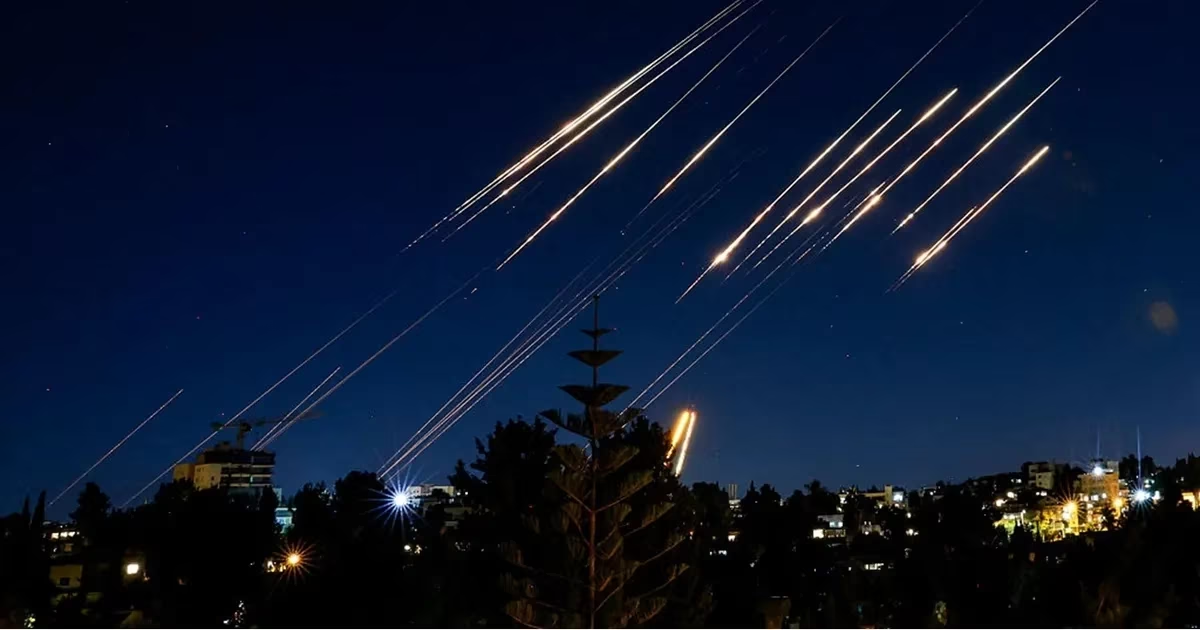







The Iranian capital, Tehran, commemorated the 47th anniversary of the Islamic Revolution amidst a charged political atmosphere, with celebrations featuring striking military parades that included advanced ballistic missiles. In a synchronized move reflecting the intensity of regional tension, Israeli security sources announced the success of new tests for defensive systems designed to intercept long-range missiles, indicating a frantic arms race preceding any potential political understandings.
These military displays are taking place at a time when Washington and Tehran are engaged in arduous and complex negotiations. US President Donald Trump is seeking to conclude what he describes as a historic deal to overcome the shortcomings of the 2015 agreement. Trump desires to achieve a diplomatic breakthrough that permanently ends Iran's nuclear ambitions, while simultaneously avoiding a comprehensive military confrontation that could exhaust the American economy and affect the stability of global energy prices.
For its part, the Iranian leadership, headed by Ayatollah Ali Khamenei, maintains a position that negotiates the right to possess nuclear technology for peaceful purposes, with an absolute refusal to compromise on conventional missile capabilities. Tehran considers its missile system to be the cornerstone of its national deterrence strategy and cannot be subjected to negotiation under the weight of American threats or the economic pressures resulting from prolonged sanctions.
Benjamin Netanyahu enters the crisis with an anticipated visit to Washington, his seventh since early 2025, with the aim of convincing the American administration of the necessity of including the ballistic missile issue as a fundamental clause in any agreement. The Israeli government believes that restricting uranium alone is insufficient if the Iranian missile system continues to develop in terms of accuracy and range, especially after the experience of the military confrontation that occurred last year.
Domestically in Israel, pressures have increased from both the opposition and the coalition. Former War Minister Avigdor Lieberman indicated that the truth about the damage caused by Iranian missiles in the 2025 confrontation has not been fully revealed. Lieberman warned that any agreement that does not include the dismantling or restriction of Iranian missile capabilities would be considered a grave security failure that places Israeli depth in permanent danger.
The authorities in Iran face severe internal challenges as a result of immense economic pressure that has affected living standards and led to scattered popular protests. The Iranian regime is trying to balance its urgent need to lift sanctions and provide economic relief to the public with maintaining its image as a regional power that has not succumbed to dictated terms, which officials there call “strategic patience.”
Informed sources indicate that Trump is trying to balance his desire to appease his regional allies and avoid making them pay the price for any potential military confrontation that might target American bases in the region. Arab allies fear that their territories could become a direct battleground, or that they might be asked to bear the exorbitant financial costs of any military action led by the United States against Iranian facilities.
Despite the complexities, outlines of a compromise formula may emerge, including reducing uranium enrichment levels and the return of strict international oversight in exchange for a gradual lifting of oil and financial sanctions. However, the ballistic missile issue remains the mine that could detonate the entire negotiation process, as Tehran considers it an integral part of its defensive doctrine that cannot be divided or conceded in the face of continuous threats.
This current battle of wills transcends security calculations to become a struggle for international image and prestige; Trump wants to appear as the hero who achieved what his predecessor could not, while the Iranian regime rejects any concession that might be interpreted internally as a sign of weakness. Amidst this tug-of-war, the risk of military escalation remains if one of the parties decides to over-press to impose new realities on the ground.
The nuclear file without ballistic missiles is half a solution, and the Iranian missile arsenal represents a direct threat no less dangerous than nuclear ambitions.
שתף את דעתך
The Clash of Wills Between Tehran and Washington: Ballistic Missiles, the Knot of the “Grand Bargain”