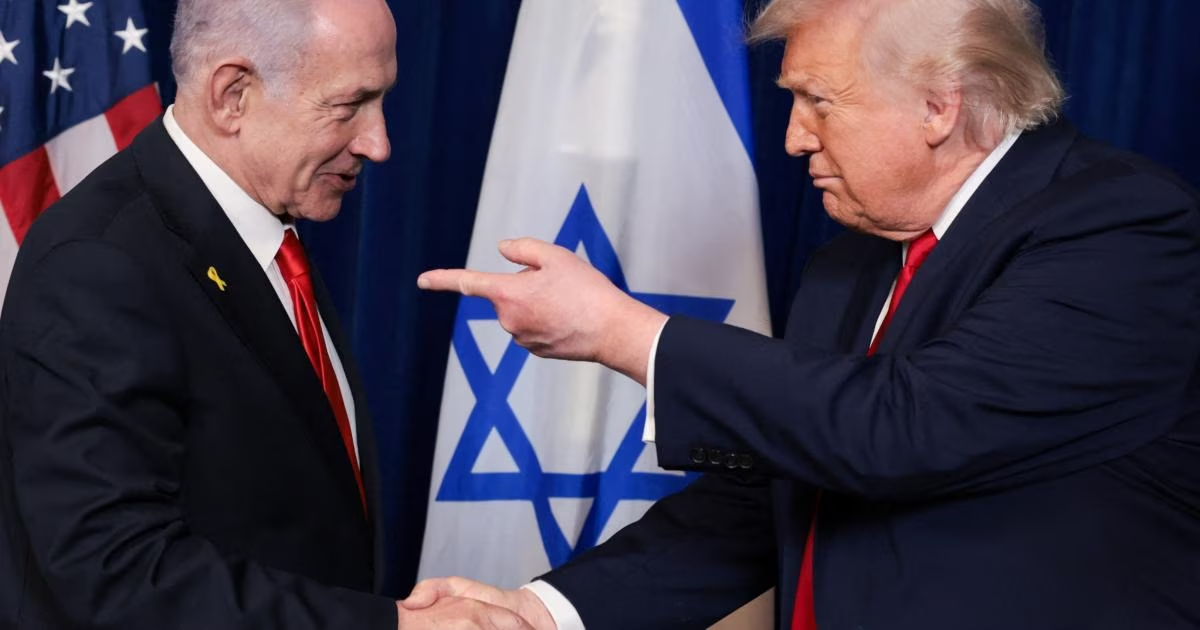







US President Donald Trump revealed details of the intensive discussions he held with Israeli Prime Minister Benjamin Netanyahu at the White House, confirming that he insisted on his desire to complete the negotiation process with Tehran. The closed meeting lasted for nearly three hours, taking place away from the media in a move reflecting the sensitivity of the issues on the table between the two allies.
Trump clarified via his 'Truth Social' platform that he clearly informed Netanyahu that reaching an agreement with Iran remains his preferred option for now. The US President indicated that the final outcomes have not yet been decided, but he seeks to explore the rationality of the Iranian side at this new stage of international discussions.
In a message with a cautionary tone, Trump reminded Iran of the consequences of rejecting previous deals, referring to the military operations that targeted Iranian nuclear sites during last June's confrontation. He affirmed that Washington is closely monitoring Iranian behavior, and that other options remain available should diplomacy fail to achieve American objectives.
For his part, Benjamin Netanyahu focused during the meeting on what he described as Israel's existential security needs, emphasizing that any agreement must include strict restrictions. Netanyahu demanded a complete halt to uranium enrichment operations and the dismantling of current stockpiles, considering military action as potentially the only way to permanently end Iran's nuclear ambitions.
Informed sources reported that the statement issued by the Israeli Prime Minister's office was cool compared to Trump's optimistic tone, indicating gaps in viewpoints. The Israeli statement lacked the traditional phrases describing meetings as warm or positive, merely referring to the continuation of close security coordination between the two sides.
Observers believe that this discrepancy in media discourse may be a deliberate tactic aimed at misleading Tehran and keeping all possibilities open on both political and military fronts. While Trump promotes a peaceful solution, Netanyahu insists on demonstrating adherence to the military option to ensure extracting the maximum possible concessions from the Iranian side.
Reports indicate that Netanyahu entered the White House through a back entrance to avoid photographers' lenses, an unusual procedure reflecting the desire of both parties to lend an air of secrecy to the deliberations. Discussions covered various scenarios for dealing with any potential breakdown of negotiations, including mechanisms for responding to any potential Iranian attack against Israeli interests.
In the context of field pressure, the United States continues to bolster its military presence in the region, having sent a second aircraft carrier to serve as a pressure tool for the American negotiator. These moves aim to compel Tehran to accept conditions that extend beyond the nuclear file to include its ballistic missile program and regional influence in the Middle East.
On the other hand, Tehran shows cautious readiness to discuss the enrichment file, but categorically rejects any interference with its missile program or reduction of its role in the region. Iranian sources affirm that any agreement must preserve the country's sovereignty and its right to nuclear technology for peaceful purposes, warning of an unrestrained response if it is targeted.
Analysts believe that Netanyahu, through these meetings, seeks to push the US administration towards adopting a strategy aimed at changing the regime in Tehran or militarily weakening it. However, Trump's current inclinations lean towards concluding a 'good deal' that ensures Iran does not acquire nuclear weapons without sliding into a comprehensive war that could destabilize the region.
Iranian ballistic missiles raise serious concerns in Israeli security circles, given their ability to reach deep into Israel without prior warning. Officials in Tel Aviv warn that Iran is capable of exhausting air defense systems in the event of a long-term conflict, making the neutralization of this weapon a top Israeli priority.
A White House official confirmed that President Trump was firm about preventing Iran from acquiring nuclear weapons or continuing to enrich uranium at high levels. The official added that the US administration is working to formulate a negotiating framework that ensures strict and comprehensive monitoring of all concerning Iranian nuclear and military activities.
At the end of the meeting, the American and Israeli sides agreed to continue close coordination on the Gaza file and the rapidly evolving regional developments in the region. Despite some differences in details, the shared commitment to preventing Iranian expansion remains the cornerstone of the strategic alliance between Washington and Tel Aviv.
The question remains whether these negotiations will lead to a real breakthrough or are merely a new round of political maneuvers preceding a potential escalation. The coming days will reveal the extent of international parties' ability to sit at one table and formulate understandings that end decades of tension and conflict in the Middle East.
I insisted on continuing negotiations with Iran to see if a deal could be made or not, and if not, we will see what the outcome will be.
שתף את דעתך
Trump insists on negotiation option with Iran, Netanyahu conditions agreement on strict security guarantees