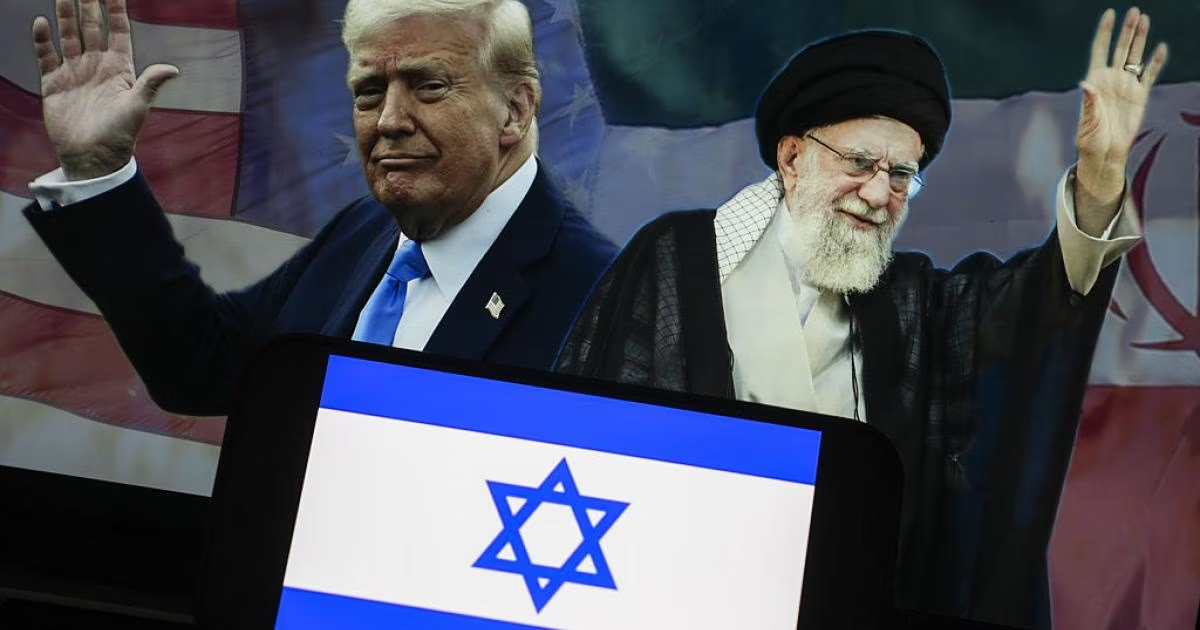







The pace of diplomatic and military movements in the region is accelerating following the conclusion of the first round of Iranian-American negotiations in Muscat. The office of Israeli Prime Minister Benjamin Netanyahu announced his travel to Washington next Wednesday to meet with President Donald Trump. This visit comes at a sensitive time, reflecting Israeli concerns about the potential understandings between Washington and Tehran, especially after Trump praised the talks, describing them as 'very good'.
Through this early meeting, Israel seeks to impose its conditions on any future agreement. Netanyahu insists that the agreement must include strict restrictions on Iran's ballistic missile program and a halt to financial and military support for Tehran's allies in the region. Netanyahu is accompanied on this visit by the commander of the Israeli Air Force, indicating that military and operational coordination will be strongly present on the discussion table with the US administration.
On the ground, informed sources have observed extensive US military movements. Steve Whitkoff, head of the US negotiating delegation, visited the aircraft carrier 'USS Abraham Lincoln' stationed in the Arabian Sea. This carrier includes a strike force comprising over 80 fighter jets and destroyers equipped with Tomahawk missiles, reinforcing the US military presence, which has reached ten major naval vessels in the region since late January.
Media reports revealed air transfers of US forces to strategic areas including the Turkmen-Iranian border and Armenia during the past twenty-four hours. These movements coincide with the deployment of advanced 'THAAD' and 'Patriot' missile defense systems at about twenty US bases and positions in the Middle East, a step interpreted as preparation for confronting any potential military escalation.
In Tehran, Iranian Foreign Minister Abbas Araqchi expressed cautious optimism about the results of the Muscat round, describing the atmosphere as very positive and representing a good start for a new diplomatic path. However, Araqchi stressed that his country would not relinquish its right to uranium enrichment under any circumstances, affirming that the US military buildup in the region does not intimidate the Iranian leadership, which is preparing for all scenarios.
Israeli intelligence estimates suggest that Iran may try to buy time through negotiations to obstruct any joint offensive plans that Washington and Tel Aviv might launch. Israel's Channel 12 believes that the United States has completed the first phase of reinforcing its forces and is about to enter a second phase that will enable it to launch a large-scale military operation if the diplomatic path fails.
Israeli demands that Netanyahu will carry to the White House include the complete dismantling of Iran's nuclear program and the removal of enriched uranium from Iranian territory. Tel Aviv also demands the return of IAEA inspectors for surprise and strict inspections, in addition to limiting the range of Iranian missiles to no more than 300 kilometers, which Tehran completely rejects.
For his part, US President Donald Trump faces the challenge of balancing his stated preference for negotiated solutions with Israeli pressures and the on-the-ground reality that necessitates constant military readiness. Observers believe that Netanyahu's early visit may be part of a 'deception' strategy preceding sudden military operations, similar to what happened in previous confrontations between the two sides.
In the context of deterrence, the Iranian Foreign Minister threatened to directly target US bases in the Middle East if Iranian territory is subjected to any attack. Araqchi clarified that Tehran has the capability to accurately strike these bases, distinguishing between targeting the US presence and attacking neighboring countries, in an attempt to neutralize Arab capitals from direct conflict.
Iran possesses the largest missile arsenal in the region, with US national intelligence reports indicating the presence of ballistic missiles with a range of up to two thousand kilometers. This arsenal is distributed in underground 'missile fortresses' in different provinces, making it difficult to completely destroy them through limited air strikes, and making any comprehensive confrontation fraught with risks.
'Sejjil', 'Khorramshahr', and 'Shahab-3' missiles stand out as the most important weapons that can reach deep into Israel, in addition to the recent revelation of hypersonic missiles capable of bypassing air defense systems. These military capabilities make the option of an all-out war a major gamble that could lead to paralysis in global trade routes and energy supplies through the Strait of Hormuz.
Despite the atmosphere of optimism that prevailed after the Muscat meeting, 'the fingers of both sides remain on the trigger,' as Iran continues to enhance its missile capabilities in parallel with the negotiations. The Center for Strategic and International Studies believes that Tehran has successfully recovered from the damage of the 'Twelve-Day War' that occurred in June 2025, and now possesses more advanced launch platforms.
The question remains about the extent of diplomacy's ability to defuse the explosion in light of the wide gap between Washington and Tel Aviv's demands and Iran's red lines. While the West demands the dismantling of the nuclear program and the reduction of regional influence, Tehran considers these issues sovereign and non-negotiable, putting the region at a dangerous crossroads.
The upcoming meeting between Netanyahu and Trump on Wednesday will largely determine the features of the next phase, either reaching a common framework that integrates military pressure and negotiations, or moving towards a field escalation that may begin with limited air strikes targeting vital Iranian facilities, a scenario for which all parties in the region are preparing with extreme caution.
Any negotiations must include limiting ballistic missiles and freezing support for the Iranian axis.
שתף את דעתך
Netanyahu Precedes Second Round of Negotiations with Trump Meeting Amidst Intense US Military Movements