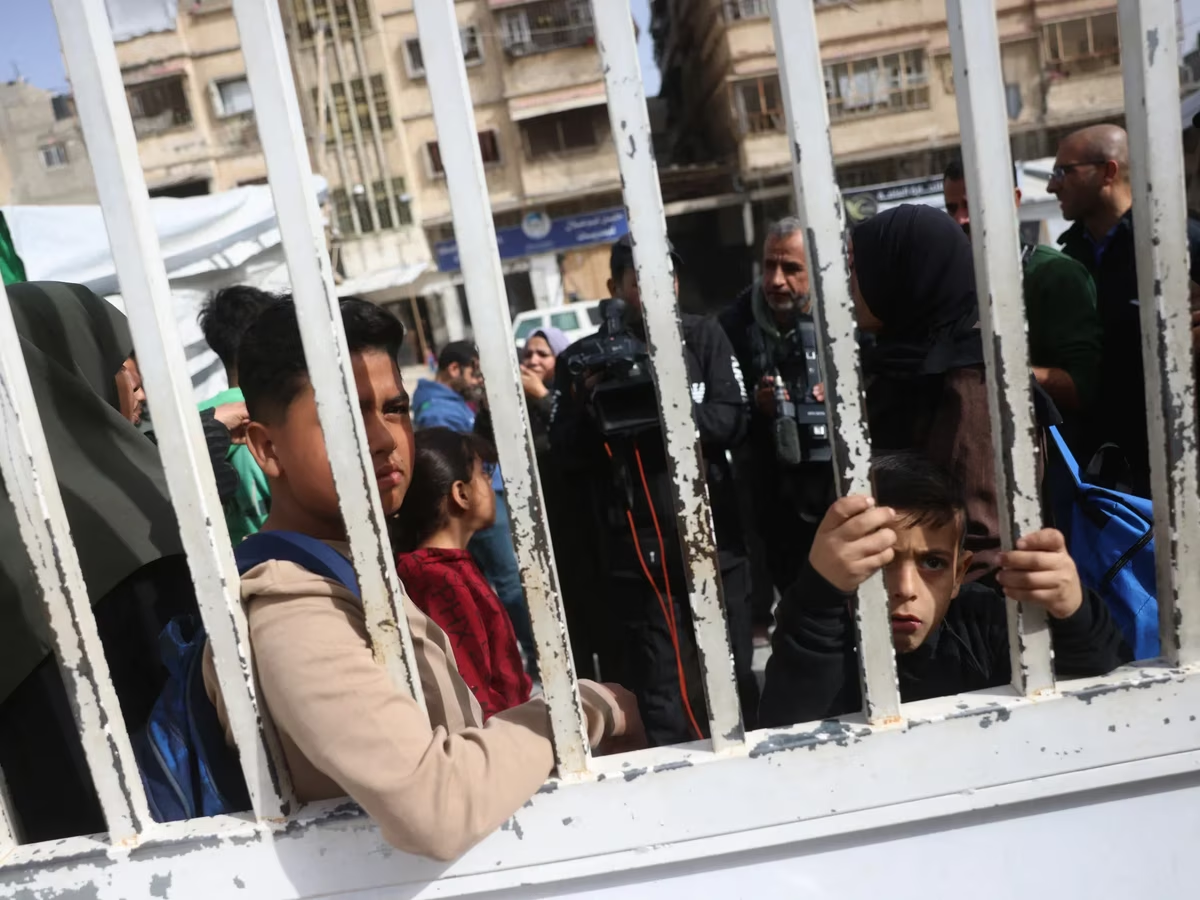







Coinciding with the entry into force of the second phase of the ceasefire agreement, the Israeli occupation is attempting to establish new realities in the Gaza Strip, centered on controlling the movement of travelers through the Rafah crossing and escalating field targeting under various pretexts. The Israeli aggression on Gaza yesterday, Wednesday, led to the martyrdom of 24 Palestinians, while the occupation tried to prevent the travel of sick people among the few allowed to leave the Strip. Observers view the latest field developments as an Israeli plan to empty the ceasefire agreement of its content.
The latest statistics published by the Government Media Office in Gaza reveal that the Israeli occupation has violated the ceasefire agreement 1520 times since its signing on October 10th, resulting in 556 martyrs, 1500 injured, and the arrest of 50 others. Over 115 days, the occupation also allowed the entry of 29,663 commercial trucks, aid, and fuel, out of 69,000 trucks that were supposed to enter based on the humanitarian protocol, a compliance rate of no more than 43%.
The Government Office listed a series of Israeli violations of the ceasefire agreement, most notably: the occupation's failure to adhere to withdrawal lines, encroaching on more kilometers across the Strip, refusing to allow in necessary materials for infrastructure repair, and preventing heavy equipment designated for rubble removal and retrieving the bodies of martyrs. It also failed to comply with the passage of health supplies and medicines, prevented the entry of tents, and the Rafah crossing was not opened as agreed, with the continued disruption of the power plant's operation.
Writer and political analyst Wissam Afifa says that the increased pace of Israeli escalation and the obstruction of the Rafah crossing cannot be separated from the broader context of the occupation's management of the post-ceasefire phase, where it treats the crossing as a political pressure tool. He explained in an interview with press sources that the travel ban decision that affected the sick yesterday confirms that the opening was selective and temporary, aiming to impose a fait accompli that links humanitarian facilities to political and security conditions, primarily the disarmament of the resistance.
For his part, security researcher Rami Abu Zubaida believes that the occupation's continuous obstruction of the Rafah crossing reflects its endeavor to turn it into a bargaining chip in exchange for political concessions. He pointed out that the entry into the second phase coincides with Benjamin Netanyahu's attempt to impose a new geographical reality by establishing the 'Yellow Line' which devours more than 50% of the Strip's area, with the aim of transforming Gaza from a political issue into merely a humanitarian file placed under the guardianship of the so-called American Peace Council.
Abu Zubaida warned that the intense military escalation aims to break popular support and push Palestinians to accept a reality of diminished sovereignty under the weight of hunger. He stressed that what Netanyahu's government is doing represents a 'flight forward' by emptying the agreement of its content and turning it into a long process of attrition, awaiting a moment of surrender that the occupation seeks to impose on the Palestinian people.
The occupation treats the Rafah crossing as a political and security pressure tool, not a humanitarian outlet, and seeks to gradually impose a fait accompli in Gaza.
שתף את דעתך
Second Phase of De-escalation: Rafah Crossing Becomes a Blackmail Tool, and the Occupation Establishes New Field Realities