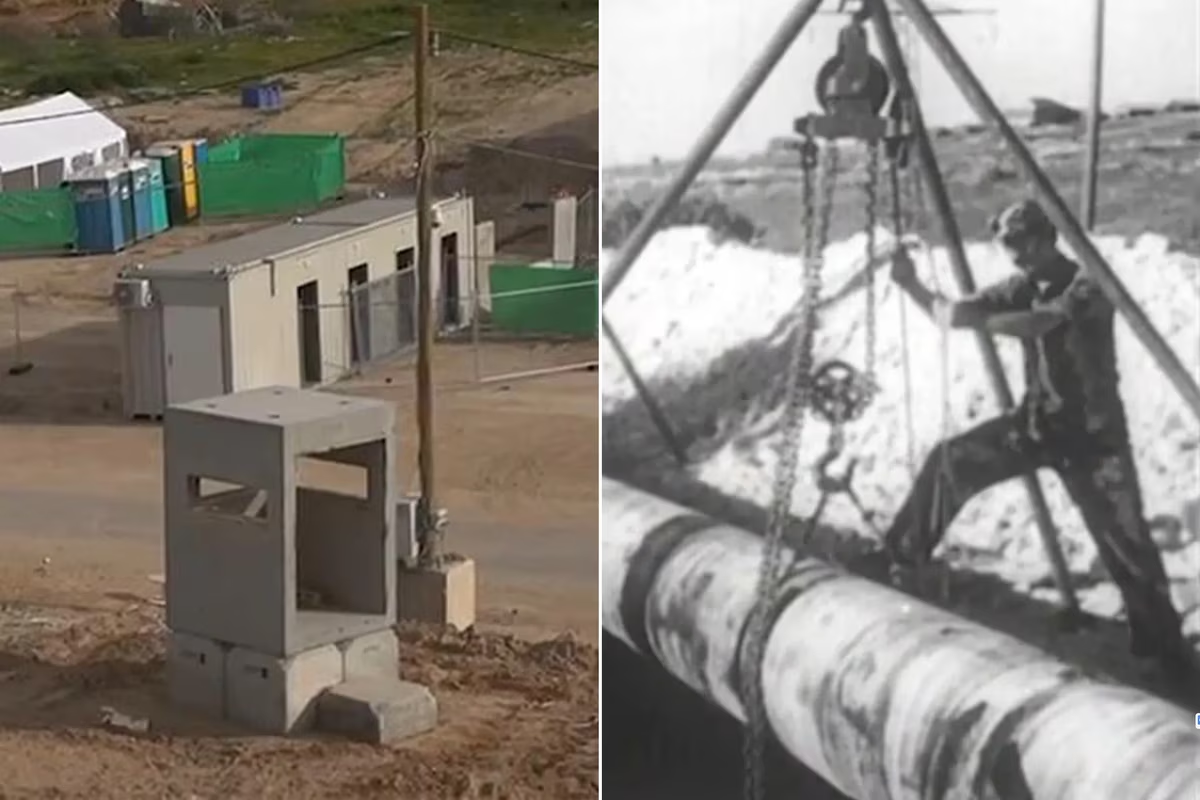







While the world awaited the opening of the Rafah crossing to be a humanitarian gateway after 18 months of closure, Israel was putting the final touches on the 'Regavim' corridor, a checkpoint that quickly turned into a center for interrogation, abuse, and humiliation. While the Israeli army markets the project as a technical measure, initial testimonies, images, and the contexts of choosing the Hebrew name reveal a reality aimed at consolidating absolute control over land and people. The Israeli army announced earlier this month the establishment of the 'Regavim' security corridor at a distance not exceeding 5 kilometers from the checkpoint for those returning to the Gaza Strip. The army manages the complex, which is equipped with advanced scanning and surveillance systems. Travelers are subjected to procedures to match identities with Israel's security lists, in addition to a thorough baggage inspection by X-ray in an area under full military control.
This report, prepared by sources, highlights the Israeli army's design of the security corridor and how it affected the passage of the first human batches through its gates. It also addresses the context of its Hebrew naming and its controversial historical contexts.
Satellite images and field footage broadcast by the army indicate that the security point was designed to be a fortified military barracks, including inspection gates and a concrete observation post directly overlooking Salah al-Din Street in Rafah.
This point is linked to a vast military site that includes vehicles, pockets, and tents for soldiers, surrounded by high earth berms in an area that witnessed extensive demolition and sweeping operations. While the army markets the corridor as part of 'strengthening control,' the first human batches that crossed the gates last Monday revealed another face of the corridor. Among dozens of waiting people, only 12 Palestinians (9 women and 3 children) were allowed to enter, after a journey of torment that lasted nearly 20 hours. A Palestinian woman recounted in a video testimony the details of what she described as 'harsh interrogation,' confirming that the soldiers blindfolded them and tied their hands for long hours, before subjecting them to questioning about issues unrelated to them. The woman mentioned that one of the interrogators threatened her with depriving her of her children in an attempt to blackmail her and recruit her to work for Israel, in a scene that reflects the transformation of the crossing from a humanitarian corridor to a tool for security and psychological pressure.
The matter does not stop at security procedures; the name 'Regavim' carries deeper connotations that go beyond routine language, as this term is closely linked to the literature of the Zionist movement, specifically a poem and children's song titled 'A Dunam Here and a Dunam There' by the poet Yehoshua Friedman. It served as an anthem for the early settlement movement, and its words glorify the gradual acquisition of land with the phrase 'clod of earth after clod of earth' (regev akhar regev). Beyond historical symbolism, the name has a direct line to the current architects of Israeli annexation policies, specifically the extremist right-wing settlement organization 'Regavim.' This organization, co-founded in 2006 by current Finance Minister Bezalel Smotrich, is the driving force behind the expansion of Israeli control in the West Bank. A journalistic investigation had revealed how this organization effectively transformed into a parallel intelligence arm of the state, using drones to map and demolish Palestinian structures, the same approach that Israel seems to be trying to replicate today at the southern Gaza gate, to establish a new reality that integrates military control and settlement ideology.
The corridor has transformed from a technical measure into a tool for security and psychological pressure, where travelers are subjected to harsh interrogations and blackmailed under threat.
שתף את דעתך
'Regavim' Corridor in Rafah.. From a Settlement Anthem to a Barracks for Interrogation and Abuse