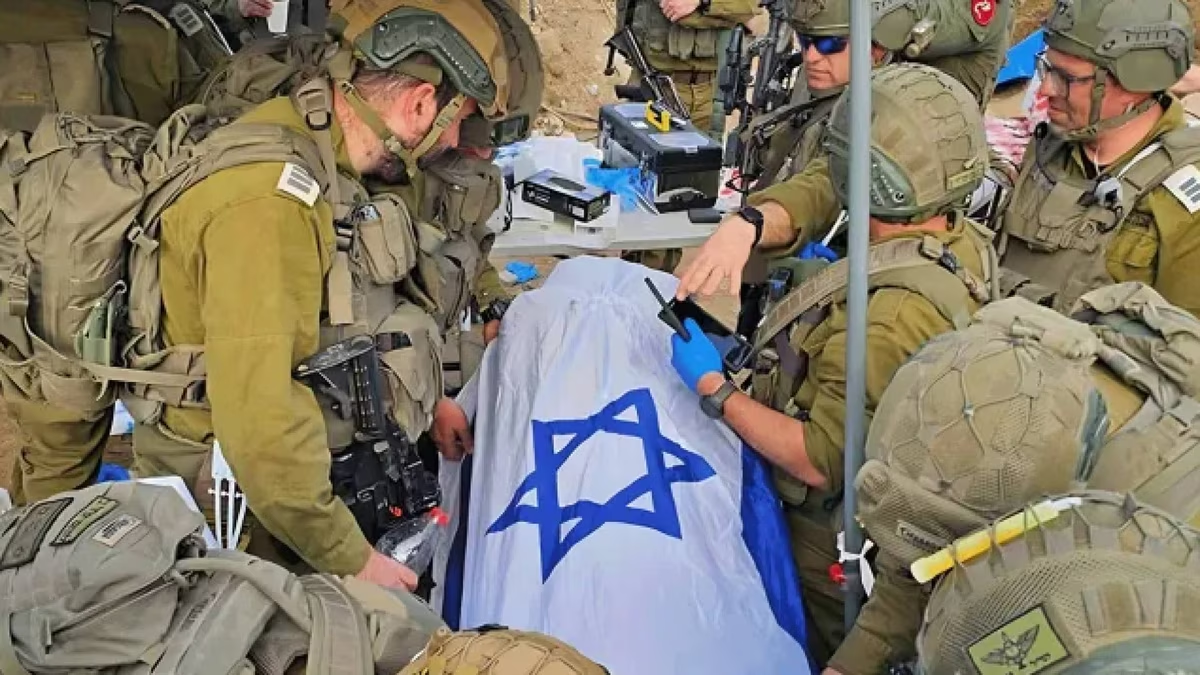







A paradox that reveals a "disparity in the value of a human being" even in their death, in a scene that summarizes the peak of moral and humanitarian contradiction in the Gaza war, the occupation mobilized its massive military machinery for two full days, committing a blatant violation of the sanctity of the dead by exhuming and bulldozing more than 250 graves in the "Al-Batsh" cemetery in the Al-Tuffah neighborhood, east of Gaza. All this destruction and mobilization had only one goal: to find the body of one soldier, "Ran Gvili," who has been missing since October 2023. This operation, celebrated by Tel Aviv as an "unprecedented achievement," in contrast, exposed a painful truth and an undeniable paradox, raising a resounding question: What about the dignity of more than 10,000 Palestinian martyrs who are still buried under the rubble for months, without the world moving a finger to honor them with a proper burial?
Violation of 250 Palestinian graves.. and the world remains silent. Under heavy fire, the occupation forces did not hesitate to bulldoze hundreds of graves containing the remains of Palestinian martyrs and dead, in a behavior described by human rights activists as a blatant assault on human dignity even after death. While the occupation exerts enormous intelligence and military efforts to recover the remains of its dead, the bodies of thousands of Palestinians, including women and children, are left to decompose under the rubble of destroyed buildings, amid an international inability to impose a humanitarian truce that would allow their extraction. This is a paradox that reveals a "disparity in the value of a human being" even in their death, where one body becomes a national and military priority, while tens of thousands of victims on the other side are neglected.
The dead as political bargaining chips. The paradox did not stop at the military implementation; reports revealed political complicity within Benjamin Netanyahu's government. Despite accurate information about the location of Gvili's body being available for weeks – information provided by the resistance to mediators – the political level of the occupation delayed the "green light" for the operation. Analysts indicate that this delay was deliberate to link the issue of the body to other political bargains, such as obstructing the opening of the Rafah crossing or manipulating the exchange deal file, which transformed the issue from its alleged humanitarian dimension into a cheap political pressure tool.
The illusion of "military pressure." While the occupation tries to market this operation as evidence of the effectiveness of "military pressure" in recovering prisoners, the numbers belie this claim. The military option has only saved 8 living prisoners since the beginning of the war, while it led to the death of 41 other Israeli prisoners, some by their own army's fire. In contrast, negotiations and mediations succeeded in recovering 126 prisoners, which confirms that military operations, such as the exhumation of the Al-Tuffah cemetery, are often more performative and destructive than life-saving. The image of the bulldozed cemetery in Gaza remains a testament to a time when even the right of the dead to eternal rest is subject to double standards and ruthless political calculations.
Testimonies from the heart of the tragedy. Ahmed Al-Masry (50 years old), a resident of Al-Tuffah neighborhood, says with words of pain, "I came to check on the graves of my brother and children.. I couldn't even get close, everything is destroyed and ashes, I can't believe how there can be such a huge effort to find the body of a soldier, while our relatives and loved ones are under the rubble. I saw the graves shattered as if death no longer respects itself.. every memory erased, this is an indescribable feeling, pain, sadness, and anger at the same time, where is the dignity of the dead?"
He adds, after a sigh that describes the extent of oppression, "My children are buried in Al-Batsh cemetery, east of Gaza City. I found their graves completely excavated and demolished. I felt helpless and let down. The world watches and remains silent while our souls are treated as if they are nothing. How can an entire army be dedicated to one body while thousands of dead are left without any respect? The sounds of shelling and dust remind us that death in Gaza has no limits."
The pain is not much different for citizen Maysoun Ibrahim, who expresses: "My mother was buried in Al-Batsh cemetery years ago, and we were surprised that her grave was completely destroyed and we found no trace, as if memory itself had been erased. I feel a lump in my throat that never leaves my heart, as her loss has become heavier amidst this destruction."
"The exhumation, bulldozers, and destruction made me feel completely helpless, as if our whole lives are treated as if they are nothing, for the dead need dignity even after their departure."
A paradox that reveals a 'disparity in the value of a human being' even in their death.
שתף את דעתך
The paradox of death in Gaza.. an entire army to recover a body for the occupation and 10,000 martyrs under the rubble without graves