





The two-state solution is the only way out for the Palestinian issue.
The Gaza Strip is an integral part of the Palestinian territories.
I will not forget the smell of Mansaf, the sweetness of Knafeh, and the hustle and bustle of Al-Tira Street.
I echo the Chinese poet's saying: Let us all strive towards the goal, despite the distances.
Wherever I am in the future, Palestine will remain in my heart forever.
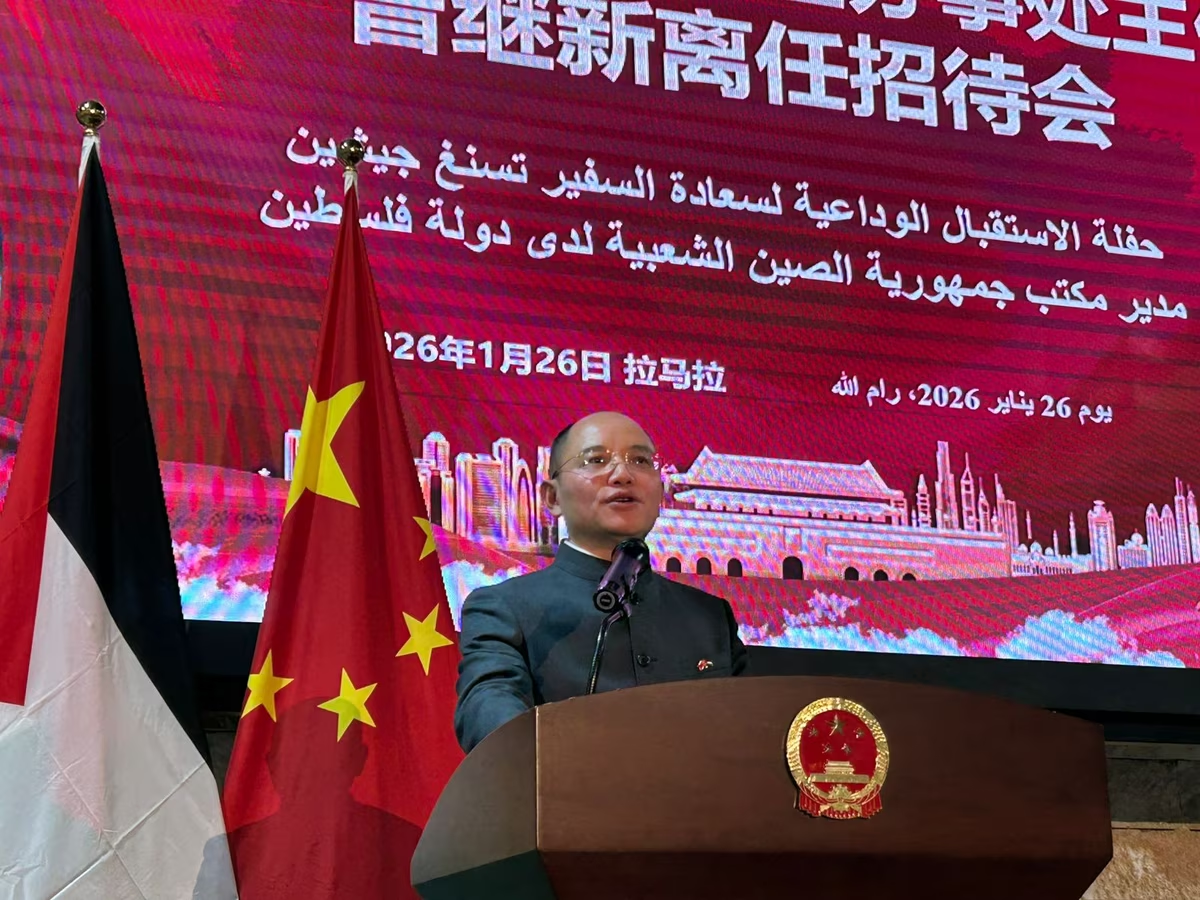
Ramallah - Exclusive to "Al-Quds" - At the farewell reception for the Ambassador of the People's Republic of China to Palestine, Zeng Jishin, held yesterday in Akka Hall at the Carmel Hotel in Ramallah, discussions focused on the constants of the Chinese position on the Palestinian issue, and that the two-state solution remains the only way out, with emphasis on Palestinian unity being a crucial condition for any viable political path, and that Gaza is an integral part of Palestinian land according to the principle of "Palestinians govern Palestine."
While Palestinian leaders, in private conversations with "Al-Quds," recalled historical milestones in relations with Beijing and the accompanying political, material, and structural support, an approach was also put forward that sees the world moving towards greater pluralism, and that what is required is to transform partnerships with China from slogans into action plans, economically, technically, and culturally, thereby enhancing the presence of international law and preventing the decline of the United Nations system.
In an exclusive interview with "Al-Quds," the Chinese Ambassador affirmed that the biggest obstacle, in his view, to transforming the two-state solution into a viable path does not negate the fact that it has become one of the common constants of the international community, stressing that despite the current challenges and difficulties, he believes that the two-state solution will "certainly" be achieved, and that it is the only way out for the Palestinian issue, expressing his full confidence in its possibility of achievement in the future.
Regarding China's next international step, the Ambassador explained that international interest and support for Palestine are increasing, citing what was reflected in the recent international conference on the two-state solution, adding that the crucial condition for achieving the two-state solution and establishing an independent Palestinian state is to strengthen internal Palestinian unity, and in this context, he said that the Chinese side has made intensive efforts.
Regarding the principle of "Palestinians govern Palestine," Zeng Jishin stressed that the Gaza Strip is an integral part of the Palestinian territories, and that any plan related to the administration of the Strip must be consistent with the principle of Palestine being governed by Palestinians, affirming that China is making efforts to implement this principle.
At the end of his speech, the Ambassador extended his warm greetings to the readers of "Al-Quds" newspaper, and said that he had visited all eleven governorates of the West Bank, and felt good and genuine feelings from the Palestinian people towards the Chinese people, expressing his wishes for the Palestinian people for unity and the achievement of national liberation.
Extended support from revolution to state
For his part, Azzam Al-Ahmad, Secretary of the Executive Committee and member of the Central Committee of the Fatah movement, said that his assessment of "China's effectiveness" as a mediator or political guarantor stems from a firm conviction that China, "when it is a friend, is fair in its friendship," stressing that Palestinian-Chinese relations preceded even the start of the Palestinian revolution, as the Fatah movement began building relations with Beijing before the revolution, and then deepened after the establishment of the Palestine Liberation Organization, when the late President of the Organization, Ahmed Al-Shukeiri, visited China, after which a wave of broad support for the Palestinian revolution began, including military, political, and material assistance.
Al-Ahmad explained that this relationship was not interrupted, but rather developed continuously with the development of events, pointing out that the first embassy opened for the PLO, and the first office for the Fatah movement, was in China even before Arab countries. He added that China has today become one of the most prominent supporters of the Palestinian Authority and the State of Palestine, affirming that it provides assistance that exceeds what other countries provide, both materially and in terms of supporting the building of infrastructure for the Palestinian state. In this context, he pointed out that the "latest donation" made by China to the Gaza Strip amounted to 100 million dollars, considering this a precedent that reflects the nature of Chinese assistance to its friends.
Regarding China's transition from hosting meetings to supporting implementation mechanisms and guarantees for reconciliation or for stabilizing a political path linked to the two-state solution, Al-Ahmad highlighted that Beijing hosted Palestinian factions three times with the aim of urging them to achieve national unity within the framework of the Palestine Liberation Organization, based on a Chinese conviction that unity "shortens the path towards achieving freedom and ending the occupation," a conclusion that China says it has learned from its experience. He concluded by emphasizing the continuation of communication with China, expressing pride in the Palestinian-Chinese relationship and friendship.
Beijing's initiatives intersect with international legitimacy and reliance on support in forums
In the same context, Dr. Ahmed Majdalani, member of the Executive Committee of the Palestine Liberation Organization, said that the Palestinian follow-up of the Chinese file stems from a conviction that the People's Republic of China, under the leadership of its president, has put forward more than one initiative at the international level to address the Palestinian issue. He explained that Chinese initiatives, especially what he described as the "four points" which include Israeli withdrawal, the establishment of a Palestinian state, and guaranteeing security for all parties, essentially intersect with the Arab Peace Initiative and relevant international legitimacy resolutions, pointing out that Palestinian-Chinese coordination is taking place at the highest levels, and that there is continuous political consultation, in parallel with a remarkable development in bilateral relations between the two countries.
Majdalani affirmed that relations with China are "historical, strong, and deep," noting that Beijing was one of the first countries to recognize the Palestine Liberation Organization, and then recognized the Palestinian state, which is reflected in various aspects of the relationship between the two parties. Regarding the Beijing dialogue and Chinese efforts in the reconciliation file, he said that the Palestinian leadership thanked China for its efforts, and considered them "sincere" efforts, but he stressed that the results do not depend on the Chinese side as much as they are related to the internal Palestinian situation.
In this context, Majdalani pointed out that the Hamas movement, in his estimation, did not want a comprehensive Palestinian-Palestinian dialogue, as much as it tended towards a bilateral dialogue between it and China, which made him believe that it was not concerned with the results or their implementation. He concluded by emphasizing that the main Palestinian demand from China focuses on continuing its international efforts to support the Palestinian cause and Palestinian rights in various international forums, in addition to continuing coordination with the Palestinian side at all levels.
Qualitative cooperation and the gateway through field assessment then projects in communications, education, and health
On the practical cooperation front, Dr. Sabri Saidam, member of the Central Committee of the Fatah movement, said that expanding cooperation with China in technology, artificial intelligence, and clean energy should begin with a practical step agreed upon with the government of the People's Republic of China, which is to organize an evaluation visit for a Chinese delegation to observe the reality of technology in Palestine and the possibilities of cooperation. He explained that this visit is supposed to take place through the embassy, and in coordination with the working teams in the relevant Palestinian ministries, with the aim of identifying "intervention projects" capable of making a clear impact in the next stage.
Saidam stressed that the Palestinian leadership is accelerating its steps to encourage this type of cooperation, considering it qualitative cooperation, especially since China, as he described it, has entered the "second generation" of the world of artificial intelligence. Regarding the projects that can be implemented during 2026, he said that the realistic focus should be on three main tracks that China believes it has made great strides in, namely communications, education, and health, considering that the selection of projects within these axes must be done in coordination with the Palestinian government, and in a way that ensures their alignment with the Palestinian situation and their transformation from scattered initiatives into a sustainable institutional work program.
International pluralism, a louder Chinese voice, and an action plan for the strategic relationship
In a broader reading of the international scene, Dr. Muhammad Shtayyeh, member of the Central Committee of the Fatah movement and former Prime Minister, said that the ongoing transformations in the international system have become clear, as he believes that the world is moving from a unipolar system and American hegemony towards greater pluralism, citing what the Canadian Prime Minister said at the Davos Forum as an indicator of a "turning point" in international politics, and considering that the United States has lost even some of its closest allies, such as Canada and parties in Europe.
Based on this diagnosis, Shtayyeh considered that China is required today to "fill some of the vacuum" that the decline of the unipolar system will leave, and to continue to play its role with a "loud and clear voice" in the United Nations in support of the Palestinian cause and Arab issues. At the same time, he called for developing Arab-Chinese relations to go beyond trade towards investment, then to the fields of culture, cultural exchange, joint delegations, and technical issues, leading to investment in technology, thereby creating a deeper and broader partnership.
Specifically on the Palestinian-Chinese issue, Shtayyeh referred to President Mahmoud Abbas's recent visit to China, and the Chinese President's announcement of the desire to establish a strategic relationship between China and Palestine, stressing that what is required from the Palestinian side is to move this relationship from the level of a slogan to implementation through a clear "action plan," based on dialogue about the soundest and most correct foundations for building this strategy. He stressed that Palestine needs China as a "friend and ally" and a "voice" in the United Nations, within a broader vision to preserve a multipolar world order.
In the context of his vision for the role of the United Nations, Shtayyeh attacked what he called the "Peace Council" and considered it a "lie" and described it as a "war council against the world," saying that there is a tendency to use Gaza to produce an alternative system to the United Nations and create a new world order, which he rejects. He affirmed his adherence to the continued existence of the United Nations as a platform for pluralism and a protector of international law and international legitimacy, warning against the "erosion" of international law and the harm it causes to the world, and stressing that international law is the champion of the weak, and that he does not want a world ruled by the strong because "the strong do not know justice," while justice, according to him, is the law.
A global center of gravity is needed to protect international law and effectively support Palestine
In an approach that aligns with this concern for pluralism, Dr. Hanan Ashrawi, Chair of the Board of Trustees of Birzeit University and former Executive Committee member, said that the challenge facing China and the rest of the world lies in attempts to "eliminate the existing system of pluralism," referring to what she described as clear American attempts, led by the Trump administration, to target the United Nations with its institutions and branches, and to seek a return to the logic of a unipolar world.
Based on this, Ashrawi stressed that what is required from China and countries that are not within the orbit of the United States is to strive to create a "center of gravity" and power capable of confronting these developments, which she described as dangerous, and the accompanying decline in human rights and international law. She added that the expected role of China at this stage is to provide "real" support to targeted countries, foremost among them Palestine, affirming that China has a long history of supporting the Palestinian cause.
Ashrawi believed that tangible political impact is not achieved merely through positions, but through pushing for the formation of this international "bloc" that prevents the world from sliding towards a unipolar world where there is no place for respect for international law or the rights of the victim, but rather where only power, control, and hegemony prevail. She concluded by affirming that she sees steps already underway to form this bloc, through the development of a global program and action plan.
Brotherhood embodied in the street and a ring road crossing Area "C"
On the municipal and tangible projects front, Issa Qassis, Mayor of Ramallah, said that the relationship with China is not limited to a specific project, but rather it is an "old, new, renewed" relationship, affirming that China has been a constant supporter through projects he described as affecting the destiny of the Palestinian people. He considered that the relationship of the Ramallah municipality with China is a relationship of brotherhood embodied in symbolic and field milestones, including the "Palestinian-Chinese Friendship Square" with the approval of President Mahmoud Abbas and the Chinese President, in addition to China's funding for infrastructure projects, schools, and other projects whose impact citizens feel in the street.
Qassis explained that the municipality recently completed with China the opening of the second section of the connecting road, and that the next project is the third section, a project presented to the Chinese Ambassador whom the municipality is bidding farewell to today and thanking for his support and understanding, along with his technical team, government, and the Chinese people. He added that there is an ongoing project that they hope will be approved, as it is part of a ring road connecting the city of Ramallah with the Palestinian countryside and surrounding cities, thereby enhancing the movement of citizens and goods, pointing out that this road passes through vital and dangerous areas classified as "C," but he said that the street "pierces through them with the pride and vigor of China."
Regarding the obstacle of areas classified as "C" and their impact on the implementation of internationally funded projects, Qassis affirmed that the municipality operates on the principle of "imposing a fait accompli," explaining that it does not view the classifications "A," "B," and "C" as a reference in its work, and that it does not want to see Palestinian geography according to this classification.
Jerusalem under the test of facts, and China's bet on steadfastness in international legitimacy
From Jerusalem, Dr. Ratiba Al-Natsheh, member of the political bureau of the Fida Party and member of the National Action Body in occupied Jerusalem, said that the most urgent Chinese step to protect Jerusalem and its institutions and stop the change of reality on the ground is to adhere firmly to the principles of justice and international integrity, and to push for the enforcement of United Nations resolutions and international legitimacy, especially with regard to the Palestinian issue and Jerusalem in particular. She considered that this approach constitutes protection in the face of what she described as Israeli attempts to impose new facts to change the geopolitical reality in the region, including Jerusalem, and thereby affect the solution of the Palestinian issue, pointing out that Israel, through the United States, is trying to circumvent United Nations mechanisms through what she called the "Peace Council."
Al-Natsheh added that the presence of a strong international player with firm positions like China is capable of protecting the legitimate rights of Palestinians, including Jerusalem as the capital of the independent Palestinian state.
Regarding Beijing's role in supporting Palestinian unity, Al-Natsheh explained that China does not interfere in internal Palestinian affairs in the sense of exerting pressure to impose a specific Palestinian project, but at the same time, it is one of the countries keen on the Palestinian national project, and has made several attempts to reconcile views between Palestinian parties. She affirmed that Beijing respects Palestinian legitimacy and emphasizes the importance of internal dialogue, considering that its primary role is to maintain consistency between protecting legitimacy and its title, and assisting in managing differences in a way that makes Palestinians stronger.

ג 27 ינו 2026 9:56 am - שעון ירושלים
Chinese Ambassador Zeng Jishin speaks to "Al-Quds" before the end of his mission in Palestine
שתף את דעתך
Chinese Ambassador Zeng Jishin speaks to "Al-Quds" before the end of his mission in Palestine