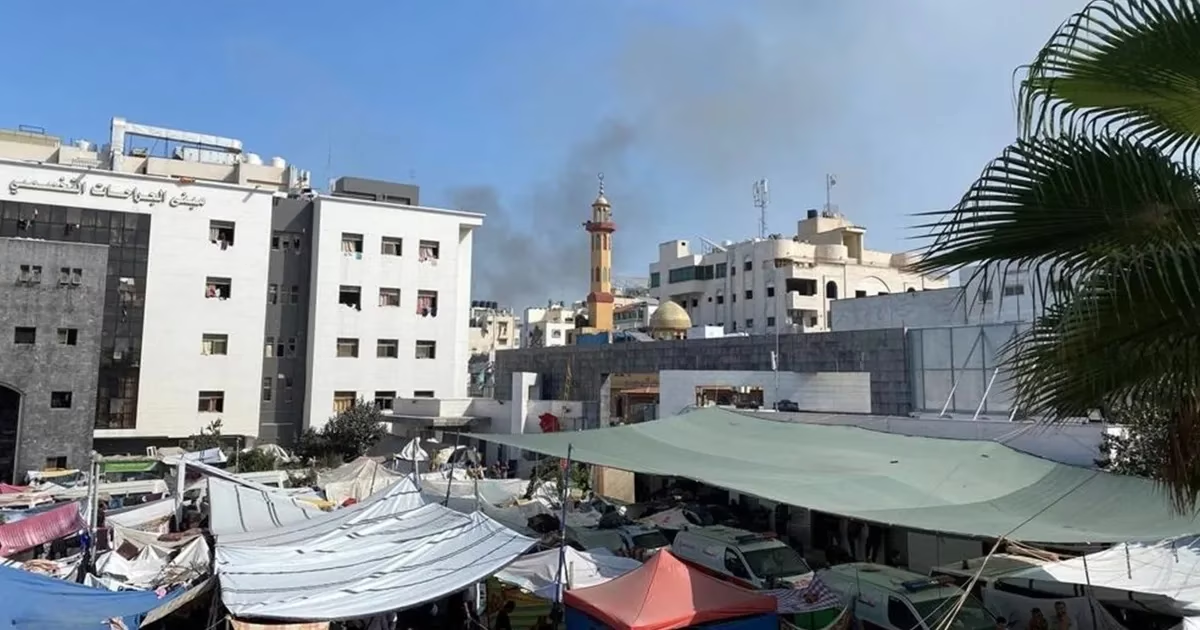







The testimony of a Palestinian doctor who recently returned to the Gaza Strip after more than a year and a half in Israeli prisons reveals the extent of the collapse of the health system in the Strip, in light of widespread destruction, a severe shortage of staff, equipment and medicines, and the continuing repercussions of the war and siege, which puts thousands of patients, including children, at risk of death due to preventable diseases.
Palestinian doctor Ahmed Muhanna returned to the Gaza Strip after 665 days spent in Israeli prisons and detention centers, to be shocked by the extent of destruction he described as beyond imagination, after he found that everything he clung to in his memory had been completely annihilated.
Muhanna, one of Gaza's most prominent emergency medicine and anesthesia consultants, said in a report that what kept him steadfast throughout 22 months of detention was the dream of returning to his family and to the Strip, adding: "We were completely cut off from the outside world in prison." He explained that after his release, he was transported by car across the border and then inside Gaza to Al-Awda Hospital, where he works, and confirmed that the scenes of destruction made his skin crawl and his chest tighten before his tears flowed.
Israeli occupation forces arrested Muhanna in December 2023 while Al-Awda Hospital was under siege, less than three months after his release.
Despite the official ceasefire, the health sector faces a new attack amid an almost complete inability to deal with a wave of preventable diseases and deaths.
Muhanna explained that he returned to a hospital almost devoid of medical staff, equipment, and medicines, noting that 75 of his colleagues at Al-Awda Hospital were martyred during his detention.
According to the Health Workers Watch organization, since October 7, 2023, about 1,200 Palestinian health workers have been martyred, while 384 others have been detained by the Israeli army.
He said: "I feel great pain and sadness for what we are facing," noting that 77 percent of Gaza's population, including 100,000 children, face high levels of acute food insecurity, according to the World Health Organization, while doctors continue to treat children suffering from severe malnutrition with worsening serious medical complications.
According to international human rights organizations, including a UN committee, the occupying state committed genocide in Gaza, and also prevents the entry of humanitarian aid and the systematic destruction of the health system.
Muhanna said that Gaza today does not have a single working MRI machine, and there is only one CT scanner, adding that the deliberate military targeting of the health system was not limited to destroying infrastructure, but also deprived residents of medical care and raised mortality rates.
The United Nations Office for Human Rights stated that 94 percent of Gaza's hospitals have been damaged or destroyed, leaving patients, including newborns, without essential care, confirming that Israel continued, despite the ceasefire, to prevent the entry of medical supplies and nutrients essential for the survival of civilians.
The situation worsened after the occupation government announced the withdrawal of licenses for 37 international non-governmental organizations operating in Gaza and the occupied West Bank, on the pretext that they did not meet the new registration requirements, including humanitarian medical organizations such as "Doctors Without Borders."
The Palestinian doctor pointed to the suffering of cancer patients from the spread of tumors due to the prevention of available treatments, in addition to the increase in kidney failure cases due to the lack of dialysis machines, saying: "I am a doctor, but I am helpless and unable to do anything to help people," although that pushes him to continue working.
Muhanna spoke about being subjected to torture, humiliation, and deprivation of food and medical treatment during detention, referring to a UN report that confirmed the existence of an "actual state policy" of systematic torture in the occupying state. He mentioned that he was initially transferred to the notorious "Sde Teiman" detention center, where he remained for 24 days blindfolded and handcuffed, before being severely beaten during his transfer to a facility in the Negev, which resulted in a broken rib, without receiving any painkillers or medical care.
He confirmed that he witnessed two detainees lose their lives due to the absence of treatment, including a 37-year-old man who showed symptoms of intestinal obstruction, adding that he appealed to the guards to urgently transfer him to the clinic without success, until his condition worsened and he died.
Muhanna said that he suffered from constant hunger due to the lack of food, and recounted that he was placed with 40 detainees in a small tent surrounded by a fence without being allowed to use the bathroom from 4 PM until 5 AM, describing it as a tragedy, and confirmed that no charges were brought against him throughout his detention.
At the end of his speech, Muhanna expressed his deep concern for the future of his children, saying that he sees no future for them in Gaza, and that he wishes them safety, education, and work, adding: "When I am not in the hospital, I try to think of a place for us to go together, but there is no place, no green spaces. Gaza was full of life, restaurants and beaches, but now nothing is left."
I am a doctor, but I am helpless and unable to do anything to help people.
שתף את דעתך
After 665 days of detention.. A Palestinian doctor's testimony about his shock at the health reality in Gaza