






The question of opening the Rafah Crossing remains one of the most complex and sensitive files in the Israeli political and security scene, as it intersects with direct American pressure and the internal coalition calculations of Israeli Prime Minister Benjamin Netanyahu, who is wanted by the International Criminal Court on charges of committing war crimes in Gaza.
While Washington insists on opening the crossing in both directions for humanitarian and political reasons, Netanyahu finds himself forced to maneuver between the requirements of his American ally and the threats from his partners in the ruling coalition, who see opening the crossing as an unacceptable concession.
Israeli political estimates indicate that Netanyahu is likely heading towards opening the Rafah Crossing, even if partially or intermittently, in an attempt to "grasp the stick from the middle." The man does not want to enter into direct confrontation with the American administration, especially President Donald Trump, and at the same time seeks to avoid the disintegration of his government coalition from within.
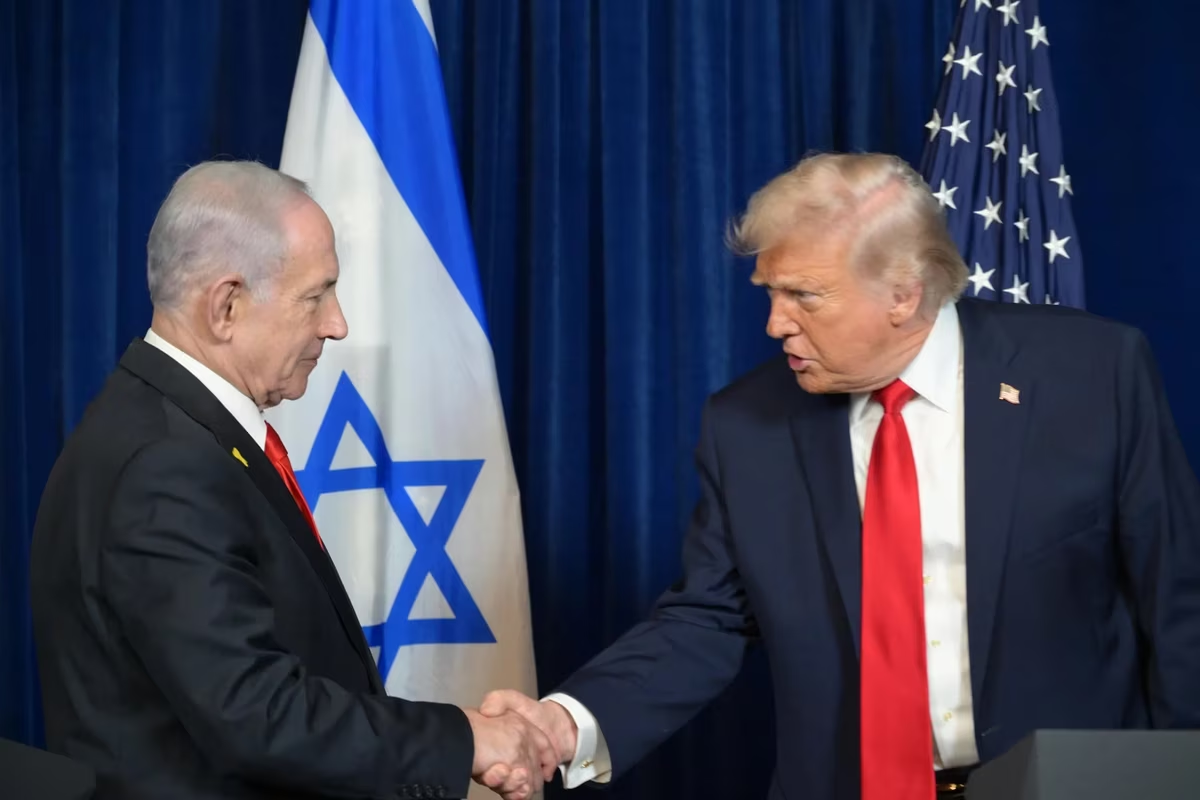
Based on understandings reached by Netanyahu and Trump during their last meeting at Mar-a-Lago resort in Florida, which stipulate opening the crossing after Netanyahu's return to Tel Aviv.
The main obstacle to implementing this step lies in the strong opposition expressed by far-right parties within the coalition, headed by the "Otzma Yehudit" party led by National Security Minister Itamar Ben-Gvir, and the "Religious Zionism" alliance led by Finance Minister Bezalel Smotrich.
Before Netanyahu's trip to America to meet Trump, Ben-Gvir and Smotrich explicitly threatened to withdraw from the government if Netanyahu proceeded to open the crossings, considering it an assault on what they call "Israeli security."
In contrast, American pressures escalated during Netanyahu's meetings in the United States, where officials in the Trump administration emphasized the necessity of opening the Rafah Crossing "in both directions," linking it to broader plans related to the humanitarian situation in Gaza and "Trump's plan" and post-war arrangements.
Opening the Rafah Crossing has become a "matter of time" after the step was postponed before Netanyahu's trip to Washington for internal political reasons, and an American official was quoted as saying that the announcement of opening the crossing may be issued within a few days directly after Netanyahu's return to Israel.
In the context, it was mentioned that clear understandings were achieved between Netanyahu and Trump, including not only opening the crossing but also starting reconstruction work in the Rafah area south of the Gaza Strip, in areas where the Israeli army claims it has ended most of the military infrastructure of the Palestinian resistance.
The most likely scenario is Netanyahu resorting to a policy of political and security compensation for his opposing partners. Instead of abandoning opening the crossing, he may offer them "prices" in other arenas, with the aim of keeping them within the coalition and avoiding early elections. This price could come in various forms, including:
A broader military escalation against Hamas in Gaza, to market opening the crossing as a "tactical measure" that does not affect deterrence.
More military and settlement encroachment in the West Bank as a reassurance message to right-wing parties and Smotrich, the sponsor of the "Decisive Plan" based on the vision of "Greater Israel" between the sea and the river in all historical Palestine.
Expanding the circle of regional confrontation, whether through strikes in Lebanon or operations against direct or indirect Iranian targets, within what Netanyahu calls a "multi-front battle."
In the end, according to Israeli estimates, Netanyahu's inclination to open the Rafah Crossing is not a conviction in itself, but a result of complex balances imposed on him by American pressures on one hand, and fears of coalition disintegration on the other.
According to Israeli analyses, opening the crossing—if it happens—will likely be a limited step accompanied by escalation or concessions in other arenas, in an attempt to maintain the government's survival and meet Washington's demands without losing his right-wing allies.
Retired Colonel Mikhail Milstein, former head of the Palestinian Affairs Department in the Military Intelligence Division of the Israeli Army (Aman), sees Hamas viewing the decision by Trump and Netanyahu to open the Rafah Crossing as a "major political and moral achievement in its favor."
In his comment, Milstein said that "reports talking about American-Israeli understandings to open the crossing in both directions are presented in Hamas's internal discourse as evidence of its success in imposing new equations after the war, and marketed as a step that restores the Gaza Strip to what it was before October 7."
Milstein says that "the essential question for Israel does not relate to symbolism only, but to the practical implications on the ground."
He wondered: "What will Israel do if it detects the entry or exit of elements it does not want to exist? And how can the movement of individuals be controlled in a crossing that is supposed to be open in both directions?"
In contrast, military correspondent for the Walla website Amir Buchbut expressed a great deal of caution regarding these reports, noting that there is no official and final confirmation yet regarding the opening of the Rafah Crossing, at least from the Israeli government, large circles of which oppose this step.
The military correspondent clarified that the picture may become clearer with Netanyahu's return to Israel, but what is happening "behind the scenes" in the corridors of the coalition parties remains surrounded by large question marks.
Buchbut raised a series of questions he described as essential, such as: Will opening the crossing be limited to pedestrians or will it include goods? Who will oversee security inspections? And how will Israel ensure the prevention of smuggling weapons or materials of military use into the Gaza Strip?
The military correspondent even went further, wondering how the Israeli government could agree to open the crossing amid the file of recovering the body of the last abducted soldier in Gaza, Major Ran Guili.
Between Milstein's reading, which sees opening the crossing as a direct gain for Hamas, and Buchbut's skepticism, which highlights the security and political ambiguity, it becomes clear that the Rafah Crossing remains an open file on complex possibilities that go beyond the decision to open itself to the strategic implications it carries for Israel and the region as a whole.
The question of opening the Rafah Crossing remains one of the most complex and sensitive files in the Israeli political and security scene.
שתף את דעתך
Rafah Crossing Disrupts Netanyahu Government's Balances