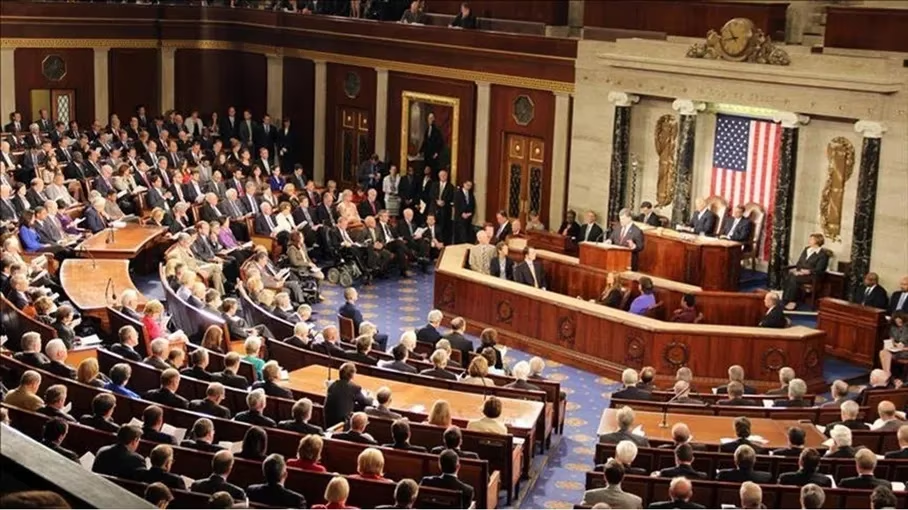







The American Israel Public Affairs Committee (AIPAC) launched a broad public campaign to assert its dominance in the previous electoral cycle, spending more than $100 million on the 2024 elections to oust critics of "Israel" from Congress.
AIPAC spent more on elections in that cycle than any other single-issue lobbying group; it celebrated its affiliated political action committee, the United Democracy Project, as "one of the largest bipartisan political action committees in America"; and attributed to itself the credit for supporting 361 pro-"Israel" candidates who won in hundreds of electoral races.
This success was met with widespread public outrage over Israel's genocide in Gaza, leading to a violent backlash and igniting a growing movement to eliminate AIPAC's influence and support independent candidates for Congress committed to rejecting support from pro-Israel lobbying groups. Now, with the 2026 midterm elections approaching, AIPAC and its preferred candidates have retreated from the aggressive electoral strategy they pursued in previous elections.
This does not mean AIPAC intends to relinquish its influence. While the group has not officially endorsed any new candidates in this electoral cycle, there is still plenty of time, and it is working covertly to bolster its preferred candidates' campaigns. For example, AIPAC's board chairman held a fundraiser earlier this month for a congressional candidate in Illinois, who publicly stated she is not seeking the group's endorsement. In another district in the same state, AIPAC donors rallied support for a real estate mogul's bid for Congress.
These moves represent the latest in a series of strategic adjustments AIPAC has made in recent years amid the changing political landscape regarding Israel-related issues.
Former Democratic Representative Mary Newman from Illinois, whose ouster in 2022 was aided by pro-Israel donors, said: "They fully realize their image is at rock bottom."
At this point in the previous electoral cycle, AIPAC had already endorsed most of its candidates. But with an increasing number of candidates adopting the slogan of rejecting AIPAC money and attacking those who receive it, the group is returning to a quieter strategy it used for years to enhance its influence.
Newman added: "AIPAC has a bad reputation across the country. When they knock on doors and participate in campaigns and events here, they find ordinary centrist Democrats saying: 'No, no more AIPAC support and no more corporate political action committee support'".
Lara Friedman, president of the Foundation for Middle East Peace, said that merely refusing AIPAC money will not be enough to be the new standard for progressive candidates for long.
Friedman added that abstaining from receiving the group's money "means nothing" in itself. "What will matter is the candidates' positions, or incumbents seeking re-election, on the issues at hand. And as it becomes clear that AIPAC will bypass the 'people don't want our money' argument and find other ways to support candidates, the real question will be: what is people's stance on the issues that serve as a real litmus test for AIPAC?"
It seems California Governor Gavin Newsom has taken note of this anti-AIPAC trend. During a press tour amid rumors of his potential presidential run, Newsom stated earlier this month that he would not accept any money from this group. In October, Newsom said on the "Higher Learning" podcast: "I haven't thought about AIPAC in years, and it's interesting that it's the first thing they mention."
Despite Newsom's statements, his record on Israeli policy raises questions about his willingness to align with the Palestinian cause. He has celebrated accolades from far-right pro-Israel groups like the Anti-Defamation League, and in his last two public statements commemorating the October 7 attacks, he did not mention the Palestinians who were killed. Newsom did not call for a ceasefire in Gaza until March 2024, after both President Joe Biden and Vice President Kamala Harris had done so.
While some Palestine advocates praised Newsom for vetoing an online hate speech bill, which they said would target politically protected speech, Newsom did not cite these concerns among his reasons for the decision. California's powerful tech industry had also hoped he would veto the bill.
Newsom also faces criticism over a controversial bill he signed in October to address antisemitism in California schools, which a coalition of teachers' unions, civil rights organizations, and interfaith dialogue groups sees as restricting legitimate criticism of "Israel" and pro-Palestine voices. Opponents have filed a lawsuit to prevent the law from taking effect on January 1.
Anticipating criticism, other candidates have remained silent on their political stances toward Israel. George Hornedo, who is challenging Democratic Representative André Carson in Indiana, had created a pro-Israel secret page on his campaign website this summer, which was later removed. Hornedo has not publicly stated whether he would accept funding from AIPAC or not, but he declared that his campaign "rejects corporate political action committee funding".
Hornedo said in a statement: "I do not coordinate with any national organizations, nor do I rely on them or seek any financial intervention from them in these elections. This campaign focuses on rallying support directly here in Indianapolis, not on inviting national groups to shape or dictate the elections." He added: "My position on Gaza is clear. Gaza must be flooded with humanitarian aid, and the United States should not supply any country with offensive weapons unless their use complies with international humanitarian law."
Hamid Baig, communications director at the Policy Project of the Middle East Understanding Institute, said: "We are seeing an increase in the number of Democrats abstaining from AIPAC money because it has become an electoral liability." He added: "But it is unclear whether they will maintain this stance by rejecting support from other organizations - and foremost, though not exclusively, the Democratic Majority for Israel - which adopt political agendas similar to AIPAC's, especially regarding providing Israel with more weapons."
In its current approach, AIPAC has returned to a strategy it employed in previous elections, directing money to candidates through other channels to keep its name - and the growing criticisms it faces - out of the electoral race. AIPAC donors have supported their candidates by donating to other undisclosed funding groups that appear unrelated to Israeli politics, such as the "314 Action" political action committee, which helps elect scientists, and which pumped huge sums into the campaign of Democratic Representative Maxine Dexter from Oregon in the previous elections, whom AIPAC never officially endorsed.
Newman said: "We know that the American Israel Public Affairs Committee (AIPAC) fully realizes how bad its reputation is. To the extent that it removes its brand from electoral campaigns and directs its money through other political action committees and donors, such as 314 Science, the DMFI Foundation, and many small political action committees, and of course individual AIPAC members who donate, so that candidates can claim they received money from donors, not from AIPAC, to avoid linking their names to it."
This does not necessarily mean AIPAC is retreating under criticism, but rather returning to its previous modus operandi before it began direct spending on elections in the 2022 cycle.
Before launching its major political committee and affiliated political action committees, AIPAC had been active in politics for more than half a century, operating quietly in congressional halls and around Washington, D.C., to establish one of the most successful lobbying apparatuses in the country. AIPAC initially started as a mechanism to counter negative media coverage of Israel, and soon expanded its focus to include influencing U.S. policy toward Israel. The organization established itself as a primary source of information on Middle East issues for Congress members, created regional offices across the country, fueling a network of local pro-Israel activists. AIPAC exerted regular pressure on presidents and congressional offices, funded trips to Israel for Congress members, and hosted members to speak at its annual policy conference, thus expanding its influence in power corridors without delving into electoral politics.
This approach achieved resounding success, enabling AIPAC to maintain bipartisan consensus in favor of "Israel" in Congress for decades. The organization had long declared it would not launch a political action committee (PAC), but that changed with the increasing number of candidates launching campaigns criticizing unconditional U.S. military support for Israel in the late first decade of the millennium. AIPAC then began spending on campaigns, starting with funding ads from "Democratic Majority for Israel," attacking Bernie Sanders in Nevada during his 2020 presidential primary campaign.
In 2021, the organization launched the AIPAC PAC, allowing it to engage in congressional races. Shortly after, it officially launched its political committee, the United Democracy Project. This group drew attention during the 2022 elections for endorsing 37 Republicans who voted to overturn the 2020 presidential election results.
Osama Anderabi, spokesperson for Justice Democrats, said: "It is clear that the American Israel Public Affairs Committee (AIPAC) fully realizes how dangerous it is to Democratic voters who see it as a far-right lobbying group, adopting a right-wing agenda, funded by huge right-wing donors seeking to buy our votes in elections.. Voters don't care about politicians who say one thing to their voters and another to billionaire Republican donors, but AIPAC is adept at finding candidates willing to reject credibility and embrace moral cowardice if it means getting a seat in Congress."
They fully realize their image is at rock bottom.
שתף את דעתך
AIPAC Retreats from Its Aggressive Strategy in US Elections