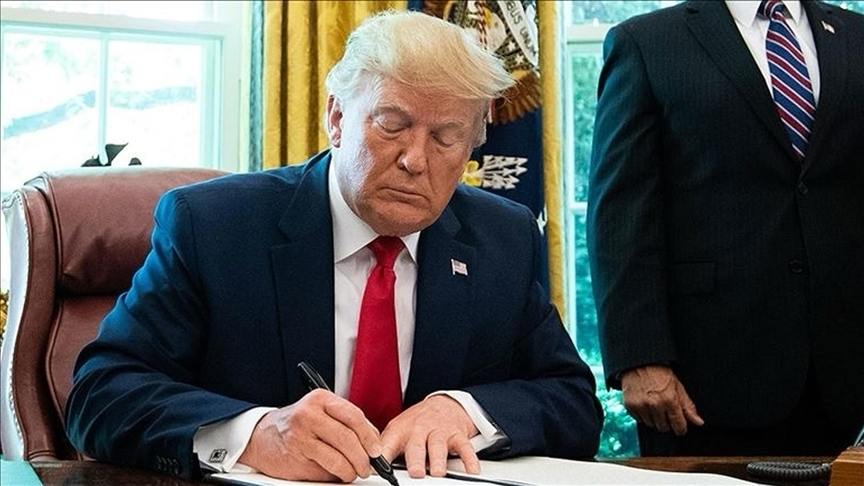







In the midst of escalating international controversy following Israel's announcement of recognizing the Somaliland region (Land of Somalia) as an independent state to stir up the region, U.S. President Donald Trump came out to clearly affirm that the United States does not intend to follow this path. Trump's stance, which reaffirmed the traditional U.S. policy supporting the unity of Somali territories, was not a passing detail, but reflected a complex network of political and security calculations, at a moment when files of sovereignty, forced displacement, and geopolitical competition intersect in the Horn of Africa.
It is noted that Israel is the first UN member state to grant "Land of Somalia" official recognition since its declaration of secession in 1991, effectively breaking the "diplomatic embargo" imposed on the region for 34 years. In exchange for this recognition, Israel gains direct access to a coastline 850 kilometers long overlooking the Gulf of Aden, allowing it for the first time to deploy surveillance and tracking systems for drones and Houthi missiles at the entrance to the Bab el-Mandeb, which puts Egypt and Turkey in front of a new security reality that grants Israel direct military influence in their historical spheres of influence.
Trump, who seemed reserved and even sometimes dismissive of the idea of recognition, emphasized that Washington does not see, at the present time, an interest in breaking the international consensus supporting Somalia's sovereignty. This position comes despite pressures from some U.S. circles that see Somaliland as a relatively stable entity compared to Somalia, and a highly sensitive strategic location on the Gulf of Aden and near global trade routes.
Somaliland, which unilaterally declared its secession in 1991, has succeeded over the past decades in building local governance institutions, conducting elections, and imposing a degree of internal security, but it has failed to gain broad international recognition. And until Israel's recent move, the region remained outside the official international system, under African rejection of any tampering with borders inherited from colonialism.
Israel's recognition of Somaliland opened the door to deeper questions beyond bilateral relations, especially in light of reports and analyses that spoke of Israel's renewed-old interest in the Horn of Africa, not only for security or maritime reasons, but also within undeclared conceptions related to the Palestinian file. Over the past years, scenarios have been proposed in Western and Israeli research centers addressing "resettlement" of Palestinians outside their land, within approaches that go beyond traditional political solutions.
In this context, the name Somaliland emerged, alongside other areas in Africa, in informal discussions linking international recognition, economic support, and transforming the region into a potential reception space for forcibly displaced Palestinians, whether from Gaza or other areas, under humanitarian or developmental pretexts. These proposals, even if not officially declared, raised deep concerns in African capitals that saw in them a reproduction of new colonial models with different facades.
The previous U.S. administration had touched on these ideas indirectly, especially during Trump's first term, when projects "Economic Peace" and "Settlement Outside Palestine" were proposed as political alternatives. And although Washington did not officially adopt any forced displacement plan, the ambiguity surrounding some proposals opened the door for Israel to test regional and international reactions.
Trump's rejection of recognizing Somaliland at this timing can also be read as a reassurance message to African allies, and a curb on attempts to use international recognition as a card for demographic engineering in the Middle East. The United States, despite its close alliance with Israel, realizes that any involvement in forced displacement projects will undermine its position in Africa, threaten its security partnerships, and fuel hostility in a highly sensitive region.
In contrast, Israel finds itself relatively isolated in this step, after its recognition of Somaliland faced explicit rejection from the African Union, the Arab League, and several regional powers that considered the move a blatant violation of Somalia's sovereignty, and a prelude to border chaos on the continent.
Trump's position, in essence, is a reflection of political pragmatism that balances support for Israel and avoiding slipping into uncalculated geopolitical adventures. It keeps the door ajar for future reviews, but at the same time sets red lines against using international recognition as a tool to liquidate the Palestinian issue outside its land.
The Somaliland issue reveals how concepts of sovereignty and recognition are used selectively in the international system. Israel's sudden support does not stem from conviction in the right to self-determination, but from political exploitation of marginal areas in service of larger agendas. Washington's rejection here does not reflect moral commitment as much as it reflects fear of unraveling the rules of the international order if the door to recognition outside regional consensus is opened.
Presenting Africa as an alternative space to solve "The Palestinian Question" reflects a dual moral and political failure: first, in recognizing the roots of the conflict, and second, in respecting African peoples' sovereignty. Any displacement project, no matter how wrapped in humanitarian discourse, will remain an extension of the logic of forced displacement. From here, rejecting these scenarios does not serve Palestinians alone, but protects Africa's own stability
In the broader context, according to experts, these developments cannot be separated from a systematic policy to fragment the Arab world, with Syria and Iraq as its most prominent arenas, as an integral part of the Zionist colonial project in the region. Weakening central states, dismantling their armies, and occupying their societies with internal conflicts and sub-identities constitutes a structural condition to ensure long-term Israeli superiority. This fragmentation does not target geography alone, but the Arab political will, ensuring that Arab states remain in a state of chronic incapacity to formulate a unified position or provide effective and sustainable support to the Palestinian cause, which remains the biggest loser in the equation of regional disintegration.
שתף את דעתך
Trump Rejects Recognition of Somaliland: Sovereignty, Displacement, and Political Geography Calculations in the Horn of Africa