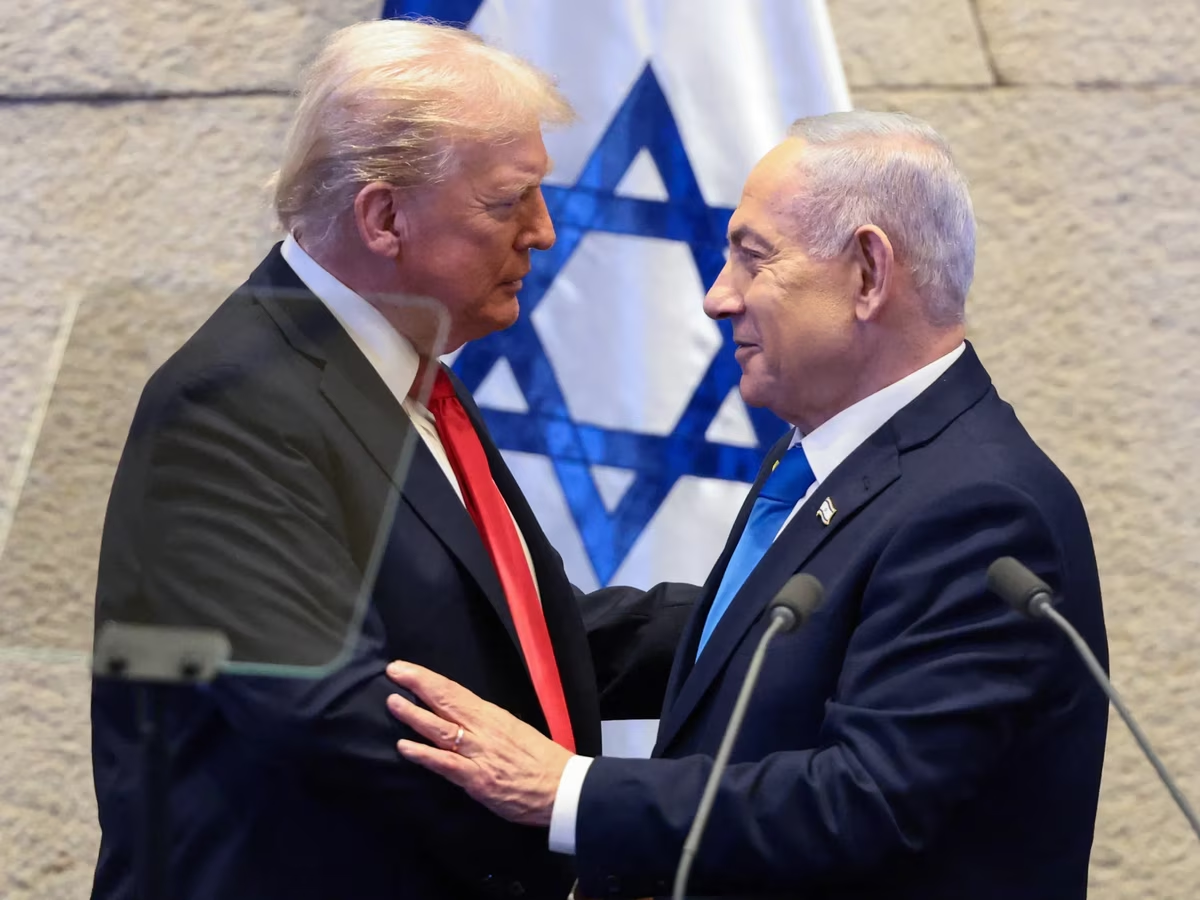







It is expected that US President Donald Trump will meet Israeli Prime Minister Benjamin Netanyahu, who is wanted by the International Criminal Court on charges of committing war crimes in Gaza, next Tuesday in Miami, Florida.
All eyes will be on the summit outcomes regarding ways to implement the second phase of the Gaza agreement, amid an atmosphere of disagreement between the two presidents on several points, including the timing of the start of the second phase of the Israeli withdrawal from the sector, the nature of forming the international force, and disarming the Islamic Resistance Movement (Hamas). The meeting will also address other thorny files, such as Lebanon, Syria, and Iran, and the future of US aid to Israel.
Former US State Department official Anne Slaughter said that "Trump's 20-point plan is highly flawed, and many of its aspects are not feasible."
Slaughter, who currently works as an expert at the Quincy Institute in Washington, added that "Arab forces will not be prepared to take on the role of occupying force and perform its tasks, nor will they be able to operate to maintain peace and protect the population from Israeli aggression. The United States should not take on this role either," considering that this task was impossible in Iraq and Afghanistan, and that most Americans have no interest in repeating it.
On the other hand, the Iranian file will be at the top of the agenda that Netanyahu will push during the meeting, and during his current visit to Tel Aviv, Senator Lindsey Graham, known for his closeness to Trump and his adoption of Israeli positions, stated that Tehran "still poses a great danger to Israel and Washington's interests in the region, by possessing a strong and massive missile arsenal."
After six months of Washington destroying Iranian nuclear facilities and supporting Israeli attacks on them, talk in the United States has renewed about the dangers of Iran's ballistic missile program and air defenses. Netanyahu and his team are preparing to brief Trump on Tel Aviv's fears that Tehran is expanding its ballistic missile program with China's help.
However, at the same time, Trump realizes that the broad support for Israel has caused a deep rift that is sweeping through the unity of his right-wing Republican stream, as clearly appeared in the annual conference event of the Charlie Kirk organization last weekend.
Osama Khalil, professor of international relations at Syracuse University in New York, said that "the Trump MAGA alliance focuses loosely on economic issues and putting America first. However, this current has faced Trump's strongly supportive policies towards Israel. With the promises Trump made to donors supportive of Tel Aviv like billionaire Miriam Adelson, this shakes the base of his political alliances."
Khalil considered that with the continuation of the Trump administration providing large amounts of economic and military support to Israel to continue the war in Gaza and expand it to Lebanon, Syria, Yemen, and Iran, this contradicts the US president's claim that he wanted to stop his country's involvement in foreign military adventures, with many of his allies expressing increasing criticism of Israel's genocide war in Gaza, including influential media figures in the MAGA movement.
In Israel, the upcoming meeting between Trump and Netanyahu is viewed as a highly sensitive political station, coming amid the continuation of bombing on the Gaza Strip, and the growing disagreements between the two sides on central regional files, most notably Iran, Lebanon, and Syria.
According to Israeli estimates, Netanyahu enters this meeting facing a complex task that has pushed Tel Aviv to conduct intensive discussions at the highest political and security levels, aiming to formulate a unified position and try to convince Trump to adopt the Israeli vision in issues it considers strategic.
These issues are topped by the demand to disarm Hamas and Hezbollah, and to tighten the stance towards Iran, especially in what Tel Aviv describes as the acceleration of ballistic missile production. Meanwhile, Israeli sources doubt Trump's readiness to give the green light for broad raids that could lead to a major regional escalation, whether in Gaza or Iran.
Military and intelligence analyst in "Yedioth Ahronoth" newspaper Ron Ben-Yishai wrote that this American hesitation reflects the essence of the disagreement between Washington and Tel Aviv, as Trump prefers to manage these issues with broader political calculations, and avoid slipping into open military confrontations.
With Netanyahu's pursuit of decisive American support, and Trump's desire to curb escalation and impose his own priorities, the upcoming meeting - according to Ben-Yishai - seems governed by a delicate balance between partnership and disagreement, making it a real test of the nature of the relationship between the two sides in a highly sensitive regional stage.
For his part, military analyst in "Haaretz" newspaper Amos Harel believes that Netanyahu is seeking to convince the US president to disarm Hamas and Hezbollah, maintain Israel's military superiority, and confront Iranian and Turkish influence, especially in Syria and Gaza.
Harel pointed to cautious Israeli optimism regarding the Lebanese government's progress in disarming Hezbollah, especially in southern Lebanon, with the possibility of moving to a second phase north of the Litani River, provided that it remains linked to international understandings and Washington's position.
In the Gaza file, the main disagreement focuses on the second phase of the ceasefire, as Israel fears - according to him - symbolic steps by Hamas that could open the door to international pressures for withdrawal, while Netanyahu conditions the recovery of the last captive's body and an actual disarmament of the movement's weapons before any political progress.
On the Iranian issue, Harel says that Tel Aviv realizes that Trump is not enthusiastic about military confrontation and does not see Tehran as an urgent priority for escalation, which weakens the bet on American green light for a broad strike and pushes Netanyahu to rely on political and intelligence pressure instead of the military option.
For his part, former Israeli Army spokesperson Avi Benayahu described the files on the table as "a herd of goats heading calmly to Mar-a-Lago," referring to Trump's private residence in Florida, hinting at Israel's readiness to pay high political and security prices behind this apparent calm.
He explained in an article in "Maariv" newspaper that these files include curbing Tel Aviv's response in Gaza, Syria, and Lebanon, moving to the second phase of Trump's plan, and the possibility of supplying Turkey and Saudi Arabia with advanced weapons, most notably F-35 fighters, in addition to "giving Ankara and Qatar a role in Gaza and presenting other surprises during the meeting."
According to Benayahu, Trump will show emotional and political support for Netanyahu, and may renew his talk about pardoning him, but it will not be free, as it will be met with a clear political price and concessions amid major regional challenges.
With Netanyahu's pursuit of decisive American support, and Trump's desire to curb escalation and impose his own priorities, the upcoming meeting seems governed by a delicate balance between partnership and disagreement.
שתף את דעתך
Trump Welcomes Netanyahu in Florida.. Thorny Files and Political Price