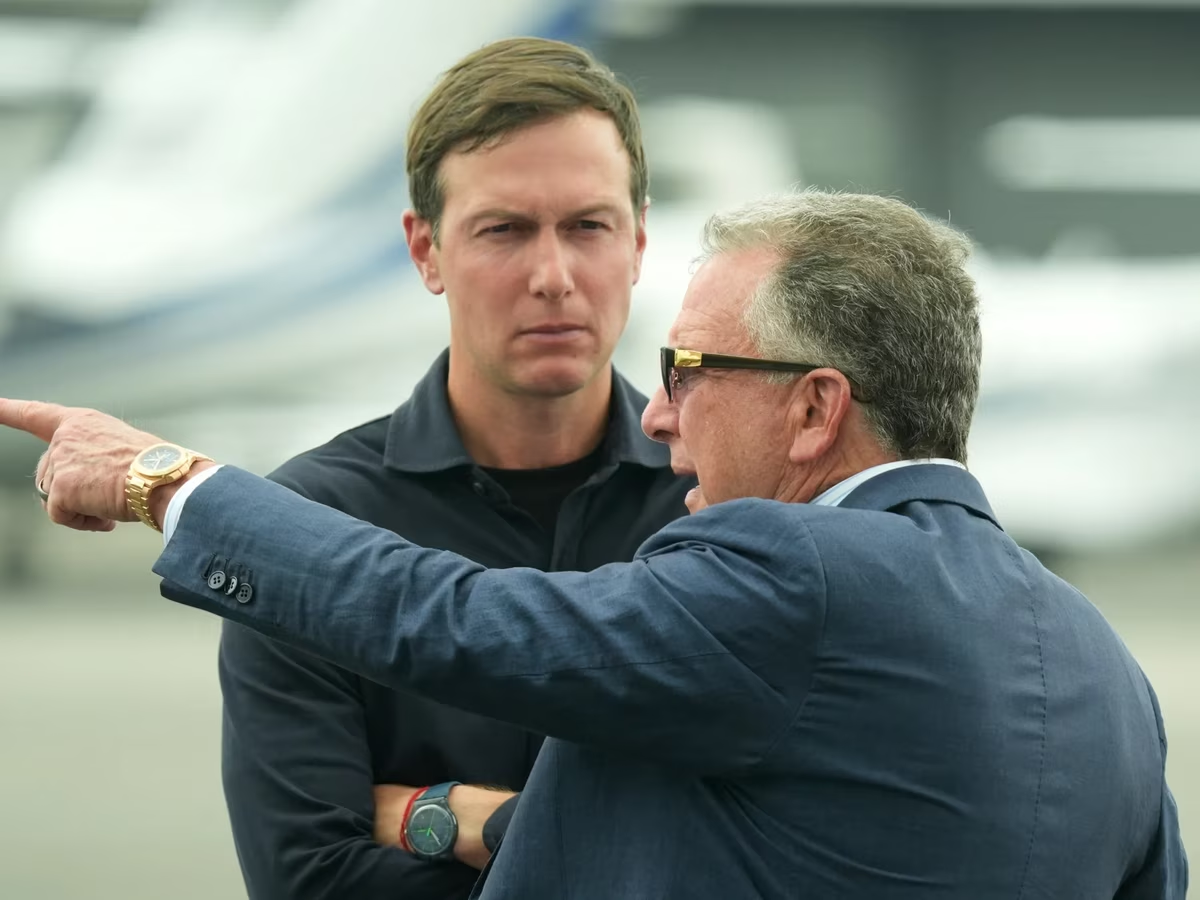







After nearly a year into the presidency of US President Donald Trump, his son-in-law Jared Kushner has returned to the foreign policy circle and is playing a larger role in sensitive peace negotiations after his role diminished throughout the previous period, joining Stephen Witkoff, the special envoy of the US President.
This change reflects a prevailing sentiment among Trump's close associates that Kushner, who has diplomatic experience, complements Witkoff's negotiation style and can bridge the seemingly intractable gaps to reach an agreement, according to several current and former administration officials who spoke, like others, on condition of anonymity to discuss internal deliberations.
This role became evident at the end of this week when Kushner and Witkoff hosted the Russian negotiator Kirill Dmitriev in Miami for talks on the latest proposals to end the Russian war in Ukraine, and they also met with Turkish and Qatari officials to discuss the fragile ceasefire between Israel and the Islamic Resistance Movement (Hamas) in Gaza, as they look to implement the second phase of Trump's plan to stop the firing.
The extended session on Saturday with Dmitriev came after several weeks of shuttle diplomacy, where Witkoff and Kushner recently met with Russian President Vladimir Putin in Moscow and Ukrainian and European diplomats in Germany. The two American envoys were scheduled to hold more talks with Dmitriev on Sunday, according to a White House official.
Witkoff, a longtime friend of Trump, is considered by some officials within the administration to be a prominent figure who has traveled the world in diplomatic negotiations on his private plane, and does not miss any opportunity to publicly praise the President for his acumen in foreign policy, according to the officials.
A Western diplomat says Kushner has complex business interests in the Middle East, sometimes known as "deal diplomacy," which has annoyed some officials in European capitals.
However, Kushner is seen as a more credible negotiator than Witkoff, who is considered by many Ukrainian and European officials to be excessively lenient towards Russian interests during the war in Ukraine that began in February 2022, according to the diplomat.
Ian Kelly, a retired diplomat and former US ambassador to Georgia, who is currently a professor of diplomacy at Northwestern University, says, "Kushner has a slightly more impressive record than Trump's first administration." But Kelly emphasized that judgment on Kushner's involvement has not yet been issued.
Trump views Kushner as "a trusted family member and talented advisor" who played a pivotal role in some of his biggest foreign policy successes, according to Anna Kelly, White House deputy spokesperson.
Kelly added that Trump and Witkoff "often seek Kushner's opinion given his experience in complex negotiations, and Kushner has been generous in providing his valuable expertise when asked."
The official spokesperson for the US State Department, Tommy Bigot, described Kushner as "a world-class negotiator." Bigot noted that Secretary of State Marco Rubio is grateful to Kushner "for his willingness to serve the country and help President Trump resolve some of the world's most complex challenges."
Kushner spoke in an interview with the program "60 Minutes" on CBS in October, about his unconventional approach to diplomacy, saying: "I actually trained in foreign policy during President Trump's first term by seeing a president come to Washington with a different school of foreign policy than what had prevailed during the previous twenty or thirty years."
However, some Democrats and government watchdog groups have expressed doubts about Kushner's role in shaping the administration's policies in the Middle East, while managing investments worth billions of dollars. Similarly, Witkoff has faced scrutiny due to his deep business relationships and his family's ties to Gulf countries.
Commenting on that, Kushner said that "what people call a conflict of interest, Witkoff and I call experience and reliable relationships we have around the world."
White House advisor David Warington said in a statement that Kushner's efforts on behalf of Trump "are in full compliance with the law."
Kelly and other veterans of American diplomatic meetings with the Russians over many years doubt Kushner's ability to secure an agreement between Russia and Ukraine because Witkoff is still technically in the lead.
Kelly said: "I don't see Witkoff's approach succeeding." "He doesn't understand the Russians well. He misunderstands what they say and conveys this misunderstanding to Washington and the Europeans."
Kelly said: "It seems they have the idea that the magic key is money: investment and development." "But these men don't care about that; they are not real estate men except in that they want the land, period."
Kushner had told Trump and others that although he would not join the White House in his second term, he was ready to offer his advice if they wished. This role he also played on a few occasions during the years of former President Joe Biden, when the Democratic administration tried, unsuccessfully, to expand the Abraham Accords.
With Trump's efforts to reach an agreement to end the war between Israel and Hamas in Gaza stalling during the summer, Kushner intervened, leveraging his experience and relationships in negotiating the Abraham Accords to help Witkoff push Trump's plan to the finish line.
The 20-point plan was agreed upon in late September after frantic talks on the sidelines of the United Nations General Assembly meetings, and it is still being implemented, but Kushner and many members of the Abraham Accords team are coordinating its implementation.
Trump told the Israeli parliament, the Knesset, shortly after the agreement: "We always call on Kushner when we want to close that deal. We need his mind sometimes."
Once the Gaza plan is completed, Kushner said he would return to his family and his daily job in Miami, where he heads a private investment company worth billions of dollars. Kushner said his involvement in the high-risk peace-making process was temporary only, joking that his wife Ivanka might change the locks if he didn't return home soon.
But within weeks of reaching the ceasefire in Gaza, Trump again turned to his problem-solving son-in-law to engage in negotiations between Russia and Ukraine. The negotiations had been at a standstill for months despite the White House's ongoing efforts to persuade Putin and Ukrainian President Volodymyr Zelenskyy to reach an agreement.
Trump hinted at the time that he would continue to rely on Kushner when the stakes are at their highest, just as he had done before.
What people call a conflict of interest, Witkoff and I call experience and reliable relationships we have around the world.
שתף את דעתך
Jared Kushner Returns to the American Foreign Policy Arena