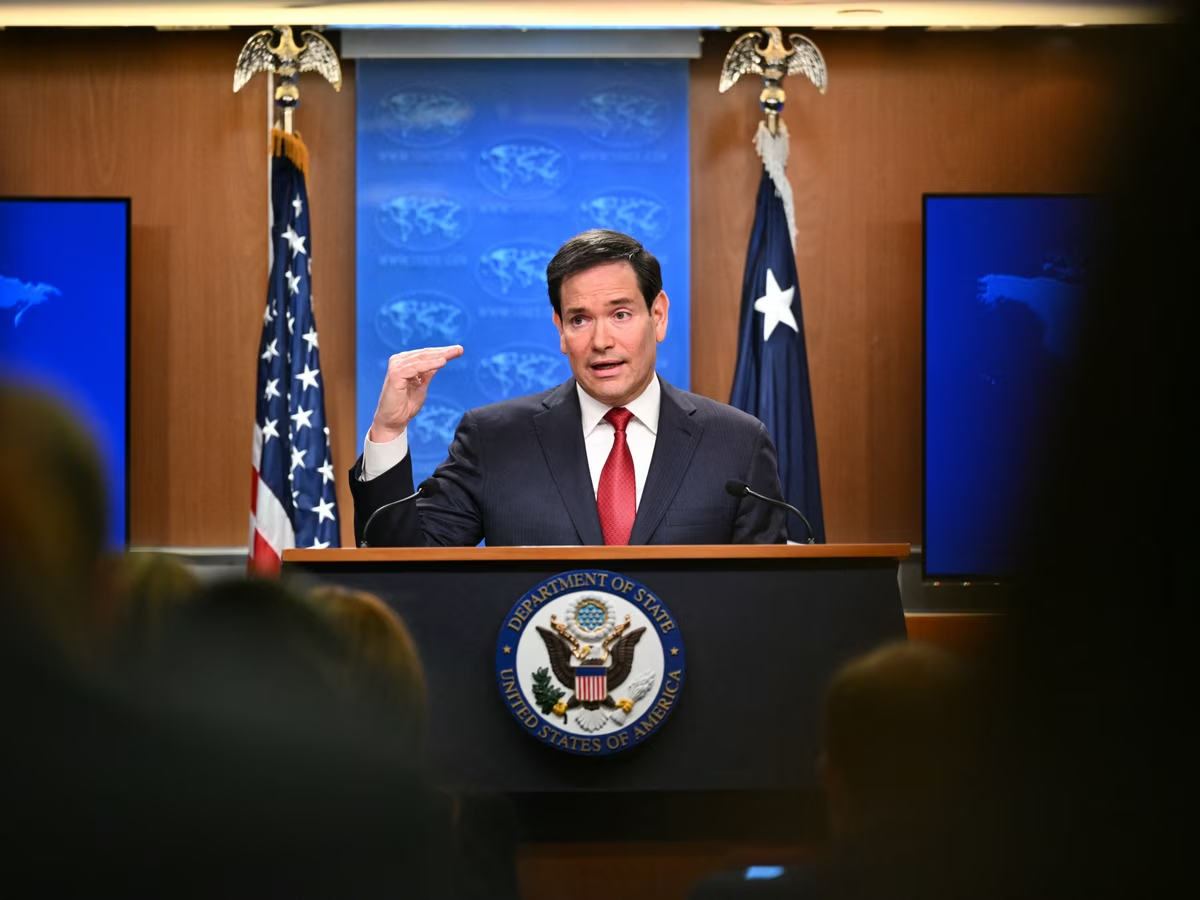







US Secretary of State Marco Rubio said that the work on implementing the second and third phases of the Gaza agreement will take a long period exceeding 3 years, while the two American envoys will hold another meeting today with officials from Qatar, Egypt, and Turkey regarding Gaza.
Rubio added -in a press conference in Washington- that it is important to complete the first phase of the ceasefire agreement in Gaza and move to the second phase. He explained, "We are in a hurry to end this phase of the agreement so that aid flows and we move to reconstruction."
The US Secretary of State continued, "We want to reach a stage where security is a fundamental part of the process of providing humanitarian aid."
Rubio expressed Washington's desire to accelerate steps to establish a stabilization force in Gaza and form a technocratic government, "because that will lead to the delivery of aid," and acknowledged -at the same time- that the matter is not easy.
He pointed out that the Gaza war is one of the biggest challenges facing President Donald Trump's administration, confirming that the ceasefire in Gaza is one of the greatest achievements that the US administration is proud of.
Rubio said, "I have great confidence that we have a number of countries acceptable to all parties in this matter, and they are ready to participate in the stabilization force." He explained that Pakistan has offered to participate in this force.
The US Secretary of State accused the Islamic Resistance Movement (Hamas) of "violating the ceasefire agreement in Gaza by firing at Israeli soldiers," and emphasized that "if Hamas is able in the future to threaten or attack Israel, there will be no peace, and it will not be possible to convince anyone to invest money in Gaza if they believe that a new war will erupt within two or three years."
He emphasized that a successful donors' conference on Gaza cannot be held before ensuring who will take charge of security in the sector.
The US Secretary of State accused the United Nations Relief and Works Agency for Palestine Refugees (UNRWA) of "corruption," saying that "it cannot be reformed, and we can provide aid in the Gaza Strip without the need for the United Nations."
In the meantime, attention is turning to Miami, where a White House spokesperson said that the American envoys Steve Witkoff and Jared Kushner will hold another meeting today with officials from Qatar, Egypt, and Turkey.
The spokesperson explained that Witkoff will discuss in Miami with the Qatari, Egyptian, and Turkish mediators the transition to the second phase of the ceasefire agreement.
The Axios website had reported, citing sources, that the officials Witkoff will meet are Qatari Prime Minister and Foreign Minister Sheikh Mohammed bin Abdulrahman Al Thani, and Turkish Foreign Minister Hakan Fidan, and Egyptian Foreign Minister Badr Abdel Ati.
In this context, Hamas Political Bureau member Bassem Naim said that the talks scheduled in Miami to move to the next phase of the ceasefire in Gaza must lead to stopping Israel's violations of the truce.
Naim added to Agence France-Presse, "Our people expect from these talks that the attendees agree to put an end to the ongoing Israeli recklessness and stop all violations and breaches and oblige the occupation to the requirements of the Sharm el-Sheikh agreement."
Qatar and Egypt -which play the role of mediators and guarantors for the ceasefire in Gaza- recently urged moving to the next phase of the American president's plan.
The second phase stipulates that Hamas hands over its weapons and Israel withdraws from its current positions in Gaza, and a transitional authority takes over governance in the sector with the deployment of an international stabilization force.
I have great confidence that we have a number of countries acceptable to all parties in this matter, and they are ready to participate in the stabilization force.
שתף את דעתך
Rubio: Implementing the second and third phases of the Gaza agreement will take more than 3 years