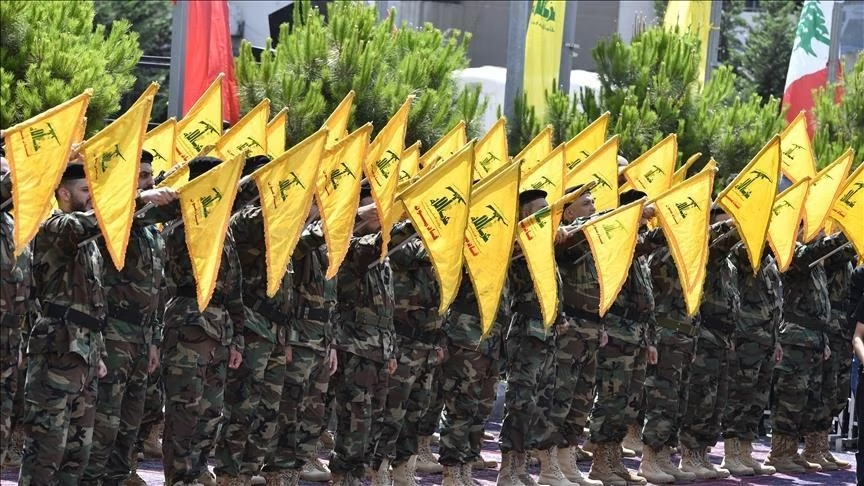







The Hebrew newspaper "Yedioth Ahronoth" estimated that the end of December/January this year could be the date for an Israeli decision to enter a new military confrontation with "Hezbollah" in Lebanon, if the American administration approves it.
The newspaper indicated in its Wednesday report that Israel is preparing for a new confrontation with Hezbollah, "which has become weaker but still well-armed".
The newspaper added: "However, defense officials believe that no operation will be carried out without the approval of US President Donald Trump, making it unlikely to take any action before Prime Minister Benjamin Netanyahu's scheduled visit to the White House later this month".
Netanyahu is scheduled to meet with Trump in Florida in the United States on December 29 this year.
The official Hebrew Broadcasting Corporation said last week that the Israeli army "completed preparations for a plan in recent weeks to launch a broad attack against Hezbollah-affiliated sites, if the Lebanese government and army fail to implement their commitment to dismantle the party's weapons before the end of 2025".
Under American-Israeli pressure, the Lebanese government approved on August 5 last year the monopolization of arms by the state, including those held by "Hezbollah", before announcing in September last year its welcome for the plan prepared by the army to implement the decision, consisting of 5 stages, but it did not specify a time frame for its application as expected, a step considered by observers as an attempt to appease the party and its base.
However, the first stage of the plan includes withdrawing "Hezbollah"'s weapons from south of the Litani until the end of this year.
But Hezbollah's Secretary-General Na'im Qassem said on more than one occasion that the party rejects this and demands the withdrawal of the Israeli army from all Lebanese territories.
"Yedioth Ahronoth" revealed that the army's intelligence branch is monitoring "hidden assets and political transformations and Iranian funding, in anticipation of a possible escalation that may be influenced by US approval and the Lebanese parliamentary elections (scheduled for May 2026)".
It said: "Hezbollah's underground network in the southern suburb of Beirut is not as deep or extensive as that in Gaza, and this is largely due to the nature of the soil that poses engineering challenges for the Iran-backed group".
But it added: "Nevertheless, Israeli military intelligence believes that the party will try to hide most of its strategic assets in tunnels and hideouts under residential buildings in Beirut's southern suburb".
It continued: "Intelligence officials were recently surprised to learn that Lebanese civilians in the capital repeatedly refused Hezbollah's requests to rent apartments outside the suburb, fearing that these properties would be targeted by Israeli air raids".
** Signs of a possible operation in Lebanon
According to the newspaper, "signs of a possible Israeli operation in Lebanon have emerged, with the Israeli army urging the political leadership to approve it, including the assassination of Hezbollah's prominent military commander, Haitham Ali al-Tabtabai".
It continued: "However, Hezbollah chose to continue exercising restraint, refraining even from launching a single mortar shell in response to the assassination of its military commander, a containment policy that was more common in previous years by Israel".
In November last year, Israel assassinated Hezbollah's Chief of Staff Haitham Ali al-Tabtabai in a raid on Beirut's southern suburb, the biggest breach of the ceasefire agreement that came into effect on November 27, 2024.
"Yedioth Ahronoth" noted that "this restraint is unlikely to continue in the event of a comprehensive escalation. The Israeli army expects Hezbollah to respond with a coordinated barrage of hundreds of rockets, shells, and drones over several days".
It added: "Officials in military intelligence believe that Hezbollah currently prefers to endure Israel's near-daily air raids instead of escalating, preferring to focus on internal power struggles that it sees as more controllable".
The newspaper quoted unnamed officials from the Israeli military intelligence branch as saying that "from a military perspective, Hezbollah is still stronger than the Lebanese army, and when this situation changes, we will know that things have turned around".
The officials added: "Until then, Hezbollah will continue to rebuild its ranks, relying mainly on local manufacturing and converting existing missiles into precision-guided ones".
The newspaper also quoted an unnamed Israeli army official as saying that "the army will have to continue confronting Hezbollah no matter the cost".
He added: "With the increasing seriousness of talk about disarming Hezbollah, and any disarmament effort tending toward the use of force, it is likely that the party will become more aggressive".
He continued: "Hezbollah will not volunteer to disarm, and the Lebanese army, for its part, maintains a neutral position".
The newspaper considered that "there is another pressure factor influencing Hezbollah's decisions, which is a political factor".
It said in this regard: "Parliamentary elections are scheduled to be held in Lebanon in May (next year), and the Israeli army believes that the current Secretary-General, Na'im Qassem, aged 72, is more concerned with restoring internal unity and political legitimacy than entering a new war with Israel".
It quoted an unnamed Israeli military official: "Qassem lacks the charisma that Hassan Nasrallah had, and as a result, there is little hope among Lebanese Shiites. More of them are now turning to the Amal Movement".
Despite the ceasefire between Israel and Lebanon coming into effect at the end of last year, Israel continues its daily attacks in Lebanon.
Since October last year, the Israeli army has intensified its attacks on Lebanon as breaches of the agreement, with media leaks about plans to launch a new attack on the Arab country.
The ceasefire agreement, signed about a year ago, was supposed to end Israel's aggression on Lebanon in October 2023, which turned into a full-scale war in September 2024, leaving more than 4,000 dead and over 17,000 injured.
Defense officials believe that no operation will be carried out without the approval of US President Donald Trump.
שתף את דעתך
Israeli Estimates: End of December Date for New Confrontation Decision with Hezbollah