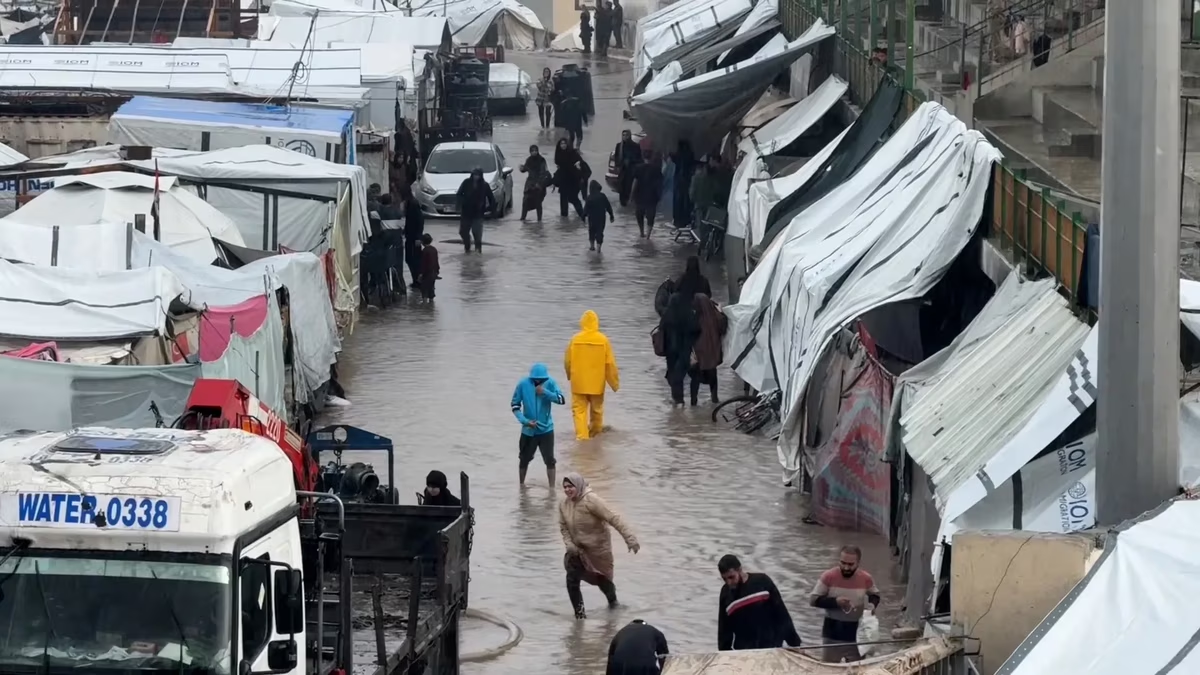







In the heart of Gaza City, amidst a makeshift displacement camp teeming with suffering, the young Palestinian woman Rafqa Al-Dughli (23 years old) finds herself in a daily confrontation with the harsh reality imposed by the ongoing Israeli war since October 2023.
This war, described by international reports as exceeding the boundaries of traditional conflict to reach levels of genocide, destroyed Rafqa's home and abducted her husband, leaving her to face the bitter cold and hunger with her infant daughter "Malak" inside a dilapidated tent fixed near a landfill.
The tent, made of worn-out fabrics and corroded nylon pieces, lacks the most basic necessities of human life. Strong winds shake its edges daily, trying to uproot it from the ground, while rainwater seeps through the holes to flood the earthen floor.
Rafqa, who lived a peaceful life before the war, now sits hunched over a primitive stove relying on damp wooden sticks, trying to prepare a warm drink for her daughter who clings to her back in fear of the storms. She says, "I never imagined living in such harsh conditions.. I lost my home and my husband, and life is no longer as it was."
Before the outbreak of the war on Gaza on October 8, 2023, Rafqa lived in a modest home with her husband Youssef Hassan (24 years old), who worked in a pastry and sweets factory. Their life was not luxurious, but it was sufficient to provide happiness and stability.
They had gotten engaged just a week before the start of the Israeli attacks, dreaming of a new life full of hope. But reality was harsh; they were soon forced into compulsory displacement from their home in Beit Lahia, moving between neighborhoods and cities like hundreds of thousands of Palestinians.
The birth of their daughter Malak in November 2024 was a rare moment of joy amidst the destruction, but it didn't last long as Youssef lost his job, the family's only source of income, amidst a deadly famine imposed by Israeli policies that prevented regular entry of aid.
Youssef did not give up; he went on August 5 to an area near the "Zikim" checkpoint northwest of Gaza to get a bag of flour from an aid truck, where hundreds of Palestinians crowded around it, but an Israeli sniper shot him, martyring him instantly.
With the approach of winter, the challenge increases; Rafqa tries to patch the holes in the tent that shelters 9 people, fighting the winds and rains. The camp itself, adjacent to the landfill, is full of similar tents hiding other painful stories, where displaced people suffer from cold, hunger, and diseases.
In a neighboring tent, Manal Al-Ariri (52 years old) lives a double suffering, having lost her husband Ayman (50 years old) on December 23, 2023, while trying to rescue his relatives in the Shujaiya neighborhood east of Gaza, after Israeli bombing destroyed the area.
Al-Ariri was paralyzed; she says about her husband and their past: "He was a metal trader, we lived happily in our home in Shujaiya," and on December 23, 2023, Ayman went out to rescue his relatives after bombing, but he was martyred by an Israeli fire belt.
The war destroyed their home, leaving Manal and her five children in a tent full of insects near the dump, deprived of everything.
Zahir Al-Wahidi, director of the Health Information Center at the Palestinian Ministry of Health, says that the genocide war has killed 70,300 Palestinians and injured 171,000, including 20,000 children, 10,000 women, and 5,000 elderly.
The war itself widowed 22,750 women and orphaned 57,000 children (49,000 lost their fathers, 5,000 lost their mothers, and 3,000 lost both parents). It wiped out 2,600 entire families, and 5,000 families witnessed massacres from which only one person survived, and 6,000 families lost members. "These numbers are horrifying, reflecting an unprecedented catastrophe," Al-Wahidi confirms.
The war claimed the lives of more than a thousand children under one year, and 450 children were born during it and died under bombardment. It destroyed infrastructure, leading to famine and diseases in the camps.
Nevertheless, widows like Rafqa and Manal continue to struggle for survival, preserving their children, awaiting a peace that restores life to the wounded Gaza.
I never imagined living in such harsh conditions.. I lost my home and my husband, and life is no longer as it was.
שתף את דעתך
Torn tents and threatened children.. Gaza floods reveal the catastrophe of displacement in winter