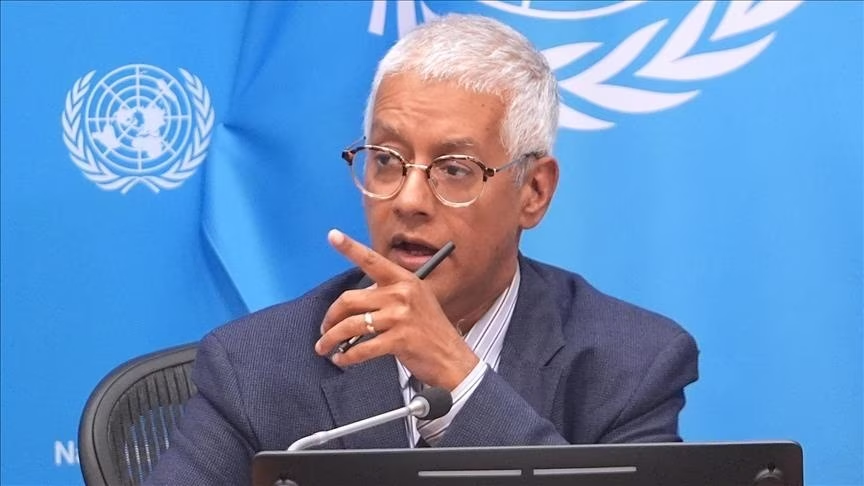







The United Nations announced that Israel continues to obstruct the entry of humanitarian aid into the Gaza Strip despite the harsh winter conditions, and warned of the increasing risk of newborns freezing due to the cold.
This came from the spokesperson for the UN Secretary-General, Farhan Haq, on Monday, during his daily press conference.
Haq explained that the United Nations and its partners continue to work to deliver aid to the "most vulnerable" Palestinian families in the Gaza Strip.
He said: "Staff from the UN Office for the Coordination of Humanitarian Affairs warn that the needs, amid the ongoing obstacles they face, still exceed the capacity of humanitarian workers to respond."
Haq pointed out that the heavy rains and extremely cold weather in recent days have worsened the situation, noting the increased risk of hypothermia in newborns, and that special aid kits are being distributed to combat freezing cases.
He clarified that during the past week, 3,800 tents and 4,600 tarpaulins were distributed, confirming the continuation of delivering packages that include, in addition to shelter supplies, basic food items and hygiene materials.
However, Haq added: "Nevertheless, our partners have been forced since Friday to reduce the scope of aid provided through these packages, due to restrictions that affect our ability to deliver sufficient quantities of aid."
He also referred to efforts to establish temporary educational spaces benefiting 5,000 children, as part of efforts to improve children's access to education in Gaza, but emphasized that attempts to return children to normal education remain limited due to Israel's prevention of importing educational materials.
He warned again of the continuation of obstacles that hinder the ability of teams from the Office for the Coordination of Humanitarian Affairs to accelerate and expand the humanitarian response, stressing the necessity of removing these obstacles so that the United Nations and its partners can reach all those in need.
On Thursday, the Director-General of the Health Ministry in Gaza, Munir al-Barsh, announced the death of the infant Rahaf Abu Jazzar in the city of Khan Yunis in the southern sector due to the cold and her tent flooding with rainwater.
Since Wednesday, thousands of tents sheltering survivors of the Israeli genocide over two years in Gaza have turned into pools of water, flooding beds, clothes, and food, leaving hundreds of families exposed to harsh conditions without warmth or shelter, amid a tragic reality exacerbated by the lack of life essentials.
Most displaced people take shelter in dilapidated tents, while the Government Media Office in Gaza estimated at the end of September last year that the percentage of tents no longer habitable in the sector reached about 93 percent, amounting to 125,000 tents out of 135,000.
Despite the end of the genocide war with the ceasefire taking effect on October 10 last year, the living reality for Palestinians in Gaza has not improved due to the strict restrictions imposed by Israel on the entry of aid trucks, thus violating the humanitarian protocol of the agreement.
Over nearly two years of genocide, tens of thousands of tents were damaged by Israeli bombing that hit them directly or targeted their surroundings, while some deteriorated due to natural factors such as high summer heat and winter winds.
The ceasefire agreement ended a genocide war launched by Israel on October 8, 2023, lasting two years, leaving more than 70,000 Palestinian deaths and over 171,000 injured, and massive destruction affecting 90 percent of civilian infrastructure, with initial losses estimated at $70 billion.
Staff from the UN Office for the Coordination of Humanitarian Affairs warn that the needs, amid the ongoing obstacles they face, still exceed the capacity of humanitarian workers to respond.
שתף את דעתך
United Nations: Israel obstructs entry of aid to Gaza despite harsh winter and warns of increasing risk of newborns freezing