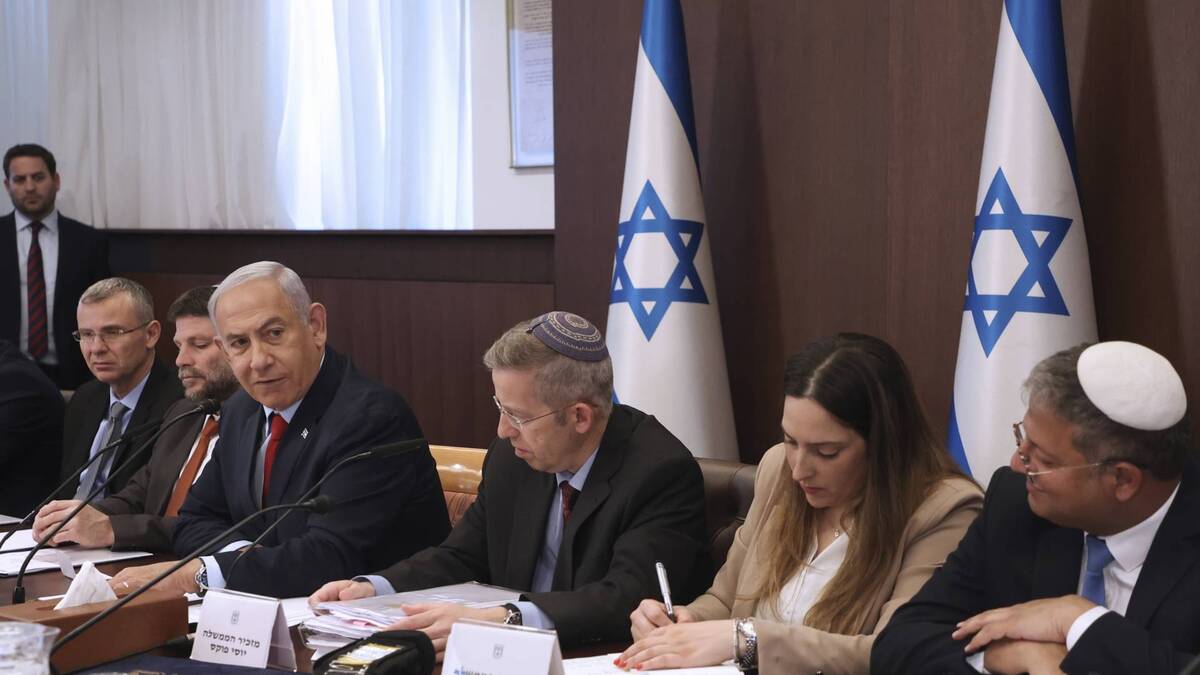







Israeli Prime Minister Benjamin Netanyahu held discussions today, Sunday, in the reduced security cabinet regarding a third draft of the resolution proposed by the United States to the United Nations Security Council.
The sharp Zionist concern regarding this draft arises because it states that once the Palestinian Authority implements the required reforms and begins the process of rebuilding Gaza, "conditions may become suitable for a reliable path towards self-determination and the establishment of a Palestinian state."
Netanyahu's firm rejection and the Knesset's move left Netanyahu and the heads of the coalition parties from the weekly government meeting, following ministers' criticisms of the American draft resolution.
Former Minister of Strategic Affairs Ron Dermer participated in the cabinet meeting, despite his resignation, indicating the magnitude of the crisis.
Netanyahu's position Netanyahu stated at the beginning of his government meeting: "Our opposition to a Palestinian state anywhere west of the Jordan River has not changed, and this opposition exists and has not changed."
He added, "I have opposed these attempts for decades and I do so in response to both external and internal pressures."
Netanyahu further stated that "regarding the alleged 'disarmament' of the area controlled by Hamas in Gaza, this will not happen."
Even in the twenty-point plan (Trump's plan to end the war and exchange prisoners), and in anything else, this area and Hamas's weapons will be disarmed.
It will either be done the easy way or the hard way. That's what I said, and that's what President Trump also said.
The dispute over the mandate and international debate The American draft resolution, which will be discussed in the Security Council on Monday, calls for the establishment of "dialogue between the occupation and the Palestinians to agree on a political horizon for peaceful coexistence."
The third draft welcomes the establishment of a "Peace Council," which is a transitional governing body for Gaza that is theoretically supposed to be chaired by Trump for a term lasting until the end of 2027.
The resolution also authorizes member states to form a "temporary international stabilization force" for disarmament and the protection of civilians.
Occupation amendments The "Wynet" website indicated that the occupation is trying behind the scenes to introduce amendments to the draft, especially since it includes clauses that are "uncomfortable for Israel."
Such as the clause that prevents the occupation from objecting to countries sending forces to the stabilization force.
International objection The American draft resolution faces widespread opposition from Russia, China, and several Arab countries, which demand the removal of the reference to the "Peace Council."
The third draft responded to previous objections by including a vision for a "future Palestinian state," albeit without binding commitments.
Netanyahu's rejection of the draft underscores the difficulty of internal consensus in light of the Palestinian state clause.
The statement by the spokesperson for the American mission that attempts to sow discord to undermine the resolution will have "serious and tangible consequences" for the Palestinians serves as evidence that Washington sees this resolution as a "historic moment" to pave the way for lasting peace in the Middle East.
Our opposition to a Palestinian state anywhere west of the Jordan River has not changed.
שתף את דעתך
The draft American resolution on Gaza is facing pressure from the occupation to introduce potential changes.