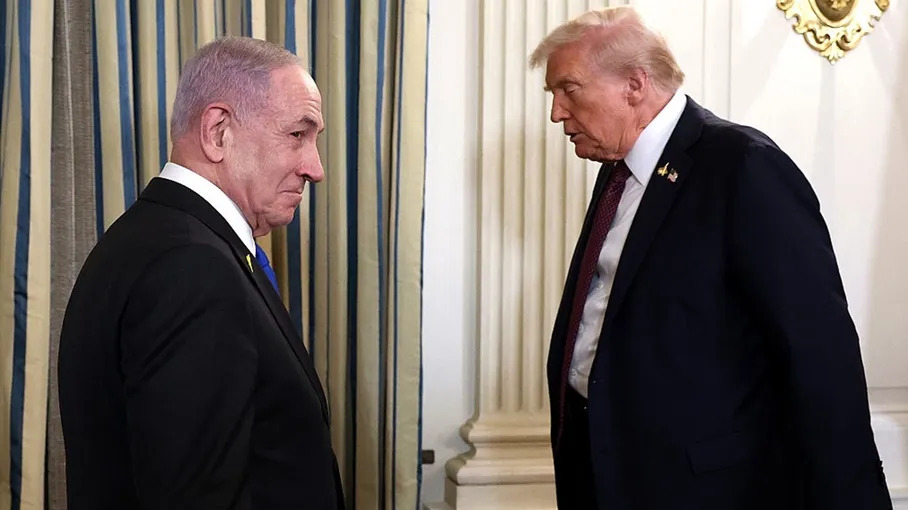







The former head of Israeli military intelligence and head of the Institute for National Security Studies at Tel Aviv University, retired General Amos Yadlin, and researcher in Palestinian affairs Noa Schusterman/Dafir, expressed their concern over Washington's presentation of the "Trump Plan" at the United Nations, due to what they described as "gaps in some provisions and ambiguity in others."
They confirmed that the proposed American draft before the Security Council contains temporary gains for Israel, but also entails deep strategic risks.
In a joint article published by the "Channel 12 Hebrew" website, they stated that the draft promoted by the U.S. administration aims to be a central pillar for implementing the "Trump Plan" regarding the Gaza Strip, which was launched last September.
They explained that the American plan seeks to grant broad international legitimacy to the proposed measures, including: forming a temporary Palestinian government of technocrats, establishing an international stabilization force and a peace council, in preparation for gradually transferring control to the Palestinian Authority after implementing internal reforms.
Despite the formal security agreements the draft carries with the Israeli position, Yadlin and Schusterman believe that the proposed resolution suffers from fundamental weaknesses, as it allows for reconstruction and disarmament to occur in parallel, whereas the original plan demanded complete disarmament as a prerequisite for reconstruction.
They pointed out that Tel Aviv still sees its war objectives clearly: disarming Hamas and ensuring that the Gaza Strip does not pose a future security threat, but these objectives – according to the article – could be significantly diluted in the Security Council resolution if approved in its current form.
The researchers warn that the anticipated resolution may not reflect the spirit of the original "Trump Plan" that was signed between the United States, Turkey, Qatar, and Egypt last October, as its passage requires a vote in the Security Council composed of 15 countries, including Pakistan and Algeria, with the possibility of objections from permanent members such as Russia or China.
They state that this dynamic makes the current draft a diluted proposal attempting to implement the second phase of the plan without a comprehensive addressing of Israeli objectives.
Regarding the security aspect, Yadlin and Schusterman clarified that the draft grants broader international legitimacy to the demand for disarming Gaza and establishing an international stabilization force in close cooperation with Egypt, but at the same time suffers from severe practical ambiguity.
It does not specify the entity responsible for implementing disarmament in case Hamas refuses to comply voluntarily, nor does it clarify the limits of the proposed Palestinian police's powers.
They noted that the absence of a link between reconstruction and complete disarmament opens the door for Hamas to exploit humanitarian and economic aid to rebuild its military infrastructure, adding that the draft does not explicitly mention tunnels or the infrastructure supporting weapon production, unlike the original Trump plan.
Concerning the Israeli military presence in Gaza, the authors expressed concern that the draft does not specify a clear withdrawal map for the Israeli army, nor does it grant it a clear legal status on the ground, which could be interpreted as a restriction on operational freedom.
They stated that the original "Trump Plan" discussed the "yellow line," the "red line," and the security perimeter, but the new draft ignores these details, creating a "dangerous strategic gap," especially if the Security Council assigns a supervisory role over field operations.
They add that the potential outcome could be the deployment of foreign forces in areas still containing Hamas fighters, amid doubts about these forces' readiness to effectively disarm the movement.
According to the article, the plan aims to establish a peace council and a Palestinian technocratic government under supervision, to prevent the return of Hamas and ensure stability, but the draft grants the council near-absolute powers in determining when the Palestinian Authority meets the required conditions.
Although Trump will lead the council, it will include Arab and international representation, which could make decision-making beyond Israeli control.
The authors also point out that the draft sets a work period of no less than two years without indicators or criteria to determine success or failure, which could turn the peace council into a mediator unsympathetic to Israel, at a time when Netanyahu's government benefits from delaying the Palestinian Authority's return to the sector.
The researchers believe that the current draft represents a temporary achievement for the Israeli narrative, as it does not refer to previous United Nations resolutions or the idea of a Palestinian state, but it remains a fragile achievement.
It is expected that France will request an amendment linking the resolution to the "New York Declaration," which could bring the idea of a two-state solution back to the table.
On the international front, Yadlin and Schusterman expect that Russia, China, Algeria, and
שתף את דעתך
Israeli concerns over a U.S. draft resolution that threatens the army's freedom in Gaza