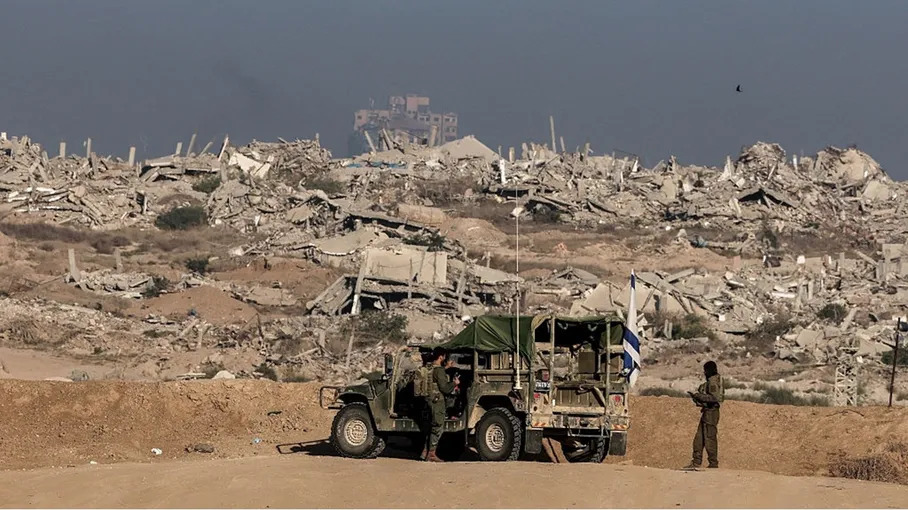







The seventh report issued by the State Comptroller in the Israeli occupation regarding the Gaza war revealed that the political leadership has failed to fulfill its duty to ensure the country's readiness to face rapid security transformations, noting the absence of a clear national vision based on an organized and updated security concept.
The newspaper "Maariv" quoted State Comptroller Matanyahu Engelman warning, in a strongly worded oversight report on the management of the war, about the lack of a long-term strategic vision within the political leadership, emphasizing that the report does not serve as a substitute for a comprehensive investigation that identifies the shortcomings and responsibilities for the events of October 7, 2023.
He stated: "In such a case, the ability of the political level to direct the Israeli army and the other security agencies with a long-term strategic vision, to challenge it, and to exercise oversight and supervision is lacking and, in some cases, non-existent," explaining that "the aim of the report is to raise issues related to the connection between the concept of national security and the events of October 7."
The State Comptroller pointed out that "Prime Minister Benjamin Netanyahu, who initiated the writing of a concept for national security for the State of Israel in the years 2017-2018 and worked to establish it, did not complete what he started and did not approve an official concept for national security for the State of Israel and make a binding decision regarding the cornerstone for implementing this concept - which is a change in national priorities and allocating significant additional budgetary resources to meet security needs at the expense of other needs, despite the importance and necessity he himself acknowledged."
Engelman added: "Thus, he did not exercise his responsibility in this regard, and his concept remained without the ability to implement it correctly and without binding authority."
The report indicated that the heads of the National Security Council, who have succeeded each other since the law establishing the council was passed in 2008, have not presented any updated vision for national security to be presented to the political-security cabinet, reflecting a shortcoming in the council's performance of its fundamental role in shaping the state's security policies.
The report stated that "Israel is going through one of its most difficult hours, as it is engaged in a war that costs many sacrifices and still faces difficult and complex challenges. The gaps in the readiness and preparedness of the State of Israel to confront the unprecedented security challenges that threaten its sovereignty, national interests, and the security of its residents and citizens, which manifested their tragic results on October 7, 2023, raise difficult questions about the long-term strategic thinking and planning of the Israeli government and the political-security cabinet led by the Prime Minister."
The report confirmed that "the failure has been ongoing and extended for years, as the political level has not exercised its responsibility over the generations to ensure that the State of Israel is prepared for changing security challenges based on an organized, updated, and officially approved national security concept. Thus, Israeli governments led by prime ministers over the generations have never approved an official concept for national security, contrary to what is practiced in Western countries."
This is also the seventh report issued regarding the "Iron Swords" war (Gaza war).
The State Comptroller noted that the Israeli army changed the scope of its tank array over the years without any direction from the political level, and with a vision lacking an organized and officially approved strategic basis.
The report mentioned that "in 2020, the Israeli army, led by then Chief of Staff Lieutenant General Aviv Kochavi, implemented a program to determine the size of the tank array, without presenting the program in advance to then Defense Minister Naftali Bennett for review of its necessity, which was not consistent with the summary of the discussion with Prime Minister Benjamin Netanyahu from January 2020."
Engelman warned that Israel, as of the completion date of the audit, does not possess an official national security concept with binding authority.
He clarified that "the events of October 7 and their fateful impacts necessitate a review, among other things, of the unofficial national security concept that has taken root in the State of Israel, the political handling of the national security concept of the State of Israel, and the need to formulate and approve an organized and official national security concept."
The report's authors viewed the surprise attack carried out by Hamas on October 7, 2023, as a simultaneous collapse of three of the fundamental pillars of Israeli national security, which are deterrence, warning, and defense, principles that are at the core of the prevailing unofficial security concept in Israel.
The report added that the fourth principle, represented by "decisiveness," which forms the axis of the "Iron Swords" war, has not yet clarified the results of its application even by the end of
שתף את דעתך
An Israeli report reveals the failures of political and military leadership during the Gaza war.