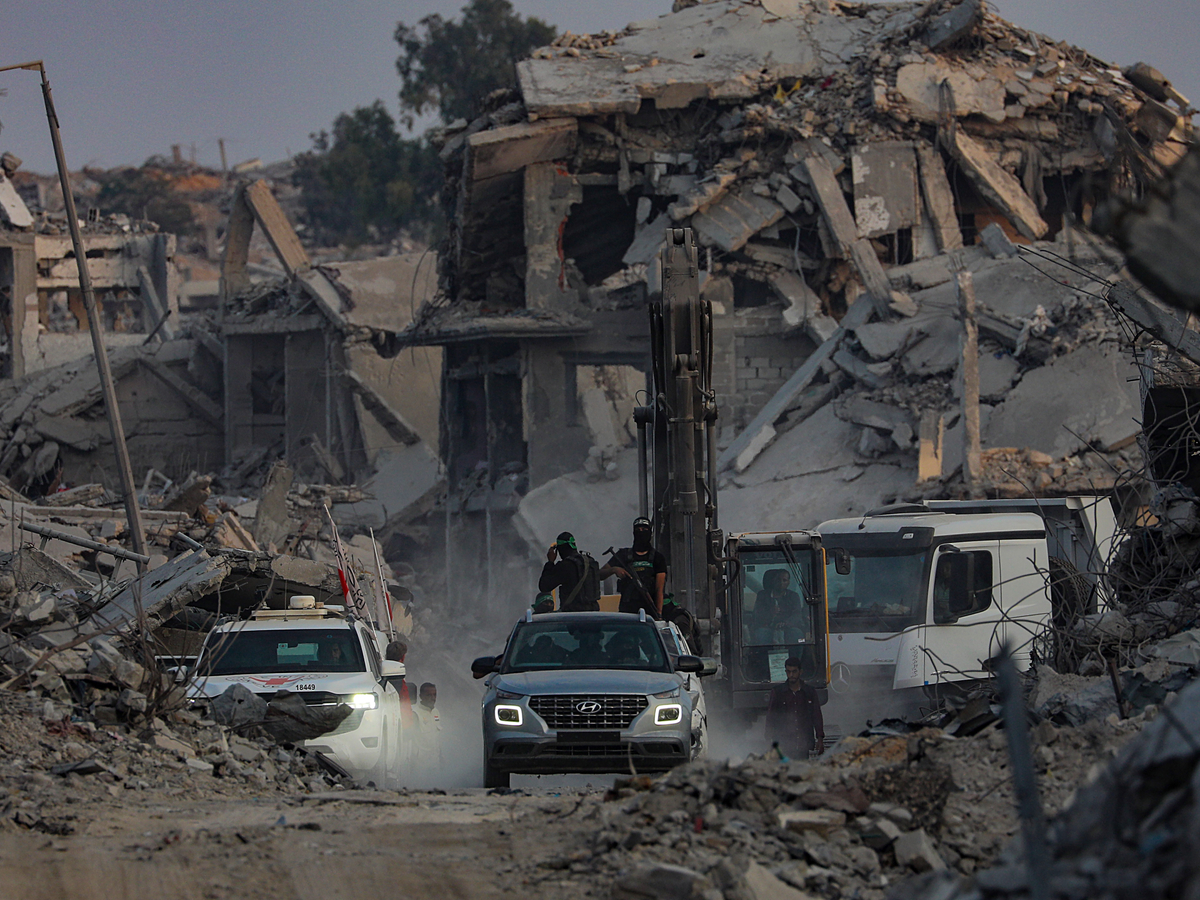







Attention is increasingly focused on the second phase of the ceasefire agreement and the exchange of prisoners according to the plan of U.S. President Donald Trump, as the first phase nears its end, amid questions and speculations about the possibility of maintaining momentum and achieving the declared goals.
Analysts suggest that the first phase did not lay the groundwork for the success of the second phase, which is described as being governed by "complexities that extend beyond the battlefield to a battle of political wills" between Washington and Tel Aviv on one side, and the Palestinians and their regional allies on the other.
According to Ibrahim Fraihat, a professor of international conflicts at the Doha Institute for Graduate Studies, the success of the first phase was limited to "achieving a temporary ceasefire and the exchange of prisoners" and implementing some humanitarian provisions, without necessarily meaning that the path is now clear for the second phase and its success.
The second phase appears to be more complicated, as it touches on the essence of the conflict - according to Fraihat during his appearance on the program "Event Path" - since it concerns security and administrative arrangements in Gaza, which are issues that have not been resolved between the major powers or between the regional and Palestinian parties.
In light of this, any deviation in the understandings "could lead to a complete collapse of the process," because "the success of the first phase was more technical and humanitarian than political."
For his part, Israeli affairs expert Mohannad Mustafa confirms that Israel views the second phase from a completely different perspective, as it seeks - according to him - to "take advantage of the relative calm to reposition itself on the ground, without getting involved in political commitments or an actual withdrawal from the sector."
According to Mustafa, Tel Aviv aims to keep its forces on the outskirts of the Gaza Strip and not withdraw during the election year, and it "will not allow the establishment of a unified Palestinian administration or an international security force that limits its military freedom."
He points out that the Israeli security and political establishment sees the second phase as "fraught with risks to achieving the goals of the war," so it manages it cautiously and seeks to expand its margin of maneuver.
Based on this, Israel wants the proposed international force to be referenced by the Peace Council under Trump's plan rather than the Security Council, as it is not entirely convinced of the usefulness of this phase and does not guarantee that it will serve its interests.
However, Fraihat does not rule out that this force "could turn into a military occupying force with absolute powers, if it enjoys excessive security under the reference of the Peace Council," emphasizing the need for its powers to be limited by a UN reference.
Meanwhile, Ahmed Atawneh, director of the Vision Center for Political Development, links the impasse of the American plan to the nature of the Palestinian political environment, noting that "any talk of success or failure remains incomplete as long as Washington deals with Gaza as a file separate from the Palestinian issue."
Atawneh believes that the absence of a unified Palestinian national reference makes the plan susceptible to disintegration, expressing his conviction that the second phase "will face a legitimacy crisis, as the local parties do not see themselves represented in the ongoing understandings."
In the same context, former U.S. State Department official Thomas Warik believes that Washington is betting on passing the second phase through the Security Council, to provide a legal cover for the proposed international force in Gaza.
However, Warik warns that "any failure to build international consensus will leave the plan halfway."
Based on this, the spokesperson sees that the success of the United States in issuing a UN resolution is a "test of credibility" for the Trump administration, which faces potential Russian and Chinese rejection, in addition to Arab and European reservations about the nature of the proposed force and its tasks.
Since the start of the ceasefire agreement on October 10, the Palestinian resistance has released 20 living prisoners and handed over the bodies of 23 out of 28, with 5 bodies remaining, one of which belongs to a Thai national and 4 others to Israelis, including officer Hadar Goldin, whose body was retrieved on Saturday evening from Rafah.
The success of the first phase was more technical and humanitarian than political.
שתף את דעתך
Complications beyond the field.. Will Trump's plan for Gaza succeed in its second phase?