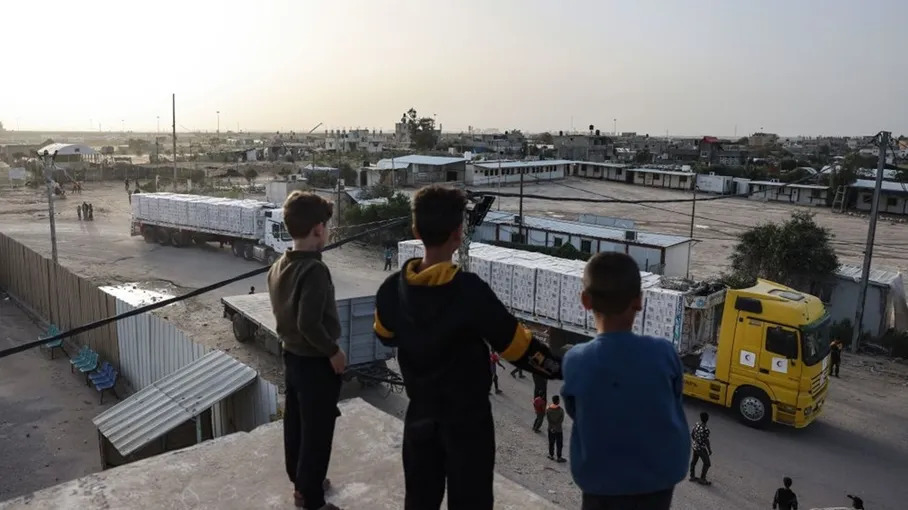







The Israeli occupation will allow the reopening of the Rafah crossing on Wednesday to facilitate the delivery of aid to the Gaza Strip from Egypt, according to the Israeli Broadcasting Authority.
The authority reported on its website, "600 trucks carrying humanitarian aid will be sent to the Gaza Strip (on Wednesday) from the United Nations, accredited international organizations, the private sector, and donor countries," without disclosing its sources.
The occupation authorities initially announced the opening of the crossing for the passage of aid, but they quickly backtracked on the implementation, citing what they described as "logistical difficulties" that prevent the resumption of movement, which sparked widespread criticism and doubts about the seriousness of the commitment to the opening decision.
An Israeli security source stated that the Rafah border crossing between the Gaza Strip and Egypt will not be reopened for the movement of individuals today, Wednesday, claiming that the reason is "logistical reasons," as the Hebrew newspaper "Yedioth Ahronoth" quoted the source, who was not named, saying that "the Rafah crossing will not open today, and the date of its opening is unknown."
He added, "This is not logistically possible; we need to go down to the area to verify and send a team, and this takes time," and "it is expected that they will decide tomorrow also to keep the crossing closed."
The United Nations and relief organizations have called for the reopening of the crossing at a time when Gaza is facing a severe humanitarian crisis following the two-year war that ensued after Hamas's attack on the Israeli state on October 7, 2023, where it was announced at the end of August that famine had been declared in Gaza.
It was mentioned that the reopening of the Rafah crossing, decided by the "political leadership," comes after Hamas handed over the remains of four other hostages late Tuesday under a ceasefire agreement in the sector that came into effect on Friday.
Under the agreement, in which U.S. President Donald Trump played a mediating role, it was scheduled for Hamas to hand over all hostages, both living and deceased, within 72 hours of the ceasefire coming into effect.
While all twenty living hostages were released on time, Israel received only the remains of eight out of 28 hostages who had died by Tuesday evening.
Israeli far-right National Security Minister Itamar Ben Gvir threatened on Tuesday to cut off aid supplies to Gaza if Hamas did not return the remains of the soldiers from the sector.
The Israeli Broadcasting Authority reported that the decision to reopen the Rafah crossing to allow the passage of aid was also made after Israel was informed of Hamas's intention to return the remains of four other hostages on Wednesday, a step that the movement has not yet confirmed.
Sources in the Islamic Resistance Movement Hamas revealed on Tuesday the reasons for the delay in finding the remaining bodies of the Israeli prisoners in the Gaza Strip, following the movement's delivery of 8 bodies in two batches through the International Committee of the Red Cross.
The British website "Middle East Eye" quoted a source in Hamas as saying that "the indiscriminate destruction practiced by the Israeli occupation army on Gaza is behind the delay in finding the bodies of the prisoners," noting that "with 10,000 Palestinians under the rubble, finding the bodies of the prisoners requires time and effort."
The same source held the Israeli occupation responsible for the delay in determining the location of the bodies of the missing prisoners in Gaza and returning them.
The indiscriminate destruction practiced by the Israeli occupation army on Gaza is behind the delay in finding the bodies of the prisoners.
שתף את דעתך
Conflicting reports regarding the reopening of the Rafah crossing and the delivery of aid.