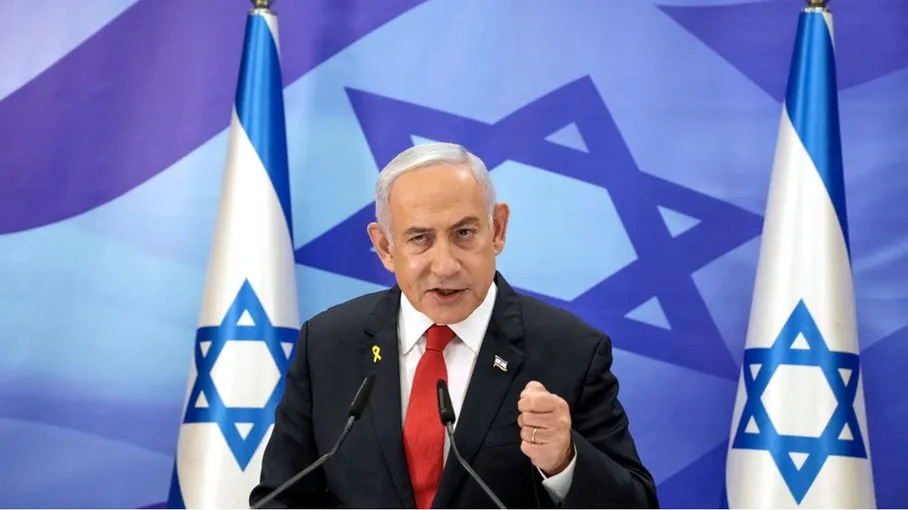







Israeli Prime Minister Benjamin Netanyahu finds himself in an escalating political and diplomatic predicament following the recognition of the Palestinian state by Britain, France, and other European countries.
The Guardian published a report prepared by Emma Graham-Harrison, stating that Benjamin Netanyahu rushed to condemn the recognition of a Palestinian state by many of Israel's historical allies, but the Prime Minister may struggle to determine how to translate rhetoric into tangible responses.
Harrison added that Netanyahu's options may be more limited than his supporters would like to believe. He has repeatedly threatened to annex occupied Palestinian territories and take unilateral actions against countries that joined the wave of recognition.
She pointed out that officially claiming part or all of the West Bank would jeopardize the Abraham Accords, the historic agreement that normalized relations with regional powers, including the United Arab Emirates.
Harrison continued that the agreement is one of the most significant achievements of foreign policy during Donald Trump's first presidency, and it has been mentioned in the nominations for the Nobel Peace Prize that Netanyahu publicly aspires to, as well as being one of his notable accomplishments.
She added that the UAE, one of his key partners, has already stated that annexation is a "red line," and the collapse of the agreement poses a significant risk of alienating Netanyahu's most important supporter.
While Israel chose a unilateral response to Ireland, Norway, and Spain when they recognized a Palestinian state last year, including withdrawing ambassadors.
She noted that former Israeli diplomats said that doing the same now, as many key allies have followed suit, would be much more complicated and could harm Israel far more than its objectives.
She continued that this would accelerate Israel's trajectory towards the isolated "great Sparta" status that Netanyahu celebrated last week before retracting it after public outrage and economic warnings.
She pointed out that Alon Liel, a former diplomat who served as Israel's ambassador to South Africa, said: "I think Netanyahu is in a very difficult predicament. Israel cannot not respond, and Israel cannot respond wisely. The government is about to discuss the mistakes that should be made."
She continued that the Jewish New Year, celebrated on Monday and Tuesday, and the upcoming United Nations General Assembly meeting have given Netanyahu a chance to catch his breath while he considers his options.
Netanyahu had said that his response to Britain, France, and other countries would come after his meeting with Trump, which will take place after the American president meets with Arab leaders in New York. Before leaving, Netanyahu called for a meeting of the Israeli security cabinet to discuss potential responses to the recognition, according to Israeli media.
Harrison continued that his actions come as a clear indication of concerns about the risks of annexation, as the strongest supporters of this approach—the far-right ministers Itamar Ben Gvir and Bezalel Smotrich—were not invited, along with the future of the Abraham Accords that Trump and Joe Biden hoped to expand to include Saudi Arabia.
Many members of the Trump family and his allies have deep financial ties in the region.
She emphasized that internal political pressures regarding the corruption trial and upcoming elections may outweigh Netanyahu's concerns about antagonizing Trump, as Alon Pinkas, another former Israeli diplomat, stated.
Pinkas, who held previous positions including Consul General in New York, said: "Netanyahu two or three years ago would not have dared to annex anything. Netanyahu in September 2025 is mentally disturbed, detached from reality, suffering from a severe case of delusions of grandeur [about the idea that he is] redrawing the regional map, afraid of elections, afraid of his trial [on corruption charges]. If all these things point to partial annexation, he might actually do something."
Harrison noted that within Israel, the debate has swung confusingly between insisting that recognition is an insignificant gesture towards an empty symbol, and the anger towards the countries that moved forward. Across most of the Israeli political spectrum, from the far right to center-left leader Yair Golan, the step of recognizing the Palestinian state has been condemned as a "reward for terrorism."
But even if a sovereign Palestine remains more of an idea than a reality, recognition has profound legal and diplomatic implications.
The British recognition carries a special diplomatic and historical weight given the role Britain played in paving the way for the establishment of the State of Israel with the Balfour Declaration in 1917.
Liel said: "I see it as more than just a bilateral event; it should be understood from the historical perspective of the Balfour Declaration. It is a kind of correction of the British historical role."
שתף את דעתך
Recognizing Palestine confuses the occupation.. Is Netanyahu risking annexation despite warnings from his allies?