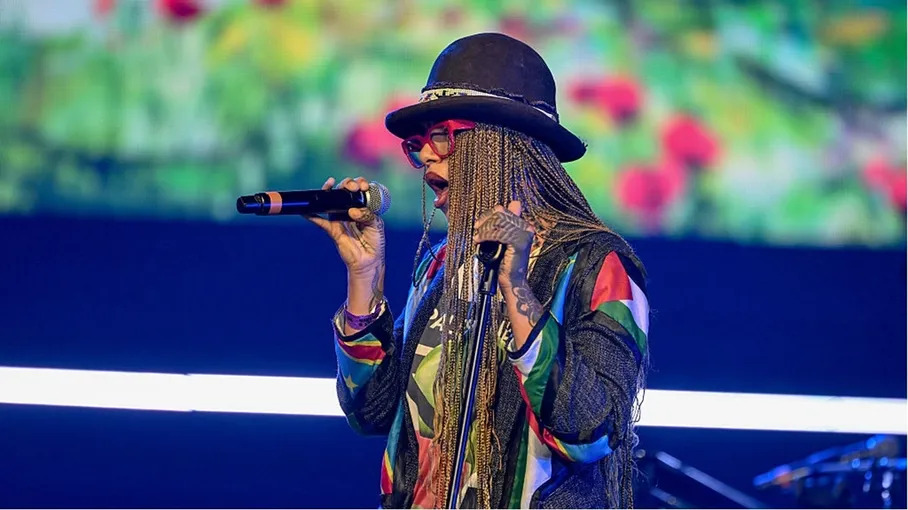







An increasing number of Western artists in the fields of music, filmmaking, and publishing are calling for a cultural boycott of "Israel" due to its war in Gaza, hoping to achieve similar success to the movement in South Africa during the apartheid era.
In light of the refusal of most Western governments to impose economic sanctions on "Israel," musicians, celebrities, and writers hope to rally public pressure for further action.
British actor Khalid Abdalla, who starred in the films "The Kite Runner" and "The Crown," told AFP after signing a petition calling for a boycott of certain Israeli cinema bodies, "I have no doubt that we have reached a global turning point."
The open letter issued by "Cinema Workers for Palestine" has gathered thousands of signatories, including actors Joaquin Phoenix and Emma Stone, who pledged to sever ties with any Israeli institutions "involved in genocide" in Gaza.
Abdalla added during an interview on Friday, "The mobilization has begun now and is extending to various fields. Not just in the film industry."
At the Emmy Awards this week, winners from Javier Bardem to Hannah Einbinder, star of " Hacks," spoke about Gaza, echoing similar statements made during the Venice Film Festival earlier this month.
On Thursday, the band "Massive Attack," pioneers of British trip-hop music, announced their joining a musical group called "No Music for Genocide," which will allow artists to prevent their songs from being broadcast in "Israel."
In another context, "Israel" is facing a boycott in the Eurovision Song Contest, and composers have signed open letters while Spanish Prime Minister Pedro Sánchez leads a campaign to exclude "Israel" from sporting events.
Israeli conductor Ilan Volkov announced last week during a concert in Britain that he would no longer perform in his homeland.
Swedish academic Hakan Thörn from the University of Gothenburg, who authored a book on the boycott movement in South Africa, stated, "I believe we are witnessing a situation similar to the boycott movement against the apartheid regime in South Africa."
The sociologist added, "There was certainly a shift this spring when the world saw images of famine in Gaza."
The international boycott of the white racist government of South Africa began in earnest in the early 1960s after a massacre of Black protesters by police in Sharpeville.
The movement peaked with artists and sports teams refusing to participate in matches in that country, and boycott violators like the band Queen and Frank Sinatra faced widespread public criticism.
Thörn noted that many public figures have been hesitant to speak about the Gaza war.
The Israeli military operations in Gaza have resulted in the deaths of more than 65,000 people, mostly civilians, according to figures from the Gaza Ministry of Health.
Thörn explained, "The history of the Holocaust and the criticism of the pro-Palestinian movement for being anti-Semitic have created a serious obstacle to broader mobilization against what Israel is currently doing" in Gaza.
The campaign to boycott Israel, known as the Boycott, Divestment, Sanctions (BDS) movement, began 20 years ago due to its occupation of Palestinian territories.
The Israeli government accuses supporters of this campaign of anti-Semitism, and Prime Minister Benjamin Netanyahu often describes critics as "sympathetic to Hamas."
David Feldman, who heads the Institute for the Study of Contemporary Antisemitism at Birkbeck College, University of London, stated that these remarks have created "an atmosphere of distrust regarding the boundaries of anti-Semitism."
He told AFP, "Any spread of anti-Semitic acts is concerning, but any current attempt to link the boycott movement against Israel to anti-Semitism is far from the truth."
He added, "It is a means of protesting Israel's destruction of Gaza and its continued killing of civilians."
Although today's activists against the Gaza war refer to an anti-apartheid movement, history offers them some impactful lessons.
After the start of the boycott movement in South Africa, it took 30 years before the regime fell, revealing the limits of international pressure campaigns.
Feldman, who authored a book on boycotts, added, "By the early 1970s, the boycott became the defining principle of a global anti-apartheid movement, but the movement alone was not enough."
The real suffering resulted from the gradual strangulation of the South African economy, as companies and banks withdrew under pressure, while the end of the Cold War sharply exacerbated the country's isolation.
In Israel, many artists fear the repercussions of the boycott movement
שתף את דעתך
The growing boycott of Western artists and celebrities against the occupying state due to the genocide in Gaza.