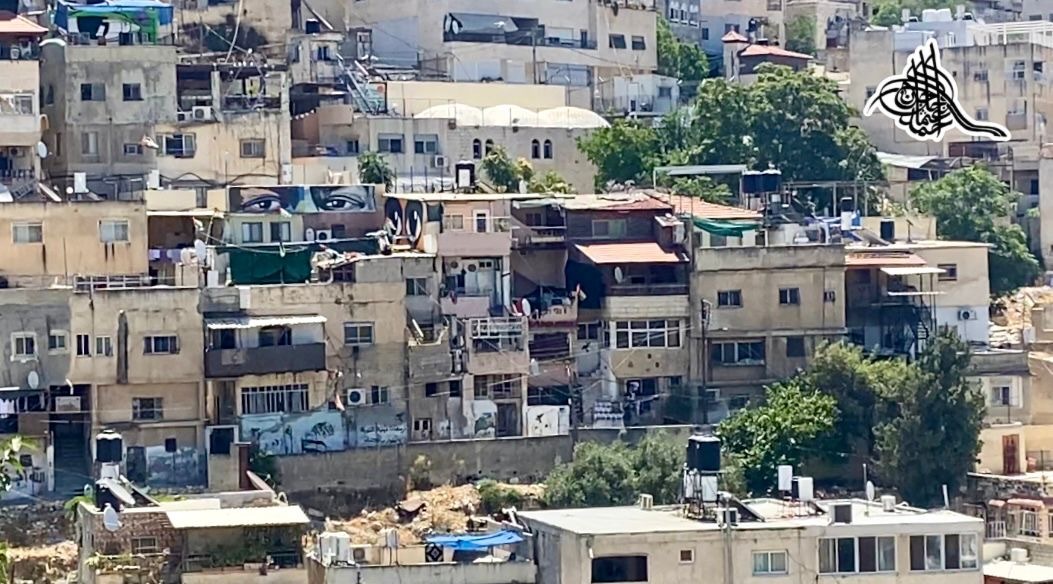







In the heart of Silwan, south of the blessed Al-Aqsa Mosque, the residents of the Batn al-Hawa neighborhood are engaged in one of their toughest battles against Israeli occupation policies, after they were given until the end of this year to evacuate their homes and hand them over to settlement associations that claim ownership since before 1948. This decision threatens to displace dozens of Palestinian families from their homes, which they have inhabited for decades, and reveals the extent of the targeting faced by Jerusalem and its original inhabitants.
The occupation attempts, through its judicial and administrative tools, to entrench a false historical narrative that gives settlement associations the upper hand in controlling the neighborhood's homes. In contrast, Jerusalemites see these decisions as a systematic policy of forced displacement, based on a larger plan aimed at emptying Arab neighborhoods of their residents and transforming them into settlement enclaves surrounding the Old City and Al-Aqsa Mosque.
The Batn al-Hawa neighborhood, in particular, holds special significance in Israeli plans, as it forms a direct extension of the historical basin of Jerusalem, making control over it a strategic step in the "holy basin" project. Therefore, the residents of the neighborhood live under daily pressure that varies between threats of eviction, imposition of fines, incursions by settlers under the protection of occupation forces, in addition to ongoing harassment aimed at pushing them towards forced departure.
For years, residents have been engaged in lengthy legal battles defending their right to remain, supported by local and international human rights organizations that affirm that what is happening in Batn al-Hawa is a blatant violation of international law and the Geneva Conventions that prohibit the displacement of populations under occupation. However, the occupation, with its political and religious pressures, insists on imposing a new reality on the ground.
Zuheir al-Rajabi: "We are not guests in our city"
In a special interview with "Quds.com," Zuheir al-Rajabi, head of the Batn al-Hawa neighborhood committee, clarified the residents' position, saying: These decisions are political par excellence, not judicial as the occupation tries to portray. The goal is to control the neighborhood and replace its original inhabitants with settlers. We have been here for hundreds of years and we are not strangers or guests; this is our land and our homes.
Al-Rajabi expressed that there is a state of great anxiety, but on the other hand, there is a greater determination to steadfastness. The residents live under immense psychological pressure, yet everyone agrees that we will not leave no matter the cost.
Al-Rajabi confirmed to the "Quds" reporter that Israeli courts are completely biased in favor of the settlers, but we resort to them to affirm our rights and to keep our cause alive in front of public opinion. Our cause is just, and even if these courts do not rule in our favor, history and international law are on our side.
He said we will remain in our homes, and we ask the international community to take responsibility and not leave us alone in facing forced displacement.
Batn al-Hawa is not just a small neighborhood; it is part of the identity and history of Jerusalem, emphasizing that the issue of Batn al-Hawa is not merely a dispute over property ownership, but a battle for existence and a historical right in the city of Jerusalem. With each passing day, as the deadline set by the occupation approaches, the circle of anxiety and fear widens, but on the other hand, the determination of Jerusalemite families to remain in the face of forced displacement that threatens their present and future strengthens.
שתף את דעתך
The Batn al-Hawa neighborhood in Silwan… a battle for existence against eviction orders.