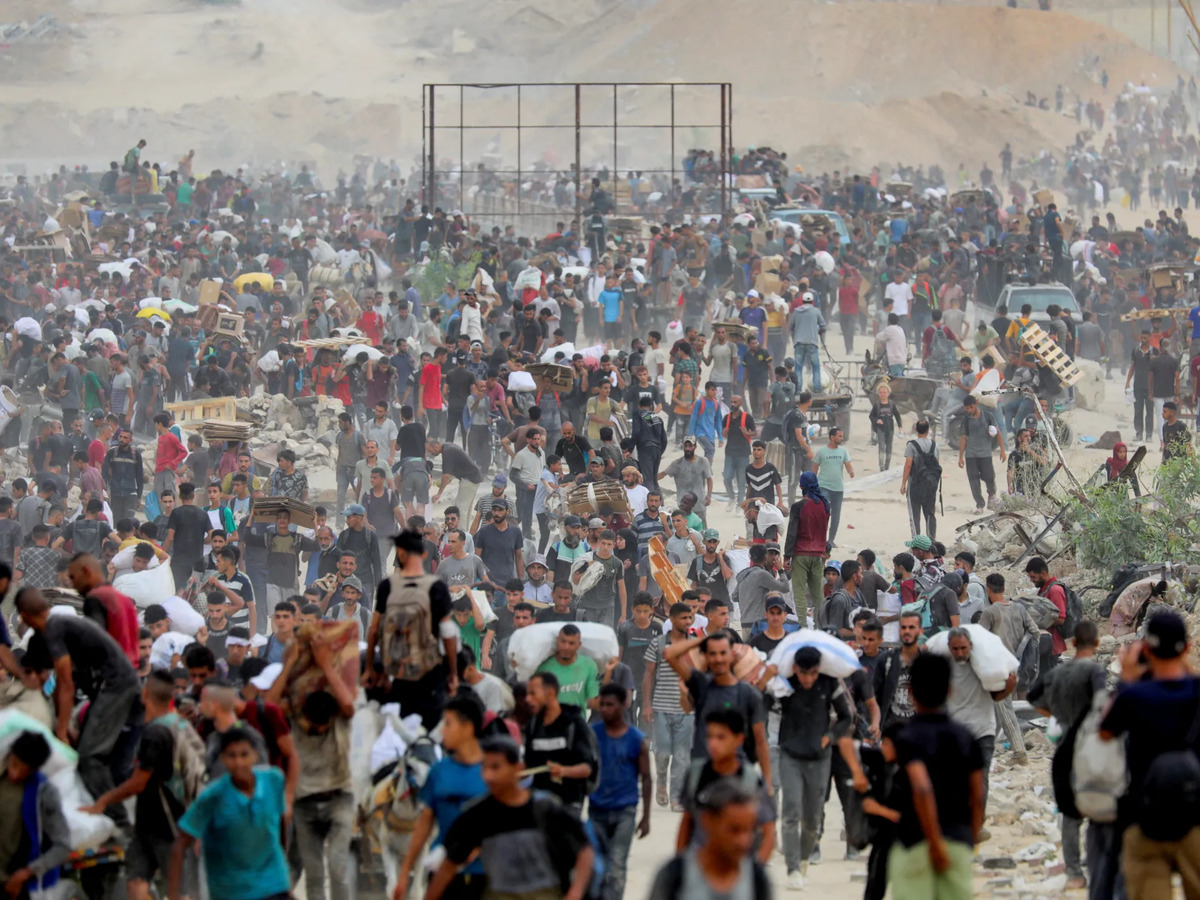







"You are hungry, therefore you are a target," this is the slogan of the Israeli army and the mercenaries operating in aid distribution areas in the Gaza Strip, according to the French website Mediapart.
The French site - in a detailed report by Gwenaëlle Lunoir - gathered testimonies from several Gazans who spoke bitterly about the details of sniping victims searching for food, those who are forced to go to death points in search of something to quench their children's hunger, heading to distribution points knowing they may not return alive.
The site reported that among the victims was a young man named Youssef (22 years old), who went with his friend one day to one of the death points, hoping they might get a bag of flour or a box of pasta.
When he arrived at the scene, known as number 3, or Tina Rafah, he found it crowded with groups, and then heavy gunfire began from nearby tanks and drones, forcing them and others to hide and flee from the bullets. They got separated on the way, but Ahmed returned to his tent while Youssef lost his life.
Blood-stained bread According to Mediapart, center 3, Tina Rafah, is located in the red zone, also known as the active military area, according to Israeli classification, and is situated along a corridor adjacent to Khan Younis, established by the Israeli army and under its full control.
Mediapart also reported on the killing of Palestine's Pele, player Suleiman Al-Obaid, who was killed in the same place.
It quoted his close friend Mustafa, stating that it was not the first time Palestine's Pele had gone to center 3, as his concern was to silence the hunger of his five children. His wife had asked him not to go to center 3 this time, but he refused.
Mustafa continued that Suleiman left with his brother and his nephew before dawn, but later his family was informed that he had been injured, just to lessen the horror of the tragedy, as he had already been killed by gunfire from an Israeli drone.
One of his cousins was also killed, while his brother was injured in the neck but survived certain death.
The head of nursing activities at Médecins Sans Frontières reported in her July report - as Mediapart follows - that she sees "the roads crowded with people, I hear screams and shouts, I see people on carts carrying bags of food, and then the injured start to arrive, almost at the same time."
The chaos of killing The site clarifies that killing or injury while going to get food has become a normal occurrence "for chaos is absolutely required, and everything is orchestrated to provoke this chaos," as analyzed by a humanitarian worker familiar with the Gaza Strip.
The site continues that aid distribution centers open on average for 20 minutes a day, completely randomly, during which random gunfire is directed at civilian populations by Israeli soldiers or mercenaries who are said to be protecting those centers.
"Who is responsible for these massacres?" Mediapart asks, explaining that the Gaza Humanitarian Foundation denies any involvement, but two former guards testified otherwise, one anonymously before the BBC, and the other openly before France 24. Whenever the Israeli army is questioned, it points out that it is investigating the "incident."
The report highlights that according to information collected and verified by the United Nations, more than two thousand people were killed while searching for assistance, primarily occurring near the Gaza Humanitarian Foundation centers, as well as near the Zikim crossing.
The writer states that the Gaza Humanitarian Foundation is a mysterious American-Israeli organization that appeared out of nowhere, lacking any known experience in the humanitarian field, and is secretive about its funds and sources. All that is known about it is that it contradicts all humanitarian norms related to independence, transparency, and fairness.
It also allowed Tel Aviv and Washington to break the traditional circles of aid distribution, which have proven effective over decades, where close cooperation between UN agencies and international and local NGOs allowed for aid distribution as close as possible to the population, with about 400 points distributed across the territory, Mediapart confirms.
It adds that the Israeli government has long sought to gain complete control over humanitarian aid, thus accusing Hamas of seizing aid shipments, a charge rejected by dozens of officials in the UN and humanitarian organizations, as well as previously rejected by a report from the U.S. Agency for International Development (USAID), "but it doesn't matter, as usual, this excuse was enough for Washington to support the Israeli plan," the writer clarifies in her report for Mediapart.
שתף את דעתך
Mediapart France: This is how the mechanism of killing the hungry in Gaza works.