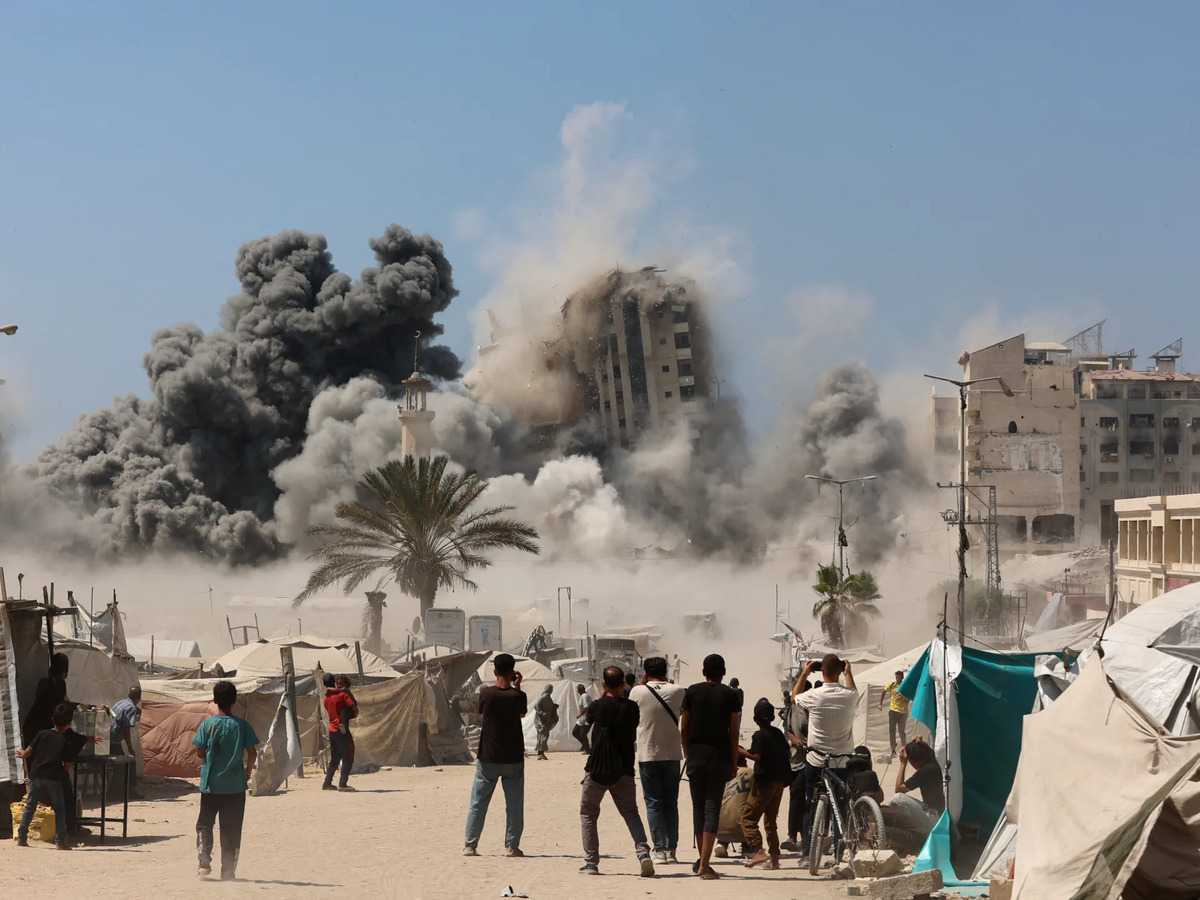







A potential plan for the reconstruction of Gaza is currently being discussed, supported by the United Nations, which includes a technocratic government for a year, an international force to stabilize the situation, the disarmament of Hamas, and a rejection of the mass deportation of Palestinians, with the United States wanting to prevent the UN General Assembly from slipping into a sharp dispute over the symbolic recognition of Palestine as a state, according to leaked reports from sources in the White House.
It is almost certain that the United Kingdom, France, Canada, Belgium, and Malta will recognize the State of Palestine at a UN conference on September 22, held on the sidelines of the 80th General Assembly, during the week when world leaders deliver their keynote speeches.
The UK had hinted that it might not recognize Palestine if Israel and Hamas reached a ceasefire, but the Israeli government strongly rejected a ceasefire and announced its intention to seize the city of Gaza.
However, the UK is keen to ensure that the two-state solution conference is not dominated by a dispute over whether recognition is premature or a reward for Hamas, which is the accusation made by the Israeli government.
It is noted that British Foreign Secretary David Lammy stated during a weekend visit to Qatar, the UAE, and Saudi Arabia that he is focused on the need to "transform any ceasefire into lasting peace, through a monitoring mechanism, the disarmament of Hamas, and a new governance framework for Gaza."
While Israeli Prime Minister Benjamin Netanyahu—who has an arrest warrant issued against him last November and faces divisions within his governing coalition—has not detailed his full vision for post-war Gaza, he has increasingly spoken about a permanent Israeli presence in Gaza and the annexation of the West Bank.
Plans for the reconstruction of Gaza approved by the UN are being discussed in detail with Marco Rubio, the US Secretary of State, who justified the Israeli threat to annex the West Bank as a completely expected reaction to Europe’s move to recognize Palestine.
Reports indicate that Palestinian Authority President Mahmoud Abbas is expected to visit London before the UN conference. The United States announced on August 29 that it would not grant visas to Abbas and the Palestinian Authority delegation for the General Assembly, a decision that Europeans protest on the grounds that reforming the Palestinian Authority is essential for a ceasefire and the future governance of Palestine.
According to multiple reports, the plans proposed in the White House that practically support Israel's annexation of Gaza and the West Bank put Europeans and Arab countries in a difficult position. Egyptian Foreign Minister Badr Abdel Atti stated on Friday: "Displacement is not an option and is a red line for Egypt, and we will not allow it to happen."
Tony Blair, close to Netanyahu, along with several Gulf leaders and Jared Kushner, Donald Trump's son-in-law, participated in discussions at the White House last week.
According to some reports, the two most controversial issues are the disarmament of Hamas and whether candidates previously associated with Hamas or terrorism will be able to run in any Palestinian presidential and parliamentary elections.
It is noted that Hussam Zumlot, the Palestinian ambassador to the UK, said in a speech this week at the Chatham House research center that the Palestinian Authority is committed to holding elections in Gaza and the occupied West Bank, including East Jerusalem, within a year after the ceasefire. A technocratic government will govern Palestine in the meantime.
Regarding the issue of Hamas figures running in subsequent elections, Zumlot said: "It is up to internal reviews within Hamas," emphasizing that the Palestinian people will elect those who serve them best.
He added, according to reports in the British press: "There must be one law, one government, and one police force. We will do this because the main demand now is to maintain the unity of our regional system, but in the end, Hamas is part of the Palestinian political, national, and social fabric, and it will not disappear suddenly. What we are discussing is not erasure, but reform, changing the direction, and internal dialogue, so that we avoid the complete Israeli extermination project."
It is noted that at a preliminary conference for the two-state solution held in New York last July, Arab and Islamic countries, including Qatar, Saudi Arabia, and Egypt, issued a joint call for Hamas to disarm and hand over authority in the Gaza Strip for the first time, as part of efforts to end the war in the region.
The Arab League, which includes 22 members, the entire European Union, and 17 other countries supported the declaration stating that "governance, law enforcement, and security throughout the Palestinian territories must be the sole responsibility of the Palestinian Authority, with appropriate international support," adding that "in the context of ending the war in Gaza, Hamas must end its rule in Gaza and hand over its weapons to
שתף את דעתך
Washington and the United Nations discuss potential plans for the reconstruction of Gaza.