






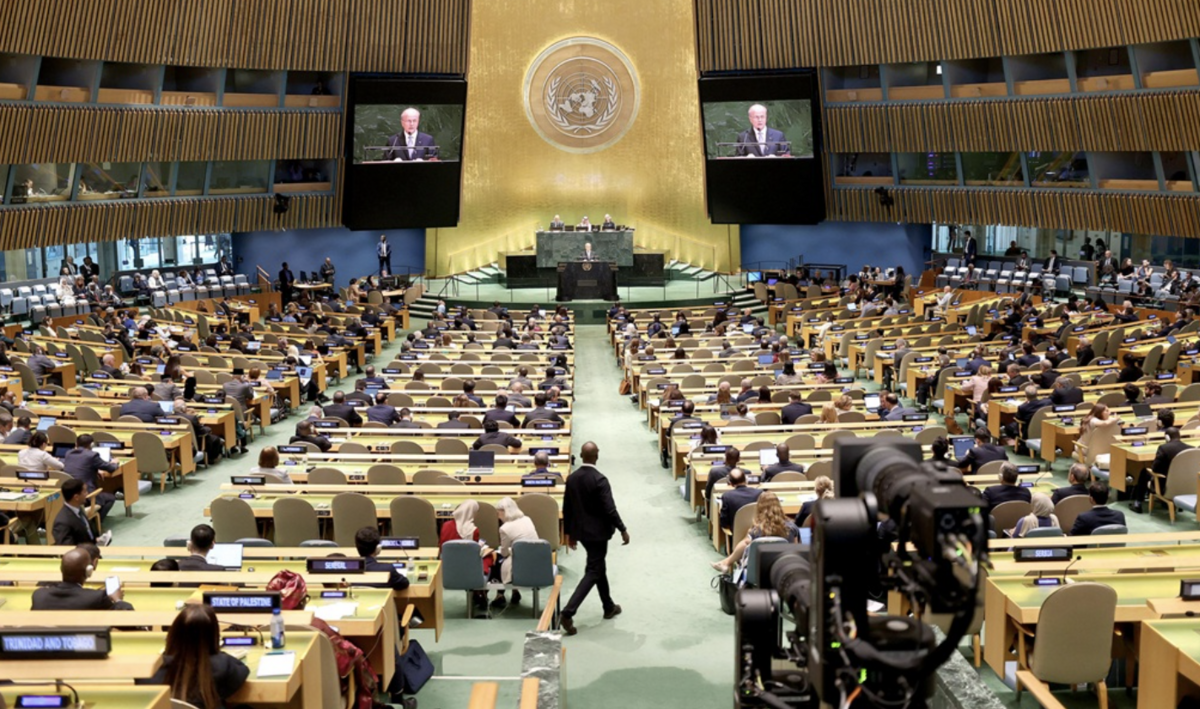
The high-level international conference on resolving the Palestinian issue through peaceful means and implementing the two-state solution continued for the second day in New York City on Tuesday evening, co-chaired by the Kingdom of Saudi Arabia and France.
Portuguese Foreign Minister: The war must end immediately.
"The war must end, as must the humanitarian crisis, the starvation, and the cycle of violence and destruction," said Portuguese Foreign Minister Paulo Rangel. "We are facing one of the worst and most horrific episodes of violence."
He added that the destruction of Palestinian property and homes in the West Bank, including East Jerusalem, must stop completely, stressing the need to halt settlement construction and end settler violence against civilians.
From the same perspective, the construction of settlements in the occupied territories must cease, and settler violence against Palestinians must stop.
Rangel affirmed his country's full and unwavering commitment to the two-state solution, saying, "That is why, over the past five decades, we have voted in favor of all relevant resolutions, maintained our financial support for UNRWA, and reiterated our full support for the Palestinian Authority and its empowerment."
He stressed that the Palestinian Authority is the only entity sufficient to implement the two-state solution, and condemned any decision by the occupation to annex the West Bank and partially or completely cut off Gaza.
The Portuguese Foreign Minister said: A Palestinian state living side by side with Israel in peace, security, and prosperity is what will bring peace, truth, and peace to humanity. War must end, death, detention, disease, and suffering must cease.
San Marino Foreign Minister: We will soon recognize the Palestinian state.
San Marino Foreign Minister Luca Beccari said: "We meet today not only as representatives of our governments, but as human beings. The Secretary-General spoke of a collective failure to confront the catastrophe unfolding before our eyes in Gaza. There are more than 50,000 lives lost, thousands of children among them."
He noted that "the tragic killing of UNRWA staff and journalists cannot be tolerated. This is not a political crisis, but a test of our shared humanity."
He stressed the demand for an immediate and permanent ceasefire in Gaza and called for the immediate and unhindered entry of aid.
He addressed the San Marino Parliament's unanimous adoption last May of a historic recommendation requiring the government to recognize the State of Palestine by the end of this year, considering that "this is not a symbolic gesture, but rather the product of deep reflection and a position based on principles and values that reject war, uphold the right of peoples to self-determination, and uphold the rule of international law."
He noted that practical recognition began with the Palestinian ambassador submitting his credentials to San Marino, and that the next step will be the appointment of a San Marino ambassador to Palestine.
He also condemned the illegal expansion of settlements in the West Bank, the violence against Palestinian civilians, and unilateral measures that threaten the viability of a Palestinian state, undermining the prospects for peace.
San Marino's foreign minister stressed that the unity of the West Bank and Gaza Strip under the administration of the Palestinian Authority is indispensable for a two-state solution, adding, "We believe that peace is not only possible but necessary if the international community acts based on the Madrid terms and the Arab Peace Initiative."
Andorran Foreign Minister: Peace will only be achieved through a two-state solution
Andorran Foreign Minister Emma Torre Faus noted that UN member states have a moral duty to create the conditions for lasting peace in the Middle East.
She added, "It is time to resolve the Palestinian issue, and this settlement can only be achieved through a two-state solution. Andorra fully supports this solution because it is based on international law."
She noted that Andorra is following with concern the events in Gaza, noting that they constitute a violation of international law, especially with the number of victims reaching approximately 60,000, the majority of whom are women and children, and the resulting catastrophic humanitarian tragedy.
She called for an immediate and permanent ceasefire and support for UN General Assembly resolutions calling for the protection of civilians, unhindered access to humanitarian aid, and the protection of international workers.
Chilean Foreign Minister Calls for Immediate Ceasefire
Chilean Foreign Minister Alberto Van Klaveren condemned the indiscriminate attacks on civilians in Gaza, noting that their suffering is unacceptable.
He added that international humanitarian law sets clear limits even in times of war, and that collective punishment, the destruction of infrastructure, and the denial of humanitarian aid cannot be justified. He added that women, children, and the elderly have been killed while seeking assistance and in places of worship.
He noted that the international community cannot stand idly by. A permanent and immediate ceasefire must be implemented, aid must be delivered, and the path must be paved for a final political solution based on international law and its binding resolutions.
He also praised the mediation efforts of Egypt, Qatar, and the United States, called for continued international funding for UNRWA, and emphasized the importance of strengthening Palestinian institutions.
He stressed that "the two-state solution is not an abstract ambition, but rather a commitment made by the international community more than seven decades ago, and unfortunately today the possibility of achieving this solution is in jeopardy."
He addressed the seriousness of the situation in the occupied West Bank, where violence against civilians continues and illegal settlement activities expand, threatening the prospects for lasting peace.
Iceland's Foreign Minister: The world must recognize the Palestinian state.
"We recognized the State of Palestine as a sovereign and stable state in 2011, and we were the first Western European country to take this step," said Iceland's Foreign Minister Thorgerdur Katrín Gunnarsdóttir.
She added, "Our position today remains as firm as it has been: supporting equal rights for both peoples and the establishment of two states living side by side in peace and security. We are firmly convinced that this is the only way to ensure lasting peace and true stability in the region. We commend France's announcement of its intention to take this step during September here in New York, and we call on other countries to follow suit."
“Unfortunately, the prospects for a two-state solution living side by side in peace have declined over the past decade, and particularly over the past years, because many want to take this solution off the table. We cannot accept that,” the Icelandic Foreign Minister said. “As we gather here this week in New York, we—those present and those absent—must recognize that the situation in the West Bank and Gaza has become unacceptable, unsustainable, and simply unsustainable. We must return to the solution that has been recognized as the only sustainable solution to this thorny issue: the two-state solution.”
South Africa's Minister of International Relations and Cooperation: No peace without protecting the existence of the Palestinian people
South Africa's Minister of International Relations and Cooperation, the Honourable Ronald Uzzi Lamola, said that the right of the Palestinian people to self-determination is guaranteed by international law, but Israel does not care about it.
He added that a week before this conference, a petition was adopted calling for the application of Israeli sovereignty over the West Bank, which would obstruct the two-state solution and allow the continuation of this blatant violation of international law, including UN resolutions and decisions of the International Court of Justice.
Lamola stressed the need to prioritize peace, reject war, and embrace dialogue, calling on all countries to recognize the Palestinian state and define its territorial integrity.
He stressed that peace can only be achieved by preserving and protecting the Palestinian people, calling on the Security Council to take immediate action to protect them, implement a ceasefire, release Palestinian and Israeli prisoners, and begin the reconstruction of the Gaza Strip.
Colombian Foreign Minister: It's time to say "Enough with hunger, war, and destruction"
Colombia's acting Foreign Minister, Rosa Yolanda Villavicencio, said the situation has exceeded expectations, and it is time for everyone to say: Enough with hunger, enough with war, enough with killing and destruction.
She affirmed that Colombia believes in a just political solution to the Palestinian issue, based on the two-state solution, and that Palestine has the right to be a viable entity, enjoying all the entitlements of sovereignty, and capable of protecting its people and defending itself.
She added that Colombia rejects any restrictions on the right to self-determination, has decided to sever diplomatic relations with the regime in Tel Aviv, has halted coal exports, and is participating in efforts to end the famine.
She noted that her country, in cooperation with South Africa, had established the "Lahia" group to advocate for peace, stressing that Colombia believes in actions, not words, and that we must all mobilize efforts and crowds to achieve a just peace.
Bangladesh's Foreign Ministry Advisor: We are experiencing one of the worst genocides of our time
Bangladesh's Foreign Ministry Advisor in the interim government, Mohammad Tawhid Hossain, said that we are living in a time when unity and solidarity are most needed to achieve real progress in the peace and justice process in Palestine.
He added that Bangladesh is clear in its position and feels a responsibility to support the oppressed and uphold the right to self-determination. He emphasized that Bangladesh's solidarity with the Palestinian people is both longstanding and ever-changing, and that peace in the Middle East will only be achieved through justice for the Palestinians.
Hussein stressed that transforming this peace into reality requires overcoming current challenges on the ground, particularly those related to settlement expansion, which is obstructing the establishment of a sovereign Palestinian state.
He pointed out that Israel's violations of international law are unprecedented in their scope and nature, and that what we are witnessing today represents one of the worst genocides of our modern era, something that cannot be tolerated.
Bahraini Foreign Minister calls for an immediate ceasefire
Bahraini Foreign Minister Abdullatif Al Zayani called for an immediate ceasefire in the Gaza Strip, stressing the need to provide relief and humanitarian aid to the population, along with the swift release of hostages.
He stressed that strengthening joint cooperation and overcoming differences are the basis for achieving peace and prosperity in the region, adding, "Together, we can achieve the aspirations of both Palestinians and Israelis."
Al Zayani explained that the summit reflected the leaders' commitment to peace, noting that the conference provided a space for negotiations for all concerned parties and contributed to focusing efforts toward the common goal of peace, prosperity, and stability.
A large number of UN member states, international and regional organizations, specialized UN bodies, and civil society organizations are participating in the conference, which will continue until July 30. The State of Palestine will be represented by Prime Minister Mohammad Mustafa.
The conference comes amidst the difficult circumstances facing the Palestinian people, as a result of the illegal Israeli occupation and its gross violations. It aims to implement UN resolutions and the two-state solution, marking a significant turning point in resolving the Palestinian issue.
It also came in response to a UN General Assembly resolution and the advisory opinion of the International Court of Justice, which affirmed the illegality of the Israeli occupation and the necessity of its immediate end. Its goal is not limited to launching a serious political process bound by a timetable, but also to establishing clear international commitments to support the Palestinian state politically and economically, support the government's reform and development program, and assist the recovery and reconstruction of Gaza after the cessation of the ongoing war of extermination.
The conference is considered a pivotal moment, moving beyond symbolism towards practical steps to implement the two-state solution and confront illegal Israeli policies: from war and starvation in Gaza, to ethnic cleansing in the West Bank, and the settlement and annexation system. It also represents an opportunity to mobilize support for the Gaza Reconstruction Conference and a donors' conference for the Palestinian economy, and to compel Israel to implement the signed agreements, most notably the immediate release of withheld Palestinian funds and a review of the agreements to liberate the Palestinian economy from the imposed restrictions, especially in Area C.
Its most prominent outcomes will focus on collective international action to immediately halt the Israeli aggression on Gaza: halting famine and forced displacement, allowing aid into the country, and ensuring effective protection for the Palestinian people. It will also include commitments from states to take time-bound, irreversible steps, beginning with immediate recognition of the State of Palestine, with the goal of a just settlement based on the two-state solution and leading to the establishment of an independent, sovereign, and viable Palestinian state, in accordance with international law and UN resolutions.
The outcomes will also include direct political and economic support for the Palestinian government and its reform program, including initiating discussions on strategic state projects such as the airport, port, and crossings, ensuring Palestinian access to their natural resources, and finding urgent solutions to release withheld clearance revenues.
The conference will establish a temporary international stabilization mission under the supervision of the United Nations and the Security Council, with regional participation, along with concrete measures to confront settlement expansion, annexation, and the disarmament of settlers.
Economically, the conference will address supporting the development of the Palestinian private sector, removing restrictions on movement and access, fully integrating Palestine into the international financial and monetary systems, working toward full membership in the United Nations and international financial institutions, establishing an international mechanism to monitor the implementation of these outcomes, and ensuring continued international momentum toward the realization of the two-state solution and the establishment of an independent, free, and economically and financially viable State of Palestine. These are not statements, but rather fateful commitments.
The UN conference on the two-state solution is not just a passing meeting or an additional statement in the archives of international politics. Rather, it is a fateful milestone and a path that will be closely monitored, its outcomes held accountable, and its translation into a political and economic reality that will transform the lives of the Palestinian people and establish a truly independent Palestinian state.
Powered by Froala Editor
שתף את דעתך
New York: The UN conference on settling the Palestinian issue and implementing the two-state solution continues.