






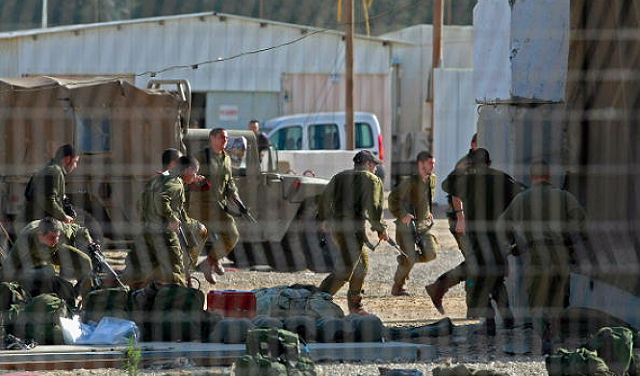
An Israeli military investigation has revealed new details about the battle at Kibbutz Sufa, which took place on October 7, 2023, as part of Hamas's surprise attack on the Gaza Envelope settlements.
Although the Israeli army failed to immediately repel the attack, the swift action of the local guard unit, supported by armed civilians and subsequent military forces, helped prevent a greater disaster and save many lives, Haaretz reported Monday.
The investigation revealed that the Nahal unit's resistance at the Sufa position impeded the advance of the first wave of Hamas fighters toward the kibbutz and delayed the arrival of reinforcements from resistance factions, reducing the number of infiltrators and significantly impacting the course of the battle.
Despite failures in preparedness and advance deployment, the investigation concluded that "the courage of the guard unit, the armed civilians, and the army forces who fought under difficult conditions prevented an even greater disaster at Kibbutz Sufa."
The attack began at dawn when approximately 50 Hamas fighters infiltrated across the border toward Kibbutz Sufa. A guard unit of only four men at the beginning of the day was the first to engage the attackers and managed to repel the first wave on its own. Later, armed civilians joined them, and military reinforcements from the Nahal Brigade, the 80th Division, and the Armored Corps soon arrived.
Some fighters managed to breach the fence surrounding the kibbutz and reach its homes. At 6:52 a.m., four fighters arrived at the western gate on two motorcycles, killed a member of the guard unit, then entered the kibbutz and began a shooting spree.
Shortly after the attack began, an armored corps tank advanced to a position near the fence and fired continuously at the fighters for three hours. The tank crew later estimated that they had killed approximately 200 Hamas operatives, who were traveling in cars and motorcycles.
An attack helicopter in the area also contributed to killing a large number of attackers and participated in the ceasefire on the kibbutz.
The battle resulted in the deaths of 14 soldiers and the wounding of 50 others around the kibbutz, while three civilians, including two from the guard unit, were killed. The guard unit prevented the attackers from infiltrating most of the houses, despite their overwhelming numerical superiority. The guard unit was operating at half its usual capacity, but with the support of civilians and army reinforcements, it was able to contain the attack.
At 10:30 a.m., a new attack began from the orchards north of the kibbutz, with approximately 30 fighters opening fire on homes. The expanded emergency response unit responded, and one of the unit's members was seriously wounded in the encounter and later died despite the efforts of his father, a paramedic.
Around 12 noon, additional military reinforcements arrived, killing several militants and ending the attack. The investigation indicated that the arrival of these forces at a crucial time played a significant role in saving the kibbutz.
That same morning, fierce fighting erupted in nearby areas, particularly at the nearby Sufa military site, where Hamas temporarily seized control of parts of it, killing nine soldiers and wounding 30 others.
In the Nirim Monument area, four Nahal patrol fighters were killed, including the company commander and a platoon commander. The deputy patrol commander was also killed on the road to the site.
Powered by Froala Editor
שתף את דעתך
The Israeli army reveals details of the battle of Kibbutz Sufa on October 7.