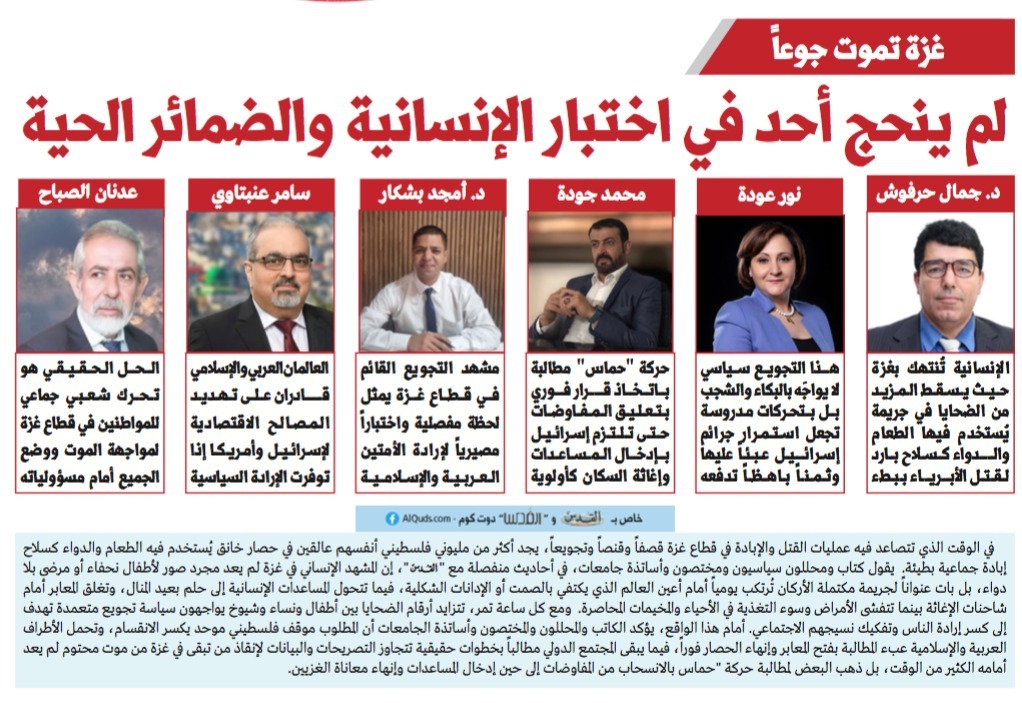







Dr. Jamal Harfoush: Humanity is being violated in Gaza, as more victims fall in a crime in which food and medicine are used as cold weapons to slowly kill innocent people.
Nour Odeh: Political starvation should not be met with tears and condemnation, but with calculated actions that make Israel's continued crimes a burden and a heavy price to pay.
Mohammed Joda: Hamas is required to make an immediate decision to suspend negotiations until Israel commits to making the entry of aid and relief to the population a priority.
Dr. Amjad Bashkar: The ongoing starvation in the Gaza Strip represents a pivotal moment and a fateful test for the will of the Arab and Islamic nations.
Samer Anabtawi: The Arab and Islamic worlds are capable of threatening the economic interests of Israel and America if they have the political will.
Adnan Al-Sabah: The real solution is a collective popular movement by citizens in the Gaza Strip to confront death and hold everyone accountable.
As the killing and genocide in the Gaza Strip escalates through bombing, sniping, and starvation, more than two million Palestinians find themselves trapped in a stifling siege in which food and medicine are used as weapons of slow-motion genocide.
In separate interviews with "I", writers, political analysts, specialists, and university professors say that the humanitarian scene in Gaza is no longer just images of thin or sick children without medicine. Rather, it has become a symbol of a full-fledged crime being committed daily before the eyes of the world, which is content with silence or formal condemnations. Meanwhile, humanitarian aid becomes a distant dream, crossings are closed to aid trucks, and disease and malnutrition spread in the besieged neighborhoods and camps.
With every passing hour, the number of victims increases, including children, women, and the elderly, who are facing a deliberate starvation policy aimed at breaking the will of the people and dismantling their social fabric.
Faced with this reality, the author, analysts, specialists, and university professors emphasize that a unified Palestinian stance is required to break the division, and for Arab and Islamic parties to shoulder the burden of demanding the immediate opening of the crossings and the end of the blockade. Meanwhile, the international community is required to take concrete steps beyond mere declarations and statements to save those remaining in Gaza from inevitable death, for which there is little time left. Some have even called on Hamas to withdraw from the negotiations until aid is delivered and the suffering of the Gazans is ended.
Full-fledged genocide
Dr. Jamal Harfoush, professor of scientific research methods and political studies at the University of the Academic Research Center in Brazil, says that what the children, women, and elderly of Gaza are experiencing today cannot be described as a mere humanitarian crisis. Rather, it is a full-blown genocide, taking place in full view of a world that continues to maintain its disturbing silence.
Harfoush explains that the inhumane blockade imposed by the Israeli occupation prevents food, medicine, and humanitarian aid from reaching more than two million Palestinians, in flagrant violation of international humanitarian law and the Geneva Conventions, which oblige parties to the conflict to ensure the basic needs of civilians.
Harfoush believes that the tragic situation in Gaza today confirms that humanity is being violated at every moment, with more victims falling due to deliberate starvation, a crime in which food and medicine are used as cold weapons to slowly kill innocent people.
As this crime continues, Harfouche calls for serious action on three key levels: Palestinian, Arab, and international.
On the Palestinian level, Harfoush stresses that the current situation calls for ending the internal division and unifying the ranks of all Palestinian factions and forces to confront the common enemy with a unified front.
Harfoush asserts that political bickering weakens the Palestinian people's ability to persevere and confront the situation. He calls for efforts to be directed toward activating legal and political paths to prosecute the occupation in international courts, including the International Criminal Court, and holding Israel fully responsible for the crimes committed against civilians.
On the Arab front, Harfoush points out that Arab countries bear a historical responsibility today to support Palestinian rights, arguing that statements and declarations alone are no longer sufficient in the face of the daily death toll in Gaza.
Harfoush calls for practical steps, starting with the urgent opening of humanitarian crossings and lifting the blockade on the Gaza Strip, in addition to providing direct logistical and financial support to humanitarian organizations operating in the field.
A unified Arab position is required that rises to the level of the catastrophe.
Harfoush calls for strong and swift diplomatic action through the Arab League to enforce a unified Arab position that rises to the level of the gravity of the ongoing humanitarian catastrophe.
On the international level, Harfoush explains that the Israeli occupation continues its crimes with unconditional support from major powers such as the United States and Europe, whose political interests prevail over humanitarian values.
Harfoush stresses the need to impose real pressure on these forces to change their policies, calling for the implementation of international sanctions against Israel and for its officials to be held accountable under international law, rather than simply offering superficial condemnations that fail to halt the ongoing massacre.
Harfoush asserts that there is no longer time for evasion or waiting. Children in Gaza are dying of hunger and disease every day, and everyone must realize that Gaza is not just a Palestinian issue, but a global humanitarian issue that requires urgent action.
Harfoush emphasizes that efforts must be integrated between the Palestinians, the Arab community, and the international community to compel Israel to lift the blockade, ensure the delivery of aid, protect civilians, and end this ongoing crime against humanity.
It is not a famine, but a systematic starvation by political decision.
For her part, writer and political analyst Nour Odeh, who specializes in diplomatic affairs and international relations, says that the food and medicine deprivation the Palestinian people are experiencing today is not a natural famine, but rather a systematic starvation policy driven by political decision. She cautions against treating the situation as if it were merely a temporary humanitarian crisis that can be resolved with some food or the introduction of aid.
Awda emphasizes that Israel is pursuing this policy with unrestrained brutality, and that what is required today is not only the entry of food, medicine, and fuel—these are self-evident and fundamental rights—but also practical political and economic steps that will make these crimes costly for the occupying state.
Awda explains that this starvation is political and cannot be confronted with tears or condemnation, but rather with calculated actions that make the continuation of these crimes a burden and a heavy price for Israel to pay before the international community.
Awda calls for a reconsideration of the fundamental question: "How did we get here?" referring to the new wave of starvation affecting more than two million Palestinians in the Gaza Strip at a time when life seems as if nothing has happened in the rest of Palestine.
Awda points out that people's preoccupation with trivial matters while their children in Gaza are forced to eat tree leaves reflects a miserable situation that will go down in history as a black mark against everyone.
Awda explains that what is required, in addition to expressing rage and anger, is a true public disclosure and national accountability after this massacre ends, even if it is a moral accountability that will at least preserve in the history books how everyone failed politically and morally.
The necessity of boycotting Israel as a "rogue state"
Awda urges effective international and Arab action, starting with boycotting Israel as a "rogue state," imposing economic and military sanctions on it, halting the cover-up of its crimes, and not treating it as a normal or acceptable entity in the international community until it abides by the law and its leaders are prosecuted for crimes and atrocities unprecedented in modern history.
Awda points out that there are many practical steps countries can take to inflict pain on Israel, such as the resolutions adopted at the Bogotá meeting in Colombia, where some countries demonstrated their ability to take real action by imposing sanctions, cutting off military cooperation, banning settlement goods, and preventing Israeli aircraft from flying over their airspace in compliance with the arrest warrants issued by the International Criminal Court against Netanyahu and Galant.
Awda stresses the importance of Arab ports beginning to refuse passage to ships carrying Israeli weapons or refueling them, describing this as "the least we can do" in confronting these crimes.
Awda emphasizes that the strength of any international movement against Israel rests primarily on the strength of the Palestinian position itself and its ability to move things in the right direction.
She added: "As a Palestinian, it is necessary to overcome the state of schizophrenia and political delirium to create a unified national position capable of influencing the international position.
A deliberate policy aimed at subjugating the population
For his part, writer and political analyst Mohammed Joda asserts that the tragedy of hunger in the Gaza Strip cannot be reduced to images of emaciated children or empty stomachs alone. Rather, it is part of an integrated system that uses hunger as a central tool within a complex strategy that combines military force with economic and political tools of control.
Joudeh explains that what is happening in Gaza is not a side effect of a war or a temporary blockade, but rather a deliberate policy aimed at subjugating the population by destroying the health and economic infrastructure and imposing severe restrictions that make life almost impossible.
Joudeh points out that the tools of this system vary, from a stifling blockade, to the closure of crossings, to banking restrictions that stifle the flow of funds, thus crippling people's ability to secure the most basic necessities of daily life.
According to Joudeh, hunger in Gaza has become a political weapon par excellence, supported by an arsenal of economic measures that tear apart the social fabric and turn daily life into an open battle for survival.
Joudah asserts that daily testimonies from doctors and field correspondents reveal the depth of the disaster, with the health system collapsing at an unprecedented rate amid a severe shortage of food, clean water, and medicine, leading to the spread of disease and malnutrition at shocking rates.
Joudeh emphasizes that this tragedy turns food deprivation into a "lethal medicine," used coldly as a weapon to weaken society's resilience.
The international position is helpless and limited to formal condemnations.
Despite the clarity of this policy in the eyes and ears of the international community, Joudeh believes that the official global response has remained ineffective and paralyzed, not going beyond formal condemnations that do nothing to stop the machine of starvation and genocide.
Joudeh points out that relief stations, which were supposed to be safe havens for civilians, have been transformed into dangerous areas, where Palestinians are exposed to danger when attempting to reach them to obtain scraps of aid.
Joudeh explains that Israel has not only imposed a military blockade, but has also penetrated deep into society by encouraging "warmongers" and affiliated local agents to steal aid and resell it at exorbitant prices, thus deepening internal divisions and deliberately exacerbating the humanitarian crisis.
Joudeh asserts that the Gaza Strip is no longer just a battlefield, but has become a political and social laboratory testing the limits of human patience, where hunger is used as a means to force people to surrender, either by starvation, murder, or forced displacement.
Joudeh believes that all parties today bear a share of responsibility for this crime, explaining that Israel is proceeding with its policies with clear support from the United States, which gives it a green light to do whatever it wants in Gaza without real deterrence. He explains that this American complicity exceeds the international community's ability to impose solutions or conditions that would halt this inhumane policy.
Timid Arab statements and condemnations that are useless
On the Arab level, Joudeh believes that Arab countries have become tools for implementing American and Israeli policies, contenting themselves with timid statements and meaningless condemnations. Joudeh emphasizes that the absence of a serious stance reflects the subservience of Arab decision-making to American and Israeli interests, rendering statements of condemnation a mere cover for impotence.
Regarding the Palestinian side, Joudeh describes the situation as even more tragic, as the Palestinian cause is experiencing a state of fragmentation and division that has deprived the official parties of their influence and ability to play any effective role in halting the catastrophe that has been raging for more than 21 months.
Joudeh specifically criticizes Hamas's position, which continues to conduct negotiations from luxurious Doha hotels far removed from Gaza's hunger and daily suffering. He calls on the movement to immediately suspend negotiations until Israel commits to prioritizing the entry of aid and relief for the population.
Joudeh emphasizes that the starvation policy in Gaza is not an isolated act, but rather a deliberate tactic that combines a military blockade with economic and political control with the aim of dismantling Palestinian society. He asserts that confronting this policy requires Arab, Islamic, and international action that goes beyond condemnations to imposing real pressure mechanisms on Israel, ensuring the safe delivery of humanitarian aid, and protecting the population and relief organizations from targeting.
A siege, starvation and genocide unprecedented in modern history.
For his part, political science professor Dr. Amjad Bashkar believes that the current starvation situation in the Gaza Strip represents a pivotal moment and a fateful test for the will of the Arab and Islamic nation. He asserts that the ongoing siege, starvation, and mass extermination of women, children, and the elderly in Gaza is unprecedented in modern history.
Bashkar emphasizes that what is lacking is not the tools or means, but rather the lack of a genuine will to use them, pointing out that Arab and Islamic countries possess painful leverage and are capable of halting the war and breaking the siege if they so desire.
Bashkar explains that the joint committee between the Arab League and the Organization of Islamic Cooperation, which comprises approximately 52 countries, could have played a pivotal role in halting the massacre had it declared that it could no longer remain silent in the face of genocide and starvation.
Bashkar said: If every Arab and Islamic country sent ten ships carrying humanitarian aid to Gaza, Israel would not dare bomb 500 humanitarian ships from fifty countries.
Bashkar stresses the importance of Egypt's role in the Rafah crossing issue, which must not remain closed to international relief convoys. Egypt has the capacity to open the crossing and allow aid into the Strip. Closing the crossing effectively contributes to the continuation of the famine and undermines Egypt's role at this critical moment.
Bashkar points out that more than 900 people have been killed and 6,000 wounded so far at aid distribution centers in Gaza, warning that these sites have become "death traps" rather than genuine humanitarian relief points, given the continued targeting of those attempting to reach them by the occupation forces.
Call on Egypt and Qatar to withdraw from mediation
Bashkar stresses that the mediators in the negotiations, Egypt and Qatar, must declare a clear position that what is happening in Gaza is not a means of negotiating pressure but rather a full-blown genocide. He calls for their withdrawal from any negotiating tracks that cover up the occupation's crimes under the guise of mediation.
Bashkar raises a major question about the absent role of the Organization of Islamic Cooperation and the Arab League, emphasizing that if these two institutions do not have an effective position today, when will they ever have a real role in any other Arab or Islamic country?
Bashkar calls on nationalist, Islamic, and leftist parties to mobilize the Arab and Islamic street to pressure governments and take practical steps to stop the massacre.
Bashkar stresses that Israel has crossed all boundaries of human morality in war and peace.
Bashkar also questions the lack of genuine effort by Palestinian ambassadors in Europe and Arab and Islamic countries, arguing that the time has come for a unified political and media campaign to confront the genocide and put an end to the catastrophic starvation.
What is happening in Gaza is unprecedented in modern history.
Writer and political analyst Samer Anabtawi asserts that what is happening in the Gaza Strip today represents an unprecedented situation in modern history. More than two million people are being besieged by means of genocide and systematic starvation, with the goal of rendering the environment uninhabitable and forcibly forcing people to emigrate.
Anbatawi explains that Israel has exhausted all its means against the Palestinians in Gaza, from direct killing and displacement to deliberate starvation, which recently reached its peak. He asserts that children, women, and the elderly are already dying from hunger and the financial inability to purchase food, if it is available at all.
Anbatawi points out that the entire world is clearly seeing these crimes, but it is shameful that it remains silent or unable to stop this massacre, which has so far killed approximately 60,000 people, including more than 18,000 children and 10,000 women, while the bombing and targeting of even those attempting to bring food aid continues.
Anbatawi points out that the occupation's policy explicitly aims to completely empty the Gaza Strip of its population, a claim confirmed by Israeli Prime Minister Benjamin Netanyahu, who insists on continuing the war to achieve this goal.
Anbatawi explains that what is happening in Gaza is linked to the economic pressures and repeated attacks by settlers and the Israeli army in the West Bank, all aimed at making the West Bank an inhospitable environment.
A long-term Israeli plan to liquidate the Palestinian cause
Anbatawi asserts that this proves the existence of a long-term Israeli plan to liquidate the Palestinian issue from its roots.
Regarding possible solutions, Anbatawi emphasizes that the beginning must be from within Palestine, by unifying ranks, strengthening the internal front, and forming a unified national leadership that adopts a comprehensive national project to confront the Zionist project.
Anbatawi calls for building a resilient national economy and activating popular resistance within villages and areas threatened by attacks.
Anabtawi calls for effective Arab and Islamic action that goes beyond statements of condemnation to include imposing sanctions, boycotting the occupation, withdrawing investments, and severing diplomatic relations, similar to the measures taken against the apartheid regime in South Africa.
Anbatawi stresses the need to pressure governments to take stronger positions, asserting that the Arab and Islamic worlds, which comprise nearly two billion people, are capable of threatening the economic interests of Israel and the United States if the political will is present.
Anbatawi warns that Israel is using starvation as a means of pressure to impose its terms in negotiations, paving the way for the forced displacement of Gaza's population. This requires a broad international response that exposes these policies and puts pressure on the Palestinian people to halt the massacre.
A complex issue with political and humanitarian dimensions
For his part, writer and political analyst Adnan Al-Sabah asserts that the starvation crisis in the Gaza Strip is not merely a fleeting humanitarian issue, but rather a complex one with both political and humanitarian dimensions.
Al-Sabah explains that humanitarian solutions alone are no longer sufficient, noting that the international community, after two years of crisis, has completely turned its back on Gaza and no longer cares about what is happening there, making waiting for external solutions unrealistic or predictable.
Al-Sabah believes that the only real and practical solution lies in a collective popular movement within Gaza to confront death and hold everyone accountable for ending the ongoing situation.
Al-Sabah said: "All segments of the Palestinian people in the Gaza Strip - children, women, elderly, and men - must stand together as one unified bloc to confront the occupation."
Al-Sabah explains that the Chief of Staff of the Israeli Defense Forces, Eyal Zamir, had previously confirmed that the army could not confront two million people moving as a single mass.
Al-Sabah asserts that this collective popular confrontation is the only way to break the international silence and hold the occupation accountable.
According to Al-Sabah, the people of Gaza have been left alone, and everyone has let them down, even the Palestinians themselves. He stressed that there is no justification for any person on earth to remain silent, inactive, or wait for Gaza and its children to die.
The world closed its ears and closed its eyes
"The world has closed its ears and shut its eyes, and no longer wants to see or hear," Al Sabah says. "Therefore, the Gazans must protect themselves."
Regarding the Arab and international role, Al-Sabah emphasizes the need for collective, institutional, rather than individual, initiatives, noting that individual actions alone do not have the power to bring about historic change.
Al-Sabah stresses that political parties, forces, organizations, and activists in the Arab world and the Islamic world must take action, and that there must be tangible public support in Arab and international arenas through solidarity movements that include hunger strikes and political pressure.
Al-Sabah suggests that millions of people taking to the streets around the world and demonstrating their hunger alongside Gaza will have a powerful impact on the governments of these countries, prompting them to respond to the demands of their people and end the suffering of the Gaza Strip. This could create real pressure to achieve tangible results.
Al-Sabah asserts that there is no longer time for waiting or remaining silent, and that the lives of millions in Gaza are at stake, calling for a serious and responsible stance from everyone.
שתף את דעתך
Gaza is dying of hunger... No one has passed the test of humanity and living conscience.