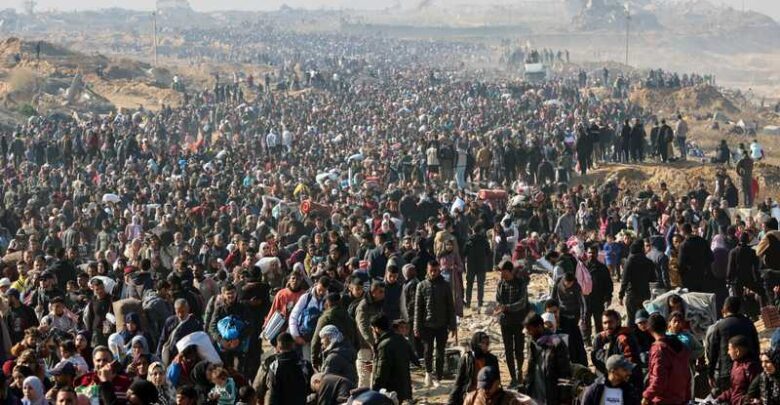







The New York Times reported that the Israeli Defense Ministry is promoting a plan to force a large portion of Gaza's population to move to a small, largely destroyed area in the southern part of the Strip, a proposal that threatens to derail recent efforts to reach a truce between Israel and Hamas.
In recent weeks, Israeli officials have briefed journalists and their foreign counterparts (including The New York Times) on a vague plan to force hundreds of thousands of Palestinian civilians to move to an Israeli military-controlled area near the Gaza-Egypt border. Legal experts have warned that the plan would violate international law because it would indefinitely prevent civilians from returning to their homes in other parts of Gaza, a restriction that would constitute a form of ethnic cleansing.
While the Israeli government has yet to officially announce or comment on the plan, the idea of establishing a new camp in southern Gaza was first proposed last week by Israeli Defense Minister Yisrael Katz. He discussed the matter in a briefing with Israeli correspondents specializing in military affairs, and The New York Times reviewed the briefing's readings written by those present. Many of the attendees also wrote articles that attracted widespread interest among both Israelis and Palestinians.
A spokesman for Mr. Katz declined to comment on the reports, as did the office of Benjamin Netanyahu, the Israeli prime minister, the newspaper reported.
Hamas has pointed to Katz's proposal as one of the latest obstacles to a new truce. Hamas insists that Israeli forces withdraw from much of the Gaza Strip during a ceasefire and that approximately 25 Israeli prisoners be released. The new Israeli plan makes this outcome far less likely, as it would ensure that Israeli forces remain in charge of a large area of the Strip.
Hossam Badran, a prominent Hamas member, described the establishment of the camp as a "deliberate obstructive demand" that would complicate the thorny negotiations.
"This will be an isolated, ghetto-like city," Badran said in a text message on Monday. "This is completely unacceptable, and no Palestinian would agree to it."
Hopes for an imminent truce rose last week after Israeli Prime Minister Benjamin Netanyahu visited Washington for meetings with US President Donald Trump. Many expected the deal to be accepted by Israel after Trump announced it ahead of his meeting with Netanyahu (Monday, July 25). Instead, Netanyahu, who had previously slowed the pace of negotiations for personal and political reasons, returned to Israel without making any progress.
Negotiations remain stalled over issues including the durability of any truce: Israel wants to be able to return to war, while Hamas wants guarantees that any ceasefire will develop into a full cessation of hostilities. Israel also wants Hamas to commit to disarmament, an idea rejected by all Palestinian factions. There are also disagreements over how aid will be delivered during the truce.
According to some readings of the press briefing (with Defense Minister Katz), the defense minister described the proposed new camp as a "humanitarian city" that would initially accommodate at least 600,000 Palestinians. Katz said it would later include all of Gaza's residents, approximately two million people, according to the readings and reports. Israeli critics have likened it to a modern-day "concentration camp," as its residents will not be allowed to leave the northern perimeter to return to their homes.
This could constitute "forced displacement," a crime under international law, according to a group of Israeli international law experts who wrote an open letter on the matter to Katz and IDF Chief of Staff Eyal Zamir.
The letter stated that if the plan is implemented, "it would constitute a series of war crimes and crimes against humanity, and under certain circumstances, may amount to genocide."
The Israeli military declined to comment on whether it had received orders to implement the plan. Because the plan has not yet been detailed or officially announced, some Israelis have speculated that it is primarily a negotiating tactic aimed either at persuading Hamas to make further concessions in truce talks or at persuading allies of Netanyahu's far-right coalition to support a ceasefire.
For his part, Israeli Chief of Staff Eyal Zamir expressed serious reservations about Defense Minister Yisrael Katz's controversial "humanitarian city" plan for Rafah in the southern Gaza Strip, according to a report in the Hebrew media on Monday, which cited quotes from a security discussion held on Sunday.
According to a report published by Channel 12, Zamir made it clear during the discussion that he strongly opposes the plan, which would allow Israel to build on the ruins of Rafah in a way that would eventually house all of Gaza's residents. The area would initially accommodate approximately 600,000 Gazans living in the coastal area of Al-Mawasi, and would then contain the entire Strip's population of more than two million.
"It's an unworkable plan," he said, according to the source. "There are too many loopholes." He went on to tell those present at the meeting, which reportedly included Katz, Netanyahu, and Finance Minister Bezalel Smotrich, that "they can make any decision, but what's the point?"
"There are countless problems with this plan," he said, adding that he was "not convinced it actually aligns with the war's objectives."
Zamir reportedly told the meeting that moving forward with the "humanitarian city" idea would reduce the likelihood of Hamas agreeing to a deal to free the remaining hostages, and while he said the IDF would implement the plan if the political echelon asked it to, he strongly recommended against it.
For his part, Itamar Ben-Gvir, a minister and far-right settler who supports the evacuation of Gaza and opposes the truce with Hamas, said in a statement that the evacuation plan is unlikely to be implemented and was simply being disseminated by his colleagues to facilitate his acceptance of the ceasefire agreement.
"The debate surrounding the establishment of a humanitarian city is essentially a debate aimed at concealing the deal being prepared," Ben-Gvir said, adding, "Turning the wheel is no substitute for absolute victory."
שתף את דעתך
An Israeli plan to displace Palestinians threatens to derail the Gaza truce.